20260918 CDTL DDE D250 28 April 1953 Bản ghi nhớ của Đại sứ Donald R. Heath gửi Bộ trưởng Ngoại giao. Việt Minh chiếm đóng Lào.
Historical
Documents - Office of the Historian
https://history.state.gov/historicaldocuments/frus1952-54v13p1/d250
Google Translated
Tài liệu số 250
Quan hệ Đối ngoại của Hoa Kỳ, 1952–1954,
Đông Dương, Tập XIII, Phần 1
Hồ sơ PSA, lô 58 D 207, “Các hoạt động
quân sự của Pháp tại Đông Dương”
Bản ghi nhớ của Đại sứ Donald R. Heath gửi
Bộ trưởng Ngoại giao
Mật
[Washington,] ngày 28 tháng 4 năm 1953.
Chủ đề:
Tình hình hiện nay tại Đông Dương
Để quý vị tham khảo, tôi xin trình bày tóm tắt quan điểm
của mình về tình hình hiện tại cũng như triển vọng ở Đông Dương, cùng những
hành động mà chúng ta có thể và nên thực hiện để cải thiện tình hình này.
Tình hình Quân sự và Triển vọng
Việc Việt Minh tràn vào chiếm đóng Lào bắt
nguồn từ việc Bộ Chỉ huy Pháp – chịu ảnh hưởng của Letourneau (1)
– đã hành động dựa trên các cân nhắc chính trị thay vì thuần túy quân sự (2), đồng
thời đánh giá thấp khả năng cơ động và tốc độ di chuyển trên địa hình của
Việt Minh. Ý đồ của Tướng Salan và Letourneau là giữ vững vùng đất
của người Thái ở Tây Bắc Việt Nam và bảo vệ Lào trước các cuộc
xâm nhập của Việt Minh. Để đạt được mục tiêu đó, họ đã giam chân một phần
lớn lực lượng xung kích tại các cứ điểm được thiết lập vội vã ở Nà Sản và
Lai Châu. Nếu không làm vậy, họ đã có đủ lực lượng tấn công để đe dọa các đơn
vị chủ lực của Việt Minh quanh vùng Đồng bằng Bắc Bộ, qua đó ngăn chặn
đối phương thực hiện cuộc xâm nhập quy mô lớn vào Lào như hiện nay. Xét thuần
túy về mặt quân sự, lẽ ra nên để Việt Minh chiếm đóng hạn chế các
khu vực này – dù điều đó sẽ là bi kịch đối với Lào – trong khi Pháp tập
trung quân lực và các hoạt động tác chiến tại Bắc Bộ để đối phó với chủ
lực của Việt Minh.
Tuy nhiên, Việt Minh không thể thắng cuộc
chiến này bằng cách phân tán lực lượng và tràn vào chiếm đóng những vùng đất ít
giá trị kinh tế như khu vực người Thái và Bắc Lào – trừ khi Tầu cộng
cử quân sang hỗ trợ. Tính đến thời điểm hiện tại, nhiều khả năng
Việt Minh sẽ chiếm được Luang Prabang – cố đô của Lào – mặc dù
chưa có gì chắc chắn rằng họ có thể chiếm được Vientiane, thủ đô hành
chính quan trọng hơn của nước này. Do những khó khăn về hậu cần và sự cần thiết
phải duy trì phần lớn lực lượng để đối phó với vùng Đồng bằng Bắc Bộ,
dường như Việt Minh khó có thể duy trì lâu dài việc chiếm đóng
Bắc Lào với sức mạnh quân sự hiện tại nếu không được Tầu cộng tăng viện,
chứ chưa nói đến việc tiến đánh Campuchia hay Thái Lan. Do đó, vấn đề đặt
ra cho Bộ Chỉ huy Tối cao Pháp là phải sớm thực hiện các bước sau:
(1) rút càng nhiều quân càng
tốt khỏi Lào để đưa về vùng đồng bằng Bắc Bộ;
(2) đồng thời, đẩy
nhanh việc xây dựng Quân đội Quốc gia Việt Nam và cả Quân đội Quốc
gia Lào theo Kế hoạch Letourneau, nhằm phá vỡ thế cân bằng lực lượng
hiện tại, hoàn tất việc bình định vùng đồng bằng Bắc Bộ, cũng như sớm tấn
công và chiếm giữ các khu vực chiến lược—chẳng hạn như tỉnh Thanh Hóa—nơi
mà việc để mất sẽ chắc chắn làm suy yếu Việt Minh.
Các Kế hoạch Quân sự của Pháp
Hội đồng Tham mưu trưởng Liên quân
đã miễn cưỡng chấp nhận Kế hoạch Letourneau về việc mở rộng quân đội quốc
gia của các Quốc gia Liên kết; theo kế hoạch này, sau khi bình định miền
Nam và miền Trung Việt Nam, quân đội sẽ tấn công lực lượng chủ lực của Việt
Minh ở miền Bắc vào giai đoạn 1954–1955, qua đó giảm thiểu sự kháng cự
của Việt Minh xuống mức "không đáng kể" như Letourneau
dự tính. Hội đồng Tham mưu trưởng Liên quân mong muốn một lộ trình nhanh
hơn, quy mô lớn hơn và các cuộc tấn công sớm hơn nhắm vào lực lượng chủ lực
của Việt Minh. Tôi cho rằng tâm lý nôn nóng muốn có kết quả nhanh chóng
này cho thấy sự thiếu am hiểu về thực trạng lực lượng Pháp và Việt Nam,
cũng như những khó khăn thực tế về tác chiến và khí hậu mà họ phải đối mặt tại
Đông Dương. Kế hoạch này thực sự có thể được đẩy nhanh tiến độ nếu phía Pháp
tìm được một người có tầm cỡ như cố Thống chế de Lattre để chỉ huy Bộ Tổng tư lệnh.
Hội đồng Tham mưu trưởng Liên quân không có ứng viên nào để đề nghị, ngoại
trừ khả năng về Tướng Guillaume – người có thể bị mang tiếng là kẻ thực
dân do từng điều hành chính quyền tại Maroc. Ngay cả khi có ứng viên,
chúng ta cũng không thể ép phía Pháp chấp nhận người đó. Tướng Valluy đã
được nhắc đến như là người kế nhiệm Tướng Salan. Nếu Valluy (hoặc
bất kỳ ai tiếp quản quyền chỉ huy) không thể hiện được sự năng nổ, năng lực và
quyết tâm cần thiết cho tình hình quân sự hiện tại trong quá trình hành động,
thì vài tháng sau đó, chúng ta có thể đưa ra những gợi ý kín đáo cho phía Pháp.
Mặc dù từng nghi ngờ về khả năng giải quyết vấn đề quân sự của Salan,
chúng tôi cảm thấy không có cơ sở chính đáng để chia sẻ những nghi ngờ này với Chính
phủ Pháp trước khi thất bại hiện tại xảy ra. Salan trước đó đã có
thành tích tốt tại Đông Dương và từng nhận được sự tin tưởng của cố Thống
chế de Lattre.
Tôi không thấy có giải pháp nào khác ngoài việc phê
chuẩn "Kế hoạch Letourneau" và cung cấp khoản viện trợ (ước
tính khoảng 800 triệu đô la) cho vũ khí và hỗ trợ ngân sách mà Pháp cần trong
năm 1954 để triển khai kế hoạch này; bên cạnh đó là một phần chưa xác định (có
lẽ ít nhất là một nửa) của khoản thâm hụt ngân sách vượt mức 230 triệu đô la của
các Quốc gia Liên kết – hệ quả từ việc mở rộng quân đội quốc gia như dự kiến.
Tuy nhiên, hoàn toàn không chắc chắn rằng việc mở rộng quân đội quốc gia theo dự
tính sẽ tự nó làm giảm sự kháng cự của Việt Minh xuống mức không đáng kể trong
vòng hai năm. Chúng ta nên mạnh mẽ ủng hộ đề nghị của Đô đốc Radford về
việc Pháp gửi thêm 10.000 đến 20.000 quân tới Đông Dương. Theo tôi hiểu,
chúng ta đang ủng hộ đề nghị bổ sung của ông ấy về việc cho mượn sáu chiếc
C-119 cùng các phi công dân sự Mỹ để vận chuyển bằng đường hàng không binh
lính và xe tăng phục vụ hoạt động tại Lào. [Trang 523]
Tình hình chính trị
Một yếu tố đang kìm hãm và thậm chí đe dọa nghiêm trọng
tiến độ quân sự chính là sự thiếu vắng một chính phủ Việt Nam năng động,
có khả năng thu phục lòng tin của đông đảo người dân. Dù thông minh và hữu ích
với tư cách là biểu tượng giúp hàn gắn những rạn nứt sâu sắc giữa hai miền Nam
- Bắc, nhưng xét về học vấn hay tính cách, Bảo Đại không phải là mẫu
lãnh đạo kiệt xuất như Churchill. Thủ tướng Tâm là người năng động, hiệu
quả và vượt trội hơn hẳn các tiền nhiệm, song khó có khả năng ông sẽ thống nhất
được đất nước một cách trọn vẹn do tính cách cũng như hồ sơ công khai ủng hộ
Pháp của mình. Trước mắt, sách lược của chúng ta là ủng hộ ông Tâm cùng
các biện pháp cải cách của ông cả về mặt tinh thần lẫn thông qua các chương
trình MSA; tuy nhiên, trong hoàn cảnh hiện tại, ta không nên theo đuổi bất
kỳ hành động nào làm tổn hại nghiêm trọng đến uy tín hay quyền lực của Bảo Đại,
hoặc dẫn đến việc ông thoái vị. Về lâu dài, cần tìm ra một người thay thế xứng
đáng hơn ông Tâm, nhưng hiện chưa lộ diện ứng viên nào rõ ràng. Hiện chỉ
có hai nhân vật người Việt sở hữu uy tín ở tầm quốc gia: Ngô Đình Diệm –
một nhà lãnh đạo giáo dân Công giáo hiện đang tự lưu vong tại Hoa Kỳ – và
Trí – Thống sứ Bắc Kỳ. Ông Diệm dường như không phù hợp vào lúc này do thái
độ cứng nhắc, lập trường chống Pháp và mối quan hệ bất hòa lẫn nhau với Bảo
Đại. Ông Trí là một ứng viên đầy tiềm năng. Hiện tại, chúng ta đang hỗ trợ
đúng đắn cho kế hoạch của ông nhằm loại bỏ Việt Minh khỏi vùng Đồng
bằng thông qua việc sáp nhập các thôn xóm nhỏ lẻ thành những thị trấn kiên cố
có khả năng phòng thủ, bằng cách cấp vốn MSA. Nếu thành công trong vai trò
Thống sứ Bắc Kỳ, ông có thể thuận lợi kế nhiệm ông Tâm. Trong
tương lai, Đại sứ quán có thể kín đáo ủng hộ ông trước Bảo Đại và
phía Pháp (trong chừng mực không để bị chỉ trích là can thiệp vào công
việc nội bộ).
Bên cạnh vấn đề thiếu hụt sự lãnh đạo xứng tầm, còn có
trở ngại về sự ngờ vực và ác cảm sâu sắc đối với người Pháp. Phía Pháp
hoàn toàn có thể đưa ra một số nhượng bộ trong các hiệp định cơ bản với các
Quốc gia Liên kết; những động thái này có thể xoa dịu – dù không thể xóa bỏ
hoàn toàn – tâm lý bài Pháp còn tồn tại ở Việt Nam và Campuchia
(tâm lý này ít phổ biến hơn trong giới cầm quyền Lào, những người nhận thức rõ
nhu cầu cần sự hỗ trợ từ Pháp). Trước đây, chúng ta đã bị cản trở bởi lập
luận của Letourneau rằng Quốc hội Pháp – cơ quan phê duyệt khoản
ngân sách hàng năm lên tới hàng trăm triệu đô la và chứng kiến sinh mạng của
người Pháp cũng như công dân Liên hiệp Pháp bị mất tại Đông
Dương – hoàn toàn không có tâm trí nào để chấp nhận thêm bất kỳ sự nhượng bộ
nào vào thời điểm đó; đồng thời, việc khăng khăng đòi hỏi những nhượng bộ này sẽ
làm gia tăng nguy hiểm sự phản đối đối với việc tiếp tục nỗ lực của Pháp tại
Đông Dương. Tuy nhiên, hiện nay tôi cho rằng có một số động thái và sự nhượng
bộ mà phía Pháp cần và có thể sớm thực hiện mà không làm tình hình tại Quốc
hội Pháp trở nên tồi tệ hơn đáng kể. Trong thời gian sớm nhất, Pháp
nên tuyên bố sẽ xem xét lại cơ chế tòa án hỗn hợp dành cho công dân Liên hiệp
Pháp, cũng như bãi bỏ quy định hiện hành – theo đó các văn bản pháp luật ảnh
hưởng đến lợi ích của Pháp (được xác định trong các hiệp định cơ bản với
các Quốc gia Liên kết) sẽ không áp dụng đối với công dân Liên hiệp
Pháp cho đến khi được Cao ủy Pháp ban hành. Tôi cho rằng tại Washington,
Paris và Sài Gòn, chúng ta cần kiên trì và khéo léo thúc giục phía Pháp đưa
ra một số nhượng bộ hoặc cam kết về những vấn đề này. Ngoài ra, còn có những
nhượng bộ hoặc động thái khác mà Pháp có thể thực hiện, chẳng hạn như việc trao
lại Dinh Norodom ở Sài Gòn cho Bảo Đại.
Việc trình vấn đề hành động xâm lược chống
lại Lào lên Hội đồng Bảo an
Những lợi ích của việc nỗ lực đạt được một nghị quyết
của Hội đồng Bảo an nhằm lên án hành động xâm lược rõ ràng nhắm vào Lào
đã được trình bày rõ ràng trong bản ghi nhớ dành cho Ngài Tổng thư ký do
UNA soạn thảo. Cần có nỗ lực ngay lập tức để thuyết phục Pháp cho
phép đại diện của Lào trình bày vấn đề này trước Hội đồng Bảo an. Tất
nhiên, một cuộc bỏ phiếu tại Hội đồng Bảo an với tỷ lệ 7, 8 hoặc 9 phiếu
thuận (trên tổng số 11 phiếu) để lên án hành động xâm lược này sẽ mang lại tác
động tích cực to lớn tại Lào cũng như tại Việt Nam. Uy tín và niềm hy vọng
của người dân Việt Nam đặt vào Liên Hợp Quốc là rất lớn; do đó, việc đa
số các nước lên án Việt Minh—ngay cả khi nghị quyết bị phủ
quyết tại Hội đồng Bảo an—vẫn sẽ có tác động mạnh mẽ trong việc tập hợp
những người theo chủ nghĩa dân tộc ưu tú về phe Bảo Đại. Tuy nhiên, việc
liệu có thể thuyết phục Pháp đưa vấn đề chung về các hành động thù địch
của Việt Minh và sự hỗ trợ từ Tầu cộng ra Hội
đồng Bảo an vào thời điểm này hay không vẫn còn là điều đáng ngờ. Dù vậy,
phương án này vẫn nên được xem xét.
Tuy nhiên, tôi tin rằng nếu Pháp thực hiện hai sự nhượng
bộ đã nêu ở trên, thì tại kỳ họp tiếp theo của Đại hội đồng, họ có thể bảo
vệ mình một cách mạnh mẽ trước bất kỳ sự công kích nào nhắm vào hồ sơ và hành động
của họ tại Đông Dương từ phía Ấn Độ, khối Ả Rập và các quốc gia
"chống thực dân" khác.
Campuchia
Tình hình tại Campuchia khác biệt so với Việt
Nam và Lào. Trái ngược với hai nước kia, đây là một quốc gia có sự đồng nhất
về mặt sắc tộc. Ngoài ra, về mặt kinh tế và tài chính, nước này cũng gần như đạt
được khả năng tự cung tự cấp. Người Campuchia không ưa—do lo sợ và căm
ghét người Việt—liên minh tiền tệ và hải quan mang tính liên bang
mà Pháp đã áp đặt lên các Quốc gia Liên kết (Associated States)
với lý do vì lợi ích của chính họ. Mặc dù đã có các hoạt động của Việt Minh và
sự xâm nhập của lực lượng này tại một số khu vực, Campuchia phần lớn vẫn
tránh được những hậu quả khốc liệt của chiến tranh mà Việt Nam, và nay
là Lào, đã phải gánh chịu. Mối đe dọa từ Tầu cộng và phe
Cộng sản dường như còn xa vời và chưa được nhận thức đầy đủ. Việc Pháp
bảo đảm an ninh nội bộ cho Campuchia không đạt hiệu quả cao do phần lớn
lực lượng của Liên hiệp Pháp tại Đông Dương đều tập trung ở Việt
Nam. Cần kể thêm một yếu tố nữa là việc Pháp trả tự do vào năm ngoái
cho Sơn Ngọc Thành —một thủ lĩnh phiến quân từ năm 1949—và việc nhân vật
này gần như ngay lập tức quay lại con đường nổi dậy trong rừng sâu. Hoạt động
tuyên truyền của Thành ngày càng hiệu quả và đã làm suy giảm sự ủng hộ
của quốc dân—vốn gần như là sự sùng kính—dành cho Nhà vua. Đây có lẽ là
nguyên nhân chính—cộng với cách xử lý kém cỏi của phía Pháp—dẫn đến thái
độ chống Pháp gay gắt mà Nhà vua thể hiện trong cuộc phỏng vấn với
tờ *New York Times* vào ngày 19 tháng 4. Trước đó, Nhà vua vẫn giữ
thái độ ôn hòa và thấu hiểu sự cần thiết của việc Pháp đảm nhận nhiệm vụ
phòng thủ tại Đông Dương.
Hiện tại, Nhà vua đang tạm lưu lại Nhật Bản
để chờ đợi cho đến khi nhận được sự đảm bảo rằng phía Pháp sẽ chấp nhận
một số yêu sách của ông. Gần như chắc chắn họ sẽ làm như vậy, và chúng ta cần
tác động để đạt được kết quả đó.
Có một nhóm phần tử quá khích mong muốn Nhà vua
nảy sinh xung đột với Pháp và sẵn sàng phát động một cuộc nổi dậy (theo bức điện
số 2029 từ Sài Gòn ngày 28 tháng 4). Tuy nhiên, tôi tin rằng bức điện của Bộ
trưởng gửi cho Nhà vua—trong đó nhấn mạnh sự cần thiết phải hợp tác
hài hòa với phía Pháp—sẽ mang lại hiệu quả nhất định; và khi phía Pháp
đưa ra những nhượng bộ, Nhà vua sẽ chọn cách hành xử hợp lý.
Các kế hoạch cá nhân của tôi
Tôi đã định xin nghỉ phép một thời gian trước khi trở
lại nhiệm sở, bởi lẽ ngoại trừ hai tuần nghỉ vào năm 1949 và vài ngày nghỉ lẻ tẻ,
tôi chưa hề có kỳ nghỉ nào kể từ năm 1947.
Tuy nhiên, theo yêu cầu của FE/PSA, tôi đã phải
liên tục tham gia các cuộc tham vấn bận rộn kể từ khi đến đây vào ngày 22 tháng
3.
Trước tình hình xảy ra cuộc xâm lược Lào, tôi dự
định sẽ hủy kế hoạch nghỉ phép; trừ khi Bộ muốn tôi ở lại đây thêm một thời
gian nữa, tôi sẽ rời Washington vào khoảng ngày 10 tháng 5. Tôi cho rằng việc
thực hiện kiểm tra sức khỏe – vốn đã được sắp xếp tại Bệnh viện Georgetown
trong khoảng thời gian từ ngày 2 tháng 5 đến ngày 8 hoặc 9 tháng 5 – là điều cần
thiết trước khi quay lại nơi công tác vốn được xếp vào diện có điều kiện sức khỏe
khắc nghiệt, nơi tôi đã phục vụ gần ba năm qua.
1. Được
chuyển qua Cục Các vấn đề Viễn Đông.↩
2. Tướng
Jean Valluy, Phó Tham mưu trưởng Bộ Chỉ huy Tối cao các Lực lượng Đồng minh tại
Châu Âu; từng là chỉ huy quân sự Pháp tại Đông Dương trong
giai đoạn 1946–1947.↩
3. Bản
ghi nhớ có tiêu đề “Các hành động có thể có của Liên Hợp Quốc liên quan
đến việc Việt Minh xâm lược Lào” đã được ông John D. Hickerson,
Phụ tá Bộ trưởng phụ trách các vấn đề Liên Hợp Quốc, trình lên Bộ
trưởng Ngoại giao vào ngày 28 tháng 4. Một phần nội dung bản ghi nhớ như
sau: “Tôi tin rằng, xét trên tổng thể, sẽ là điều nên làm khi thúc giục phía Pháp
đồng ý đưa vấn đề này ra Liên Hợp Quốc. Hành động tại đó sẽ mang lại
tính chất quốc tế cho vấn đề, qua đó tạo cơ sở tốt hơn cho việc gia tăng viện
trợ của Hoa Kỳ và đưa Đông Dương vào danh sách các vấn đề cần đàm phán
quốc tế. Hành động của Liên Hợp Quốc cũng sẽ duy trì nguyên tắc phản đối
hành động xâm lược của Thế giới Tự do.” (751G.00/4–2853)↩
4. Trong
bức điện số 2029 gửi từ Sài Gòn ngày 28 tháng 4 (không được in lại ở đây), Đại
biện lâm thời McClintock đã báo cáo về các cuộc thảo luận mà ông thực hiện
với các quan chức Pháp tại Phnom Penh trong ngày hôm đó. Phía Pháp bày tỏ quan ngại
rằng có nguy cơ xảy ra một cuộc nổi dậy vũ trang chống lại họ ngay lập tức nếu Quốc
vương Norodom Sihanouk phát lệnh. (751H.00/4–2853)↩
5. Tham
chiếu đến bức điện số 2539 gửi tới Tokyo ngày 28 tháng 4, tr. 520.↩
https://history.state.gov/historicaldocuments/frus1952-54v13p1/sources
List of
Abbreviations and Symbol
https://history.state.gov/historicaldocuments/frus1952-54v13p1/terms
https://history.state.gov/historicaldocuments/frus1952-54v13p1/persons
https://history.state.gov/historicaldocuments/frus1952-54v13p1/comp2
1.
Document 250
Foreign Relations of the United States, 1952–1954,
Indochina, Volume XIII, Part 1
PSA files, lot 58 D 207, “French Military Operations
in Indochina”
Memorandum
by Ambassador Donald R. Heath to the Secretary of State1
secret
[Washington,] April 28, 1953.
Subject:
· Current
Situation in Indochina
As of possible interest I am setting down very briefly my
views as to the present and prospective situation in Indochina and action which
we can and should take towards redressing it.
Military Situation and Prospects
The overrunning of Laos by the Viet Minh is due to the fact
that the French High Command, influenced by Letourneau, (1) acted on
political rather than on purely military considerations (2) underestimating the
ground-covering ability and agility of the Viet Minh. The idea of
General Salan and Letourneau was to hold the Thai country
in northwestern Viet-Nam and protect Laos against Viet Minh incursions. To that
end he immobilized a large proportion of his shock troops in the improvised
strong point of Na San and in Lai Chau. Had he not done so, he would have had
sufficient striking forces to be in a position to menace the main Viet Minh
forces around the Tonkin Delta and would have deterred them from mounting an
incursion on the present large scale into Laos. From a purely military
standpoint, it would have been better to let the Viet Minh indulge in limited
occupation of these areas, tragic as that would have been for Laos, while the
French concentrated their troops and operations in Tonkin against the Viet Minh
main forces.
The Viet Minh cannot, however, win this war by dispersing
their forces and overrunning economically unrewarding Thai country and north
Laos—unless the Chinese Communists send troops to help them. As of today, it
seems likely that the Viet Minh can capture the hereditary capital of Luang
Prabang although there is as yet no certainty that they can take Vientiane, the
more important administrative capital of Laos. It seems unlikely both because
of supply difficulties and the necessity of keeping the bulk of their forces
against the Tonkin Delta that the Viet Minh, unless reinforced by the Chinese,
can indefinitely maintain their occupation of northern Laos in their present
military strength let alone proceed against Cambodia or Thailand. The problem
of the French High Command is then, as soon as feasible to (1) disengage as
many troops as it can from Laos and return them to the Tonkin Delta, (2)
meanwhile to build up as fast as possible, according to
the Letourneau Plan, the Vietnamese National Army and, now, the
Laotian National Army, in order to break the present equilibrum [Page 522]of forces to complete
the clean-up of the Tonkin Delta and to attack and occupy as soon as possible
such strategic areas as the Thanh Hoa Province whose loss would definitely
weaken the Viet Minh.
French Military Plans
The Joint Chiefs of Staff have reluctantly accepted
the Letourneau Plan for expansion of the Associated States National
Armies and after cleaning up south and central Viet-Nam to attack, in 1954–1955
the main forces in the north reducing, according to Letourneau, Viet Minh
resistance to “negligible proportions”. The Joint Chiefs of Staff would like a
faster schedule and larger scale and earlier attacks on the main Viet Minh
forces. I suggest that this human impatience for quick results reveals
unfamiliarity with the French and Vietnamese forces, as they are and with the
actual battle and climatic difficulties they face in Indochina. The plan might
indeed be accelerated if the French could find for the High Command someone of
the late Marshal deLattre’s calibre. The Joint Chiefs of Staff have no
candidate to suggest beyond the possibility of General Guillaume who would be
tarred as a colonialist because of his administration of Morocco. Even if we
had a candidate, we could not force the French to accept him.
General Valluy2 has
been mentioned as Salan’s successor. If Valluy or whoever takes
command fails to exhibit in action the energy, ability and resolution which
this military situation requires, then we might some months hence make some
discreet suggestions to the French. While we had our doubts as to Salan’s ability
to handle the military problem, we hardly felt justified in passing on these
doubts to the French Government before the present defeat. Salan had
previously made a good record in Indochina and had enjoyed the confidence of
the late Marshal deLattre.
I see no alternative to approving the
“Letourneau Plan” and giving the apparently $800 million for arms and
budgetary support which France will need in 1954 to implement it plus an as yet
undetermined slice, probably at least half, of the Associated States budget
deficit in excess of $230 million which will result from the contemplated
expansion of their national armies. But it is far from certain the contemplated
expansion of the National Armies will in itself reduce Viet Minh resistance to
negligible proportions within two years. We should vigorously support
Admiral Radford’s recommendation that France send an additional 10–20
thousand troops to Indochina. We are, I understand, supporting his additional
recommendation that we lend six C–119s with American civilian pilots to airlift
troops and tanks for use in Laos.
The Political Situation
Slowing up and indeed gravely imperiling military progress
is the lack of a dynamic Vietnamese Government, commanding general popular
confidence. Bao Dai, although intelligent and useful as a symbol in
bridging the strong north-south friction in Viet-Nam, is not by education or
personality, the stuff of which Churchills are made. Tam, the Prime
Minister, is dynamic and efficient and a great improvement over his
predecessors, but it is doubtful he will be able thoroughly to unite the
country because of his personality and candidly pro-French record. Our course
is to support Tam and his reform measures morally and through
our MSA Programs for the moment, but not, under present
circumstances, to follow any of his courses of action which would greatly
undermine the prestige or authority of Bao Dai or cause the latter’s
abdication. Somebody better than Tam must eventually be found, but
the successor is not clearly apparent as yet. There are only two Vietnamese now
with something approaching national prestige; Ngo Dinh Diem, the Catholic
lay leader, self-exiled at present in the United States, and Tri, Governor
of North Viet-Nam. Diem seems at present disqualified due to his
intransigence, his anti-French stand and his cordially reciprocated dislike
of Bao Dai. Tri is a definite possibility. At present we are
properly supporting his project for cleaning the Viet Minh out of the Delta
through joining scattered hamlets into fortified defensible towns, by the
allocation of MSA funds. If he succeeds in his governorship of the
north he might then succeed Tam with advantage. At some future date
the Embassy might discreetly support him vis-à-vis Bao Dai and the
French (to the extent of not incurring the reproach of intervening in internal
politics).
Apart from the lack of qualified leadership there is the
problem of the profound distrust and dislike of the French. There are certain
concessions in their basic accords with the Associated States which the French
might well make which might allay although not remove the residual Francophobia
in Viet-Nam and Cambodia (there is relatively little feeling among ruling
groups of Laos who realize their need of French help). We have been stopped in
the past by Letourneau’s contention that the French Assembly, voting $¼
billions a year and seeing French and French Union lives lost in Indochina, was
in no mood for any further concessions at this time and that to insist on them
would dangerously strengthen the opposition to the continuance of the French
effort in Indochina. There are certain gestures and concessions which now,
however, I feel the French must and can shortly make without particularly
worsening the situation in the French Assembly. At some early date the French
should announce that the system of mixed courts for French Union nationals will
be reexamined and also the abrogation of the present requirement that
legislation [Page 524]affecting French
interests as defined in the basic accords with the Associated States shall not
apply to French Union nationals until promulgated by the French High
Commissioner. I think that in Washington, Paris and Saigon we must persistently
and discreetly urge the French to some concession or promise on these points.
There are other concessions or gestures which the French can make such as the
surrender of Norodom Palace in Saigon to Bao Dai.
Presentation of Aggression Against Laos to Security Council
The advantages of attempting to obtain a Security Council
resolution of condemnation of the clear aggression against Laos are well stated
in the memorandum for the Secretary prepared by UNA.3 An
immediate effort should be made to persuade France to let a Laotian
representative make this presentation in the Security Council. A 7, 8 or 9–2
vote of the Security Council condemning the aggression would have an excellent
effect in Laos, of course, and in Viet-Nam. The prestige and hope in the UN
among the Vietnamese is very strong and a majority condemnation of the Viet
Minh, even if vetoed by the Security Council, should have a great effect in
rallying standout nationalists to Bao Dai’s side. Whether France can be
persuaded to raise the general question of Viet Minh hostilities and Chinese
Communist support at this time in the Security Council is doubtful. It should
be explored.
I believe, however, if France would make the two
concessions mentioned above, that at the next meeting of the General Assembly,
she might strongly defend herself against any attack on her record and actions
in Indochina which might be made by India, the Arab bloc and any other
“anti-colonialist” states.
Cambodia
The situation of Cambodia is distinct from that of Viet-Nam
and Laos. In contrast with them it is an ethnically homogeneous nation. In
contrast it is, economically and financially, not far from self-sufficiency.
Cambodians dislike, because they fear and hate the Vietnamese, the federative
monetary and customs union which French influence has placed on the Associated
States for their own good. While [Page 525]there have been Viet
Minh operations and regional infestation, Cambodia has largely escaped the
rigors of war which Viet-Nam, and now Laos, have experienced. The Chinese and
Communist menace seems remote and little appreciated. French military defense
of Cambodian internal security has not been too successful since the bulk of
French Union forces in Indochina have been concentrated in Viet-Nam. To these
factors must be added the recent release last year by the French of the 1949
rebel Son Ngoc Thanh and his almost immediate taking to the brush and rebellion
again. Thanh’s propaganda has been increasingly effective and has diminished
the national support, almost veneration enjoyed by the King. This is probably
the principal cause—plus inept French handling—of the anti-French outburst of
the King in the interview he gave the New York Times April
19th. Hitherto the King had been reasonable and appreciative of the necessity
of French defense of Indochina.
The King is at present waiting it out in Japan until he is
assured that the French will make some concessions to his demands. It is almost
certain they will do so and our influence must be exerted to that end.
There is a hot-blooded group which would like to see him
come into conflict with the French and are ready to launch a rebellion. (Saigon
telegram 2029 April 28th).4 I
believe, however, the Secretary’s telegram to the King5 emphasizing
the necessity of harmonious cooperation with the French will have some effect
and with some concession forthcoming from the French, the King will follow a
reasonable course.
My Personal Plans
I had planned to take some leave before returning to my
post since aside from two weeks in 1949 and an occasional day or so off, I have
had no leave since 1947.
At FE/PSA’s request I have remained on busy
consultation since my arrival here March 22nd.
In view of the invasion of Laos I now plan to forego my
leave and unless the Department desires me to stay on here a time longer, I
will leave Washington around May 10th. I believe it advisable to undergo a
medical check-up, which had been arranged for me at Georgetown Hospital, for
the period May 2–8 or 9, before returning to a post classified as unhealthful
where I have served for nearly three years.
1.
Transmitted through the Bureau of Far Eastern Affairs.↩
2.
Gen. Jean Valluy, Deputy Chief of Staff, Supreme
Headquarters, Allied Powers in Europe; a French military commander in
Indochina, 1946–1947.↩
3.
The memorandum, “Possible United Nations Action with
Respect to Invasion of Laos by Vietminh,” was transmitted to the Secretary of
State by John D. Hickerson, Assistant Secretary for United Nations
Affairs, on Apr. 28. It read in part as follows: “I believe that, on balance,
it would be desirable to urge the French to agree to the introduction of the
problem in the United Nations. Action there would give the problem an
international character, and thus provide a better basis for increased United
States aid and the inclusion of Indochina among the list of items subject to
international negotiation. United Nations action would also maintain the
principle of Free World opposition to aggression.” (751G.00/4–2853)↩
4.
In telegram 2029 from Saigon, Apr. 28, not printed,
Chargé McClintock reported on discussions he conducted with French
officials at Phnom Penh that day. The French had expressed the belief that
there was an immediate danger of armed revolt against them if King Norodom
Sihanouk gave the word. (751H.00/4–2853)↩
5.
The reference is to telegram 2539 to Tokyo, Apr. 28, p. 520.↩
https://history.state.gov/historicaldocuments/frus1952-54v13p1/d250
https://history.state.gov/historicaldocuments/frus1952-54v13p1/pg_522
https://history.state.gov/historicaldocuments/frus1952-54v13p1/pg_523
https://history.state.gov/historicaldocuments/frus1952-54v13p1/pg_524
https://history.state.gov/historicaldocuments/frus1952-54v13p1/pg_525
https://history.state.gov/historicaldocuments/frus1952-54v13p1/pg_520
Thân thế (các) nhân vật
Chief
of State of Vietnam.
De Lattre De Tassigny, Général d’Armée Jean,
French
High Commissioner and Commander of French Forces in Indochina, December
1950–November 1951; died January 1952.
https://en.wikipedia.org/wiki/Jean_de_Lattre_de_Tassigny
https://history.state.gov/historicaldocuments/frus1952-54v13p1/d8
https://www.britannica.com/biography/Jean-de-Lattre-de-Tassigny
https://ww2db.com/person_bio.php?person_id=738
Heath, Donald R.,
Ambassador (Minister to June 1952) at Saigon
accredited to Vietnam, Laos, and Cambodia. Appointments terminated October
(Cambodia) and November (Vietnam, Laos) 1954.
https://en.wikipedia.org/wiki/Donald_R._Heath
https://history.state.gov/departmenthistory/people/heath-donald-read
https://oac.cdlib.org/findaid/ark:/13030/c81260v0/
Hickerson,
John D.,
Assistant
Secretary of State for United Nations Affairs to July 27, 1953.
https://en.wikipedia.org/wiki/John_D._Hickerson
https://prabook.com/web/john.dewey_hickerson/2224309
https://1997-2001.state.gov/about_state/history/officers/aseciof.html
https://reference.org/facts/john_d_hickerson/Gsd6adVv
https://www.trumanlibrary.gov/library/oral-histories/hickrson
https://www.nndb.com/people/798/000130408/
https://everything.explained.today/John_D._Hickerson/
Letourneau, Jean,
French Minister in Charge of Relations with the Associated States
until July 1953; also served as French High Commissioner in Indochina, April
1952–July 19, 1953.
https://history.state.gov/historicaldocuments/frus1952-54v13p1/d220
https://en.wikipedia.org/wiki/Jean_Letourneau
https://avalon.law.yale.edu/20th_century/inch012.asp
https://history.state.gov/historicaldocuments/frus1952-54v13p1/d53
https://granger.com/0146908-jean-letourneau-frech-minister-jean-letourneau-at-the-depar-image.html
McClintock, Robert,
Counselor of Embassy in
Vietnam.
https://en.wikipedia.org/wiki/Robert_M._McClintock
https://history.state.gov/historicaldocuments/frus1952-54v13p2/d1126
https://www.usni.org/people/robert-mcclintock
https://grokipedia.com/page/robert_m_mcclintock
https://www.nndb.com/people/689/000122323/
https://adst.org/OH%20TOCs/Funseth,%20Robert%20L.toc.pdf
https://www.archives.gov/publications/prologue/2011/spring/bernard-fall.html
https://www.trooprewards.org/organization/our-ambassador/honorary-ambassador
https://history.state.gov/historicaldocuments/frus1952-54v13p1/d221
President of the Council of Ministers of the
State of Vietnam to October 1955; thereafter President and Chief of State of
the Republic of Vietnam
https://en.wikipedia.org/wiki/Ngo_Dinh_Diem
https://millercenter.org/the-presidency/educational-resources/diem-coup
https://www.jfklibrary.org/search?f[0]=subject:Vietnam%20War,%201961-1975
The Diem Coup audio
https://soundcloud.com/the-miller-center-at-uva/sets/the-diem-coup
February 1, 1966: President
Johnson remembers Diem coup (admitted) to Eugene McCarthy
https://soundcloud.com/the-miller-center-at-uva/february-1-1966-president
November 4, 1963: President
Kennedy on the Diem coup
https://soundcloud.com/the-miller-center-at-uva/november-4-1963-president-kennedy-on-the-diem-coup
NHỚ LẠI NHỮNG NGÀY Ở CẠNH
TỔNG THỐNG NGÔ ĐÌNH DIỆM (Full) - Tài Nguyễn Diễn Đọc
https://www.youtube.com/watch?v=sWTTgB7oE6U&t=6927
Một
phụ nữ miền Bắc viết về cố TT Ngô Đình Diệm.
https://www.youtube.com/watch?v=UMEkUQRp01o
"The
Death of Diem and Nhu"
https://www.youtube.com/watch?v=U8O1HOTXS8A
"The Coup in Saigon"
https://www.youtube.com/watch?v=k4IaJYiNanc
"Everybody'll Say We Did It"
https://www.youtube.com/watch?v=Jaai1NdZ70k
"We Have Plans
for Withdrawal"
https://www.youtube.com/watch?v=0BABdRu7FY0
"The Road to Disaster"
https://www.youtube.com/watch?v=dr5dRFVV-ok
https://www.youtube.com/channel/UChty22qJfdeAd8dAee9Mo7g/featured
“The President Is Dead”
https://www.youtube.com/watch?v=lD-akTUBFWs
“That Wasn't What Killed Kennedy”
https://www.youtube.com/watch?v=LAF0JGttS3E
Kennedy and Vietnam: The great what-if
https://www.youtube.com/watch?v=6XLhqXt2pww
JFK, LBJ and the Paradox of Vietnam
https://www.youtube.com/watch?v=TYRsahM-GqQ&t=2054
BÀI 305: NHÌN LẠI LỊCH SỬ: ĐỆ NHẤT CỘNG HÒA
http://www.bacaytruc.com/index.php/16996-bai-305-nhin-l-i-l-ch-s-d-nh-t-c-ng-hoa-tac-gi-vu-linh-ddtc
BÀI 306: NHÌN LẠI LỊCH SỬ: ĐỆ NHỊ CỘNG HÒA
https://diendantraichieu.blogspot.com/2023/11/bai-306-nhin-lai-lich-su-e-nhi-cong-hoa.html
BÀI 307: NHÌN LẠI LỊCH SỬ: VAI TRÒ CỦA MỸ
http://www.bacaytruc.com/index.php/17092-bai-307-nhin-l-i-l-ch-s-vai-tro-c-a-m-tac-gi-vu-linh-ddtc
JFK and the Diem Coup
https://nsarchive2.gwu.edu/NSAEBB/NSAEBB101/
Evidence on the Diem Coup in South Vietnam
1963
https://www.tokyoprogressive.org/evidence-on-the-diem-coup-in-south-vietnam-1963/
Tập 1 - Đời Một Phóng Viên & Những Ngày Bên Chí Sĩ Ngô
Đình Diệm
https://www.youtube.com/watch?v=2CJ1CXSWwpI
Tập 2. Đời Một Phóng Viên & Những Ngày Bên Chí Sĩ Ngô
Đình Diệm
https://www.youtube.com/watch?v=Po5Hlbfk6Zc
Tập 3 - Đời Một Phóng Viên & Những Ngày Bên Chí Sĩ Ngô
Đình Diệm
https://www.youtube.com/watch?v=vdluTn-L8sc
Tập 4 : Đời Một Phóng Viên & Những Ngày Bên Chí Sĩ Ngô
Đình Diệm
https://www.youtube.com/watch?v=p58HIMAy_Hg
Tập 5 - Đời Một Phóng Viên & Những Ngày Bên Chí Sĩ Ngô
Đình Diệm
https://www.youtube.com/watch?v=ti24AXG12YE
Tập 6 - Đời Một Phóng Viên & Những Ngày Bên Chí Sĩ Ngô
Đình Diệm
https://www.youtube.com/watch?v=LB0xpBPX9UI
Tập 7 - Đời Một Phóng Viên & Những Ngày Bên Chí Sĩ Ngô
Đình Diệm
https://www.youtube.com/watch?v=Rvv0ze1mG_8
Tập 8 - Đời một Phóng Viên và Những ngày chung sống với Chí
Sĩ Ngô Đình Diệm
https://www.youtube.com/watch?v=Ht1u6A62KXk
Tập 9 - Đời một Phóng Viên và những ngày chung sống với Chí
Sĩ Ngô Đình Diệm
https://www.youtube.com/watch?v=bcZZ9O5cwgA&t=18s
Tập 10 - Đời một Phóng Viên & Những ngày chung sống với
Chí Sĩ Ngô Đình Diệm
https://www.youtube.com/watch?v=bgJnv7kALSA
Interview with Madame Ngo Dinh Nhu, 1982
https://video.alexanderstreet.com/watch/interview-with-madame-ngo-dinh-nhu-1982
Tài liệu cộng sản giặc Hồ xuyên tạc Tổng thống
Diệm và quân đội Mỹ
https://sachhiem.net/LICHSU/N/NgoDacTriet.php
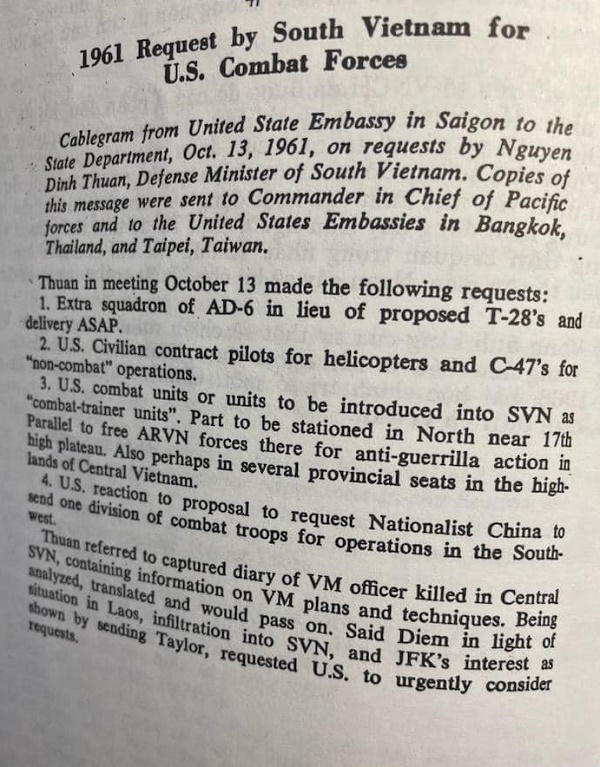
https://sachhiem.net/LICHSU/IMG/NGODD/1961XinQuanMy.jpg
Nguyen Huu Tri,
Governor of Northern Vietnam, 1952–1954;
leader of the Dai Viet (Vietnamese political party).
Nguyen Van Tam,
Minister of the Interior of the State of Vietnam
and Acting Governor of Northern Vietnam to June 3, 1952; Prime Minister of the
State of Vietnam, June 3, 1952–December 17, 1953.
Sihanouk, Prince Norodom,
Norodom Sihanouk,
King of Cambodia to March 1955, thereafter
Prince of Cambodia; Prime Minister and Foreign Minister, October 1955–January
1956; Prime Minister, Foreign Minister, and Minister of the Interior,
March–April 1956; Prime Minister, September–October 1956; Prime Minister,
Foreign Minister, Minister of Plans, and Minister of the Interior, April–July
1957
Cambodian Head of State until March 1970;
thereafter, leader of Cambodian Government in exile in Beijing
Prince, Head of State of Cambodia until March
18, 1970; thereafter, leader of the Cambodian government-in-exile in Beijing
(GRUNK)
4/11/75 - Phnom Penh Evacuation
Chairman of the Joint Chiefs of Staff to
August 1957
https://www.jcs.mil/About/The-Joint-Staff/Chairman/Admiral-Arthur-William-Radford/
https://www.history.navy.mil/research/histories/ship-histories/danfs/a/arthur-w-radford.html
https://en.wikipedia.org/wiki/Arthur_W._Radford
Salan, Général Raoul,
Commander of French Forces in Indochina, April
1, 1952–May 1953.
https://en.wikipedia.org/wiki/Raoul_Salan
https://www.britannica.com/biography/Raoul-Albin-Louis-Salan
https://www.britishpathe.com/asset/219896/
https://history.state.gov/historicaldocuments/frus1952-54v13p1/d21
http://saigon-vietnam.fr/raoul-salan_en.php
https://foreignlegion.info/1952-battle-of-na-san/
https://grokipedia.com/page/Raoul_Salan
https://historfiction.fandom.com/wiki/Raoul_Salan
Valluy, Jean,
General, French Member of the NATO Standing Group in the United States
and French Representative at the Five-Power Military Conference in Washington,
June 1954.
https://en.wikipedia.org/wiki/Jean_%C3%89tienne_Valluy
https://www.jcs.mil/Portals/36/Documents/History/Vietnam/Vietnam_1947-1954.pdf
https://www.nato.int/content/dam/nato/webready/documents/Archives/tools/98-XIB.pdf


No comments:
Post a Comment