20260725 CDTL DDE D195 15 March 1953 Điện văn của Đại sứ Heath tại Sài Gòn gửi Bộ Ngoại giao. Cải Cách Ruộng Đất Tại Miền Nam
https://history.state.gov/historicaldocuments/frus1952-54v13p1/d195
Google Translated
Tài liệu 195
Quan hệ Đối ngoại của Hoa Kỳ, 1952–1954, Đông Dương, Tập XIII, Phần 1
751G.5/3–1553: Điện văn của Đại sứ Heath tại Sài Gòn gửi Bộ Ngoại giao.
Mật
Sài Gòn, ngày 15 tháng 3 năm 1953 – 19 giờ.
1796. Thông tin được gửi tới Paris (không đánh số) và Hà Nội (không đánh số). Tôi đã đến gặp Thủ tướng Tâm vào ngày 13 tháng 3. Khi thảo luận về chuyến thăm Washington của phái đoàn Mayer–Bidault–Letourneau, ông Tâm cho biết vấn đề lớn của Việt Nam là tìm kiếm nguồn tài chính để tiếp tục mở rộng Quân đội Quốc gia Việt Nam [Trang 409] trong năm 1954. Việc tuyển mộ 54 tiểu đoàn trong năm 1953 đã bắt đầu. Ông vừa ký lệnh tuyển mộ đợt đầu gồm 10.000 quân. Tôi lưu ý rằng chi phí phát sinh cho các tiểu đoàn này trong năm 1954 sẽ vào khoảng hơn một tỷ đồng bạc (50 triệu đô la). Ông cho biết kế hoạch của Tướng Alessandri cho năm 1954 dự kiến tuyển thêm 98 tiểu đoàn nữa. Ông khẳng định rằng việc này chỉ có thể được tài trợ thông qua sự hỗ trợ từ bên ngoài. Ông đã nâng mức đóng góp của Việt Nam vào ngân sách quân sự từ một tỷ đồng bạc lên 1,7 tỷ đồng bạc trong năm 1952, và năm nay Việt Nam sẽ đóng góp 2,9 tỷ đồng bạc.
Tôi đã phản bác nhận định của ông ta cho rằng đây là mức đóng góp tối đa mà Việt Nam có thể thực hiện; tôi lập luận rằng nếu phía Pháp và các nhóm lợi ích khác không phản đối, thì hoàn toàn có thể áp dụng các loại thuế mới hoặc tăng thuế hiện hành—chẳng hạn như thuế đánh vào các giao dịch chuyển tiền ra nước ngoài. Ông ta cười và tán thành ý kiến này, đồng thời chia sẻ rằng bản thân ông đã cân nhắc việc áp dụng thuế chuyển tiền từ hơn một năm nay, nhưng vấp phải sự phản đối gay gắt không chỉ từ phía Pháp mà còn từ chính Bảo Đại.
2. Ông không đồng tình với nhận định của tôi cho rằng chương trình cải cách ruộng đất của ông dường như đang bị đình trệ. Đúng là mới chỉ có 30.000 héc-ta đất thuộc các điền trang lớn thực sự được bán lại cho người tá điền. Tuy nhiên, ngày càng có nhiều địa chủ lớn tìm đến ông để ngỏ ý bán đất cho nhà nước. Ông đã khuyên họ nên bán trực tiếp cho tá điền và cho biết chính phủ sẽ hỗ trợ tài chính để tá điền chi trả khoản tiền thanh toán ban đầu, bởi chính phủ không có đủ ngân sách để mua đứt các khu đất này. Ông tin rằng rồi đây nhiều địa chủ sẽ đạt được thỏa thuận mua bán với tá điền của mình. Ông chỉ có thể tiến hành cải cách ruộng đất một cách chậm rãi do vấp phải sự chống đối từ quá nhiều thế lực. Dù vậy, những bước tiến vẫn đang được thực hiện. Điển hình là tại tỉnh Bến Tre, một hợp tác xã đã được thành lập và đàm phán thành công với các địa chủ để giảm mức tô hàng năm xuống còn 15-25% sản lượng lúa, thay vì mức 40-50% như trước đây.
3. Ông kiên quyết thực hiện kế hoạch thành lập một Quốc hội. Sự phản đối từ phía Bảo Đại là điều có thể vượt qua được. Vì lợi ích của chính mình cũng như của chế độ quân chủ, Bảo Đại không thể trì hoãn quá lâu việc đáp ứng nguyện vọng của người dân về một Quốc hội, nhất là khi ông từng hứa hẹn về cơ quan này trong thông điệp dịp Tết hai năm trước. Chỉ có một cơ quan lập pháp quốc gia mới có thể hợp thức hóa chế độ quân chủ. Là bước khởi đầu, ông Tâm vẫn ủng hộ mô hình Quốc hội được bầu gián tiếp: các hội đồng xã vừa đắc cử sẽ chọn đại diện vào hội đồng tỉnh, và các hội đồng tỉnh này sau đó sẽ cử đại diện tham gia cơ quan lập pháp quốc gia. Tuy nhiên, cũng có khả năng dư luận sẽ đòi hỏi một cơ quan lập pháp quốc gia được bầu trực tiếp. Ông dự định sẽ ra miền Bắc vào cuối tháng, đi khắp đất nước để thăm dò ý kiến công chúng về vấn đề này cũng như các vấn đề khác.
4. Một trong những mục đích chuyến đi về phía bắc của ông ấy là để xem xét hoạt động thí điểm của dự án siêu làng của Thống đốc Trí. Ông ấy sẽ không tin rằng nông dân thực sự ủng hộ việc di dời khỏi các thôn xóm của họ đến làng mới cho đến khi ông ấy thực sự nói chuyện với họ. Ngoài ra còn có vấn đề là dự án siêu làng sẽ vô cùng tốn kém và chính phủ đơn giản là không có đủ kinh phí. Tôi nói với ông ấy rằng tôi đã kiểm tra làng thí điểm và tôi nghĩ rằng từ góc độ bình ổn vùng đồng bằng, việc xây dựng một số "làng mạnh" là vô cùng cần thiết.
Heath.
https://history.state.gov/historicaldocuments/frus1952-54v13p1/sources
List of Abbreviations and Symbol
https://history.state.gov/historicaldocuments/frus1952-54v13p1/terms
https://history.state.gov/historicaldocuments/frus1952-54v13p1/persons
https://history.state.gov/historicaldocuments/frus1952-54v13p1/comp2
1. Document 195
Foreign Relations of the United States, 1952–1954, Indochina, Volume XIII, Part 1
751G.5/3–1553: Telegram
The Ambassador at Saigon (Heath) to the Department of State
secret
Saigon, March 15, 1953—7 p.m.
1796. Rptd info Paris unnumbered, Hanoi unnumbered. I called on President Tam March 13. Discussing the Mayer–Bidault–Letourneau visit to Washington Tam said the great problem of Vietnam was to find financial means further to increase Vietnamese National Army [Page 409] in 1954. The recruiting of 54 battalions in 1953 had already started. He had just signed an order to recruit an initial 10,000 men. I remarked that the additional cost in 1954 of these battalions would be something slightly over one billion piastres ($50 million). He stated that General Alessandri’s plans for 1954 called for recruiting 98 battalions more. They could be financed he asserted only by outside help. He had increased Vietnamese contribution to the military budget from one billion piastres to 1.7 billion piastres in 1952 and this year Vietnam would contribute 2.9 billion piastres.
I challenged his statement that this was the maximum that Vietnam could contribute saying that, if French and other interests would not oppose such action, increased or new taxes, such as a tax on financial transfers abroad, could be levied. He laughingly agreed to this saying that for more than a year he had thought about imposing a transfer tax but there would be firm opposition not only from French interests but from Bao Dai himself.
2.
He objected to my observation that his agrarian reform program seemed to have stalled. It was true that only 30,000 hectares of large holdings had actually been sold to the tenants. But more and more big landlords were approaching him trying to sell their holdings to the state. He had told them to sell direct to the tenants and that the government would assist the tenants financially in making initial payments. The government had no funds to buy properties outright. He thought that many of the landlords would eventually make sale arrangements with their tenants. He could move only slowly toward agrarian reform because there were too many forces in opposition. Progress was, however, being made. For example in Bentre Province a cooperative had been formed which had negotiated agreements with the landlords reducing annual rentals to from 15 to 25 percent of the rice crop from the 40 or fifty percent previously charged.
3.
He insisted that he was going ahead with his plans to form a National Assembly. The opposition of Bao Dai could be overcome. In his own interest and that of the monarchy Bao Dai could not delay too long in yielding to popular demand for a National Assembly, the more so since Bao Dai two years ago in his Tet message had promised the assembly. Only a national legislature could legalize the monarchy. As an initial step, he, Tam, still favored an indirectly elected assembly, the recently elected communal councils choosing representatives to provincial assemblies which in turn would name representatives to the national body. However it was possible that public opinion would insist on a directly elected national legislature. He was going to go to the north the end of the month and travel through the country and test public opinion on this and other subjects.
4.
One of the purposes of his trip to the north was to take a look at the pilot operation of Governor Tri’s super-village project. He would not be convinced that the peasants were actually in favor of moving out of their hamlets into the new village until he had actually talked with them. Also there was the problem that the super-village project would be enormously expensive and the government simply did not have the funds. I told him that I had inspected the pilot village and I thought that from the standpoint of pacification of the delta the construction of a number of “strong villages” was imperatively desirable.
Heath
https://history.state.gov/historicaldocuments/frus1952-54v13p1/d195
https://history.state.gov/historicaldocuments/frus1952-54v13p1/pg_409
Bao Dai,
Chief of State of Vietnam.
Ngo Dinh Diem,
President of the Council of Ministers of the State of Vietnam to October 1955; thereafter President and Chief of State of the Republic of Vietnam
https://en.wikipedia.org/wiki/Ngo_Dinh_Diem
https://millercenter.org/the-presidency/educational-resources/diem-coup
https://www.jfklibrary.org/search?f[0]=subject:Vietnam%20War,%201961-1975
The Diem Coup audio
https://soundcloud.com/the-miller-center-at-uva/sets/the-diem-coup
February 1, 1966: President Johnson remembers Diem coup (admitted) to Eugene McCarthy
https://soundcloud.com/the-miller-center-at-uva/february-1-1966-president
November 4, 1963: President Kennedy on the Diem coup
https://soundcloud.com/the-miller-center-at-uva/november-4-1963-president-kennedy-on-the-diem-coup
NHỚ LẠI NHỮNG NGÀY Ở CẠNH TỔNG THỐNG NGÔ ĐÌNH DIỆM (Full) - Tài Nguyễn Diễn Đọc
https://www.youtube.com/watch?v=sWTTgB7oE6U&t=6927
Một phụ nữ miền Bắc viết về cố TT Ngô Đình Diệm.
https://www.youtube.com/watch?v=UMEkUQRp01o
"The Death of Diem and Nhu"
https://www.youtube.com/watch?v=U8O1HOTXS8A
"The Coup in Saigon"
https://www.youtube.com/watch?v=k4IaJYiNanc
"Everybody'll Say We Did It"
https://www.youtube.com/watch?v=Jaai1NdZ70k
"We Have Plans for Withdrawal"
https://www.youtube.com/watch?v=0BABdRu7FY0
"The Road to Disaster"
https://www.youtube.com/watch?v=dr5dRFVV-ok
https://www.youtube.com/channel/UChty22qJfdeAd8dAee9Mo7g/featured
“The President Is Dead”
https://www.youtube.com/watch?v=lD-akTUBFWs
“That Wasn't What Killed Kennedy”
https://www.youtube.com/watch?v=LAF0JGttS3E
Kennedy and Vietnam: The great what-if
https://www.youtube.com/watch?v=6XLhqXt2pww
JFK, LBJ and the Paradox of Vietnam
https://www.youtube.com/watch?v=TYRsahM-GqQ&t=2054
BÀI 305: NHÌN LẠI LỊCH SỬ: ĐỆ NHẤT CỘNG HÒA
http://www.bacaytruc.com/index.php/16996-bai-305-nhin-l-i-l-ch-s-d-nh-t-c-ng-hoa-tac-gi-vu-linh-ddtc
BÀI 306: NHÌN LẠI LỊCH SỬ: ĐỆ NHỊ CỘNG HÒA
https://diendantraichieu.blogspot.com/2023/11/bai-306-nhin-lai-lich-su-e-nhi-cong-hoa.html
BÀI 307: NHÌN LẠI LỊCH SỬ: VAI TRÒ CỦA MỸ
http://www.bacaytruc.com/index.php/17092-bai-307-nhin-l-i-l-ch-s-vai-tro-c-a-m-tac-gi-vu-linh-ddtc
JFK and the Diem Coup
https://nsarchive2.gwu.edu/NSAEBB/NSAEBB101/
Evidence on the Diem Coup in South Vietnam 1963
https://www.tokyoprogressive.org/evidence-on-the-diem-coup-in-south-vietnam-1963/
Tập 1 - Đời Một Phóng Viên & Những Ngày Bên Chí Sĩ Ngô Đình Diệm
https://www.youtube.com/watch?v=2CJ1CXSWwpI
Tập 2. Đời Một Phóng Viên & Những Ngày Bên Chí Sĩ Ngô Đình Diệm
https://www.youtube.com/watch?v=Po5Hlbfk6Zc
Tập 3 - Đời Một Phóng Viên & Những Ngày Bên Chí Sĩ Ngô Đình Diệm
https://www.youtube.com/watch?v=vdluTn-L8sc
Tập 4 : Đời Một Phóng Viên & Những Ngày Bên Chí Sĩ Ngô Đình Diệm
https://www.youtube.com/watch?v=p58HIMAy_Hg
Tập 5 - Đời Một Phóng Viên & Những Ngày Bên Chí Sĩ Ngô Đình Diệm
https://www.youtube.com/watch?v=ti24AXG12YE
Tập 6 - Đời Một Phóng Viên & Những Ngày Bên Chí Sĩ Ngô Đình Diệm
https://www.youtube.com/watch?v=LB0xpBPX9UI
Tập 7 - Đời Một Phóng Viên & Những Ngày Bên Chí Sĩ Ngô Đình Diệm
https://www.youtube.com/watch?v=Rvv0ze1mG_8
Tập 8 - Đời một Phóng Viên và Những ngày chung sống với Chí Sĩ Ngô Đình Diệm
https://www.youtube.com/watch?v=Ht1u6A62KXk
Tập 9 - Đời một Phóng Viên và những ngày chung sống với Chí Sĩ Ngô Đình Diệm
https://www.youtube.com/watch?v=bcZZ9O5cwgA&t=18s
Tập 10 - Đời một Phóng Viên & Những ngày chung sống với Chí Sĩ Ngô Đình Diệm
https://www.youtube.com/watch?v=bgJnv7kALSA
Interview with Madame Ngo Dinh Nhu, 1982
https://video.alexanderstreet.com/watch/interview-with-madame-ngo-dinh-nhu-1982
Tài liệu cộng sản giặc Hồ xuyên tạc Tổng thống Diệm và quân đội Mỹ
https://sachhiem.net/LICHSU/N/NgoDacTriet.php
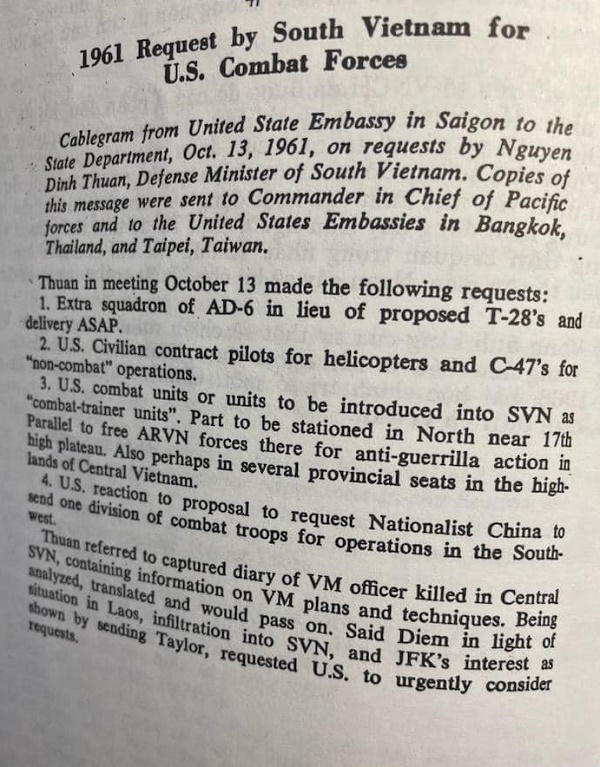
https://sachhiem.net/LICHSU/IMG/NGODD/1961XinQuanMy.jpg
Nguyen Huu Tri,
Governor of Northern Vietnam, 1952–1954; leader of the Dai Viet (Vietnamese political party).
Nguyen Van Hinh,
Chief of Staff of the Army of the State of Vietnam, 1953–1954; son of Nguyen Van Tam.
Nguyen Van Tam,
Minister of the Interior of the State of Vietnam and Acting Governor of Northern Vietnam to June 3, 1952; Prime Minister of the State of Vietnam, June 3, 1952–December 17, 1953.
Nong Kimny,
Cambodian Ambassador in the United States from July 1, 1952. Member of the Cambodian Delegation at the Geneva Conference.
Norodom Sihanouk,
King of Cambodia to March 1955, thereafter Prince of Cambodia; Prime Minister and Foreign Minister, October 1955–January 1956; Prime Minister, Foreign Minister, and Minister of the Interior, March–April 1956; Prime Minister, September–October 1956; Prime Minister, Foreign Minister, Minister of Plans, and Minister of the Interior, April–July 1957
Cambodian Head of State until March 1970; thereafter, leader of Cambodian Government in exile in Beijing
Prince, Head of State of Cambodia until March 18, 1970; thereafter, leader of the Cambodian government-in-exile in Beijing (GRUNK)
4/11/75 - Phnom Penh Evacuation
Ourot Souvannavong,
Laotian Minister in the United States from July 13, 1953; Laotian Delegate at the Geneva Conference of 1954.
Deputy Prime Minister of the State of Vietnam, 1952; Governor of Central Vietnam, 1953–1954.
Laotian Prime Minister. Prime Minister of the Kingdom of Laos until 1975
Prince, half-brother of Souphanouvong, Head of Government of Laos on several occasions until 1975; represented neutralist forces
Thống đốc Nam Kỳ. Governor of Cochin China. Prime Minister of Vietnam to June 3, 1952.
https://en.wikipedia.org/wiki/Tr%E1%BA%A7n_V%C4%83n_H%E1%BB%AFu
https://history.state.gov/historicaldocuments/frus1952-54v16/d279
https://vietnamproject.archives.msu.edu/objects/159-547-2488/
Vo Nguyen Giap,
General, People’s Army of Vietnam, Defense Minister, Democratic Republic of (North) Vietnam, Vice Premier for Defense, Democratic Republic of Vietnam


No comments:
Post a Comment