20260717 CDTL DDE D187 21 February 1953 Điện văn của Đại sứ Heath tại Sài Gòn gửi Bộ Ngoại giao.
https://history.state.gov/historicaldocuments/frus1952-54v13p1/d187
Google Translated
Tài liệu 187
Quan hệ Đối ngoại của Hoa Kỳ, 1952–1954, Đông Dương, Tập XIII, Phần 1
751G.5/2–2153: Điện văn của Đại sứ Heath tại Sài Gòn gửi Bộ Ngoại giao.
Mật
Sài Gòn, ngày 21 tháng 2 năm 1953—16:00 giờ.
1665. Đồng gửi tới Paris và Hà Nội (không đánh số). Hôm qua, tôi đã giới thiệu ông Brayton Wilbur, Trưởng phái đoàn MSA của Stassen, với ông Letourneau.
(1) Tôi đã chuyển cuộc trò chuyện sang tỷ giá hối đoái. Letourneau thừa nhận rằng việc phá giá đồng piastre sẽ có lợi cho Pháp nhưng nhấn mạnh rằng điều đó hiện tại là không thể do sự phản đối của AS đối với động thái như vậy. Sau đó, ông thẳng thắn thừa nhận rằng cũng sẽ có sự phản đối từ cả quân nhân và nhân viên dân sự Pháp tại IC vì tỷ giá hiện tại cho phép họ gửi những khoản tiền lớn hơn [Trang 395] tiền gửi để tiết kiệm và/hoặc duy trì gia đình ở Pháp. (Bình luận: Sự phản đối của AS đối với việc phá giá đồng piastre là một trở ngại thực sự.) Chúng tôi không thấy nhiều giá trị trong lập luận của Letourneau rằng vì mục đích tinh thần của quân nhân và nhân viên dân sự Pháp, tỷ giá hiện tại phải được duy trì. Vì tiền lương của họ cuối cùng được tính bằng franc nên họ có thể nhận được một khoản tiền lớn hơn bằng tiền tệ địa phương nếu đồng piastre bị phá giá. Như báo cáo McDiarmid chỉ ra, có thể có những sắp xếp đặc biệt cho việc gửi tiền của nhân viên Pháp.
(2) Letourneau cho biết phía Pháp hoàn toàn tán thành sự cần thiết phải tăng quân số cho Quân đội Quốc gia Việt Nam thêm 40.000 người trong năm 1953, đồng thời cũng cơ bản đồng ý với việc trao cho quân đội này quyền tự chủ lớn hơn trong việc quản lý các khu vực. Ông đã chỉ đạo Bộ Tổng tham mưu Pháp cần đáp ứng tối đa các yêu cầu của phía Việt Nam về vấn đề này, miễn là không gây nguy hại cho an ninh quân sự của Pháp. Đề nghị mới nhất do Tướng Hinh đưa ra được Letourneau đánh giá là "thực tế". Đề xuất này không yêu cầu đặt toàn bộ vùng Nam Kỳ dưới quyền chỉ huy quân sự của Việt Nam. Tướng Hinh đề nghị phía Pháp tiếp tục đảm nhiệm an ninh tại khu vực biên giới Campuchia - Việt Nam, vùng do lực lượng Cao Đài kiểm soát và khu vực phía bắc Sài Gòn – nơi vẫn còn hiện diện lực lượng Việt Minh khá đông đảo.
(3) Letourneau nói tiếp rằng mặc dù đã có sự đồng thuận về việc tăng cường Quân đội Quốc gia Việt Nam [Việt Nam], vấn đề tài chính cho việc gia tăng này vẫn là một bài toán chưa có lời giải. Tôi phản bác lại bằng cách nêu rõ hiểu biết của mình rằng: dựa trên các khoản ngân sách hiện có của Pháp và kỳ vọng vào nỗ lực tài chính lớn hơn từ phía Chính phủ Việt Nam, thì nguồn kinh phí cho việc tăng thêm 40.000 quân trong năm 1953 đã được bảo đảm. Letourneau miễn cưỡng thừa nhận điều này nhưng cho rằng vấn đề thực sự sẽ nảy sinh vào năm 1954. Ông thừa nhận chi phí duy trì quân đội Việt Nam là quá cao nhưng khẳng định không thể cắt giảm lương trong thời chiến. Quân đội Việt Nam ngay từ đầu đã được xây dựng theo mô hình quân đội chuyên nghiệp, vốn dĩ tốn kém hơn so với quân đội dựa trên chế độ nghĩa vụ quân sự. Dù có thể tuyển thêm tân binh theo diện nghĩa vụ, nhưng không thể trả lương cho họ thấp hơn mức lương của binh sĩ chuyên nghiệp khi họ cùng thực hiện các nhiệm vụ và đối mặt với những rủi ro như nhau.
(4) Letourneau khẳng định mạnh mẽ rằng tình hình chính trị và quân sự tại Campuchia không gây ra vấn đề gì vào thời điểm đó. Pháp [Trang 396] và Campuchia thật may mắn khi có Tướng Langlade làm chỉ huy lực lượng Pháp-Mỹ [và Khmer]. Langlade là một vị tướng khác biệt; dù rất hăng say, ông không chủ trương sa vào những trận đánh vô ích. Thay vào đó, ông tập trung thực hiện hiệu quả công tác tập hợp, tái định cư và tổ chức lực lượng tự vệ cho người dân tại các khu vực đang chịu sự xâm nhập của Việt Minh.
Heath.
1. Ông Brayton Wilbur, Chủ tịch Công ty Wilbur Ellis tại San Francisco, là trưởng đoàn của phái bộ đánh giá gồm bốn thành viên thuộc Cơ quan An ninh hỗ tương (MSA) trong chuyến thăm Đông Dương. MSA đã cử các phái bộ tương tự đến một số địa bàn khác trong tháng 2 năm 1958.↩
2. Tài liệu này đề cập đến một bản báo cáo có tiêu đề “Vấn đề Tỷ giá Hối đoái tại các Quốc gia Liên kết Đông Dương” (The Exchange Rate Problem in the Associated States of Indochina), do ông Orville J. McDiarmid thuộc Phái bộ MSA tại Philippines soạn thảo dựa trên kết quả nghiên cứu thực tế tại Đông Dương. Một bản dự thảo của báo cáo này, đề ngày 10 tháng 2 năm 1953, đã được gửi về Washington kèm theo công văn số 385 từ Sài Gòn đề ngày 17 tháng 3 năm 1953 (tài liệu này không được in trong tập hồ sơ). (851G.131/3–1753)↩
3. Vào ngày 24 tháng 2, Ủy ban Quân sự Cấp cao Pháp-Việt họp tại Đà Lạt đã quyết định mở rộng quy mô Quân đội Việt Nam thêm khoảng 40.000 quân, chủ yếu thông qua việc thành lập một số lượng đáng kể các đơn vị biệt kích thuần túy là người Việt. Hội nghị cũng quyết định bàn giao quyền kiểm soát một số khu vực nhất định cho lực lượng Việt Nam và tăng cường thẩm quyền cho chính quyền địa phương của Việt Nam. Các nhân vật tham dự cuộc họp bao gồm Quốc trưởng Bảo Đại, Thủ tướng Tâm, Tổng Tham mưu trưởng Hinh, Bộ trưởng Letourneau và Tướng Salan.↩
https://history.state.gov/historicaldocuments/frus1952-54v13p1/sources
List of Abbreviations and Symbol
https://history.state.gov/historicaldocuments/frus1952-54v13p1/terms
https://history.state.gov/historicaldocuments/frus1952-54v13p1/persons
https://history.state.gov/historicaldocuments/frus1952-54v13p1/comp2
1. Document 187
Foreign Relations of the United States, 1952–1954, Indochina, Volume XIII, Part 1
751G.5/2–2153: Telegram
The Ambassador at Saigon (Heath) to the Department of State
secret
Saigon, February 21, 1953—4 p.m.
1665. Repeated information Paris, Hanoi unnumbered. I presented Mr. Brayton Wilbur, Chief of Stassen’s MSA Mission,1 to Letourneau yesterday.
(1)
I brought conversation around to exchange rate. Letourneau admitted that it would be in interest of France to devalue the piastre but insisted that it would be presently impossible in view of opposition of AS to such a move. He then admitted frankly that there would also be objection on the part of both French military and civilian personnel in IC since the present [rate] allowed them to send larger [Page 395] remittances for savings and/or maintenance of families in France. (Comment: The objection of the AS to devaluation of the piastre is a real obstacle.) We do not find much merit in Letourneau’s contention that for purposes of morale of French military and civilian personnel present rate must be maintained. Since their pay is eventually computed in francs they could receive a larger sum in local currency if the piastre were devalued. As the McDiarmid report2 indicates special arrangements could be made for the remittances of French personnel.
(2)
Letourneau said the French were in full agreement with necessity of increasing the Vietnam National army by 40,000 men during CY 1953 and were in near agreement as to giving greater autonomous area responsibilities to national army.3 He had told the French general staff that they must go as far as possible in meeting Vietnam demands on that score to the point of not imperiling French military security. The latest Vietnamese proposal made by General Hinh was described by Letourneau as “realistic”. It did not call for placing all of Cochinchina under Vietnamese military command. Hinh asked the French to retain responsibility for the Cambodian-Vietnamese frontier, the area controlled by the Cao Daists and the region north of Saigon where there are still fairly considerable Viet Minh forces.
(3)
Letourneau went on to say that while there was agreement on increasing Viet Minh [Vietnam] National army question of financing this increase presented an unsolved problem. I countered with the statement that it was my understanding that under available French appropriations and counting on a greater fiscal effort on the part of the Vietnamese Government the financing of 40,000 increase was assured for 1953. Letourneau, somewhat reluctantly, admitted this but said that real problem would come in 1954. He admitted that the Vietnamese army was too expensive but said that it was impossible during wartime to reduce the pay. The Vietnamese army had been started as a professional army which naturally costs more than a conscript army. New troops might be conscripted but they could not be paid less than the enlisted professional soldier when they were performing the same duties and incurring the same risks.
(4)
Letourneau insisted very strongly that the political and military situation in Cambodia presented no problem at this time. France [Page 396] and Cambodia were fortunate in having General Langlade as commander of the Franco-American [Khmer] forces. Langlade was an unusual general who while very active did not believe in fighting useless battles. Instead he was effectively regrouping, resettling and organizing for self defense the populations in areas subject to Viet Minh infiltration.
Heath
1. Brayton Wilbur, President of the Wilbur Ellis Company of San Francisco was Team Leader of a four-man Mutual Security Agency evaluation mission on visit in Indochina. MSA dispatched similar missions to a number of posts during February 1958.↩
2. Reference is to a report titled “The Exchange Rate Problem in the Associated States of Indochina,” prepared by Orville J. McDiarmid of the MSA Mission in the Philippines on the basis of research in Indochina. A draft copy of this report dated Feb. 10, 1953, was transmitted to Washington as an enclosure to despatch 385 from Saigon, Mar. 17, 1953, not printed. (851G.131/3–1753)↩
3. On Feb. 24, the French-Vietnamese High Military Committee meeting at Dalat decided to expand the Vietnamese Army by approximately 40,000 men, primarily by creating a substantial number of purely Vietnamese commando units. It was also decided to turn certain areas over to Vietnamese forces and to increase the authority of local Vietnamese authorities. Among those participating in the meeting were Bao Dai, Premier Tam, Chief of Staff Hinh, Minister Letourneau, and General Salan.↩
https://history.state.gov/historicaldocuments/frus1952-54v13p1/d187
https://history.state.gov/historicaldocuments/frus1952-54v13p1/pg_395
https://history.state.gov/historicaldocuments/frus1952-54v13p1/pg_396
Chief of State of Vietnam.
Ngo Dinh Diem,
President of the Council of Ministers of the State of Vietnam to October 1955; thereafter President and Chief of State of the Republic of Vietnam
https://en.wikipedia.org/wiki/Ngo_Dinh_Diem
https://millercenter.org/the-presidency/educational-resources/diem-coup
https://www.jfklibrary.org/search?f[0]=subject:Vietnam%20War,%201961-1975
The Diem Coup audio
https://soundcloud.com/the-miller-center-at-uva/sets/the-diem-coup
February 1, 1966: President Johnson remembers Diem coup (admitted) to Eugene McCarthy
https://soundcloud.com/the-miller-center-at-uva/february-1-1966-president
November 4, 1963: President Kennedy on the Diem coup
https://soundcloud.com/the-miller-center-at-uva/november-4-1963-president-kennedy-on-the-diem-coup
NHỚ LẠI NHỮNG NGÀY Ở CẠNH TỔNG THỐNG NGÔ ĐÌNH DIỆM (Full) - Tài Nguyễn Diễn Đọc
https://www.youtube.com/watch?v=sWTTgB7oE6U&t=6927
Một phụ nữ miền Bắc viết về cố TT Ngô Đình Diệm.
https://www.youtube.com/watch?v=UMEkUQRp01o
"The Death of Diem and Nhu"
https://www.youtube.com/watch?v=U8O1HOTXS8A
"The Coup in Saigon"
https://www.youtube.com/watch?v=k4IaJYiNanc
"Everybody'll Say We Did It"
https://www.youtube.com/watch?v=Jaai1NdZ70k
"We Have Plans for Withdrawal"
https://www.youtube.com/watch?v=0BABdRu7FY0
"The Road to Disaster"
https://www.youtube.com/watch?v=dr5dRFVV-ok
https://www.youtube.com/channel/UChty22qJfdeAd8dAee9Mo7g/featured
“The President Is Dead”
https://www.youtube.com/watch?v=lD-akTUBFWs
“That Wasn't What Killed Kennedy”
https://www.youtube.com/watch?v=LAF0JGttS3E
Kennedy and Vietnam: The great what-if
https://www.youtube.com/watch?v=6XLhqXt2pww
JFK, LBJ and the Paradox of Vietnam
https://www.youtube.com/watch?v=TYRsahM-GqQ&t=2054
BÀI 305: NHÌN LẠI LỊCH SỬ: ĐỆ NHẤT CỘNG HÒA
http://www.bacaytruc.com/index.php/16996-bai-305-nhin-l-i-l-ch-s-d-nh-t-c-ng-hoa-tac-gi-vu-linh-ddtc
BÀI 306: NHÌN LẠI LỊCH SỬ: ĐỆ NHỊ CỘNG HÒA
https://diendantraichieu.blogspot.com/2023/11/bai-306-nhin-lai-lich-su-e-nhi-cong-hoa.html
BÀI 307: NHÌN LẠI LỊCH SỬ: VAI TRÒ CỦA MỸ
http://www.bacaytruc.com/index.php/17092-bai-307-nhin-l-i-l-ch-s-vai-tro-c-a-m-tac-gi-vu-linh-ddtc
JFK and the Diem Coup
https://nsarchive2.gwu.edu/NSAEBB/NSAEBB101/
Evidence on the Diem Coup in South Vietnam 1963
https://www.tokyoprogressive.org/evidence-on-the-diem-coup-in-south-vietnam-1963/
Tập 1 - Đời Một Phóng Viên & Những Ngày Bên Chí Sĩ Ngô Đình Diệm
https://www.youtube.com/watch?v=2CJ1CXSWwpI
Tập 2. Đời Một Phóng Viên & Những Ngày Bên Chí Sĩ Ngô Đình Diệm
https://www.youtube.com/watch?v=Po5Hlbfk6Zc
Tập 3 - Đời Một Phóng Viên & Những Ngày Bên Chí Sĩ Ngô Đình Diệm
https://www.youtube.com/watch?v=vdluTn-L8sc
Tập 4 : Đời Một Phóng Viên & Những Ngày Bên Chí Sĩ Ngô Đình Diệm
https://www.youtube.com/watch?v=p58HIMAy_Hg
Tập 5 - Đời Một Phóng Viên & Những Ngày Bên Chí Sĩ Ngô Đình Diệm
https://www.youtube.com/watch?v=ti24AXG12YE
Tập 6 - Đời Một Phóng Viên & Những Ngày Bên Chí Sĩ Ngô Đình Diệm
https://www.youtube.com/watch?v=LB0xpBPX9UI
Tập 7 - Đời Một Phóng Viên & Những Ngày Bên Chí Sĩ Ngô Đình Diệm
https://www.youtube.com/watch?v=Rvv0ze1mG_8
Tập 8 - Đời một Phóng Viên và Những ngày chung sống với Chí Sĩ Ngô Đình Diệm
https://www.youtube.com/watch?v=Ht1u6A62KXk
Tập 9 - Đời một Phóng Viên và những ngày chung sống với Chí Sĩ Ngô Đình Diệm
https://www.youtube.com/watch?v=bcZZ9O5cwgA&t=18s
Tập 10 - Đời một Phóng Viên & Những ngày chung sống với Chí Sĩ Ngô Đình Diệm
https://www.youtube.com/watch?v=bgJnv7kALSA
Interview with Madame Ngo Dinh Nhu, 1982
https://video.alexanderstreet.com/watch/interview-with-madame-ngo-dinh-nhu-1982
Tài liệu cộng sản giặc Hồ xuyên tạc Tổng thống Diệm và quân đội Mỹ
https://sachhiem.net/LICHSU/N/NgoDacTriet.php
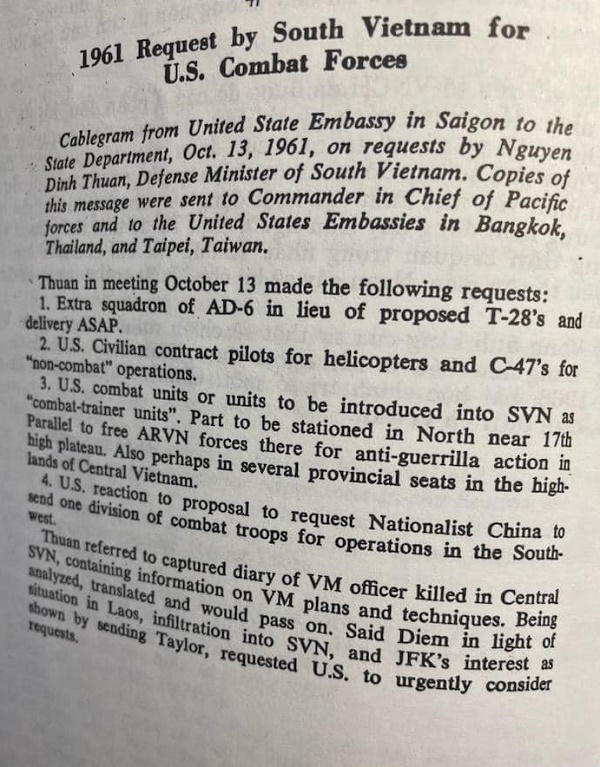
https://sachhiem.net/LICHSU/IMG/NGODD/1961XinQuanMy.jpg
Nguyen Huu Tri,
Governor of Northern Vietnam, 1952–1954; leader of the Dai Viet (Vietnamese political party).
Nguyen Van Hinh,
Chief of Staff of the Army of the State of Vietnam, 1953–1954; son of Nguyen Van Tam.
Nguyen Van Tam,
Minister of the Interior of the State of Vietnam and Acting Governor of Northern Vietnam to June 3, 1952; Prime Minister of the State of Vietnam, June 3, 1952–December 17, 1953.
Nong Kimny,
Cambodian Ambassador in the United States from July 1, 1952. Member of the Cambodian Delegation at the Geneva Conference.
Norodom Sihanouk,
King of Cambodia to March 1955, thereafter Prince of Cambodia; Prime Minister and Foreign Minister, October 1955–January 1956; Prime Minister, Foreign Minister, and Minister of the Interior, March–April 1956; Prime Minister, September–October 1956; Prime Minister, Foreign Minister, Minister of Plans, and Minister of the Interior, April–July 1957
Cambodian Head of State until March 1970; thereafter, leader of Cambodian Government in exile in Beijing
Prince, Head of State of Cambodia until March 18, 1970; thereafter, leader of the Cambodian government-in-exile in Beijing (GRUNK)
4/11/75 - Phnom Penh Evacuation
Ourot Souvannavong,
Laotian Minister in the United States from July 13, 1953; Laotian Delegate at the Geneva Conference of 1954.
Deputy Prime Minister of the State of Vietnam, 1952; Governor of Central Vietnam, 1953–1954.
Laotian Prime Minister. Prime Minister of the Kingdom of Laos until 1975
Prince, half-brother of Souphanouvong, Head of Government of Laos on several occasions until 1975; represented neutralist forces
Thống đốc Nam Kỳ. Governor of Cochin China. Prime Minister of Vietnam to June 3, 1952.
https://en.wikipedia.org/wiki/Tr%E1%BA%A7n_V%C4%83n_H%E1%BB%AFu
https://history.state.gov/historicaldocuments/frus1952-54v16/d279
https://vietnamproject.archives.msu.edu/objects/159-547-2488/
Vo Nguyen Giap,
General, People’s Army of Vietnam, Defense Minister, Democratic Republic of (North) Vietnam, Vice Premier for Defense, Democratic Republic of Vietnam


No comments:
Post a Comment