20261031 CDTL NRM D123 20 October 1975 123. Bản ghi nhớ cuộc Hội đàm.
https://history.state.gov/historicaldocuments/frus1969-76v18/d123
Google Translated
Tài liệu 123
Quan hệ Đối ngoại Hoa Kỳ, 1969–1976, Tập
XVIII, Trung Quốc, 1973–1976
123. Bản ghi nhớ cuộc Hội đàm.
Bắc Kinh, ngày 20 tháng 10 năm 1975, 17:07–18:08
THÀNH PHẦN THAM DỰ
Đặng Tiểu Bình, Phó Thủ tướng Quốc vụ viện, Cộng
hòa Nhân dân Tầu cộng
Kiều Quán Hoa, Bộ trưởng Bộ Ngoại giao
Đại sứ Hoàng Trấn, Trưởng Văn phòng Liên lạc Cộng
hòa Nhân dân Tầu cộng tại Washington
Vương Hải Dung, Thứ trưởng Bộ Ngoại giao
Lâm Bình, Vụ trưởng Vụ châu Mỹ và châu Đại Dương, Bộ
Ngoại giao
Đường Văn Sinh, Phó Vụ trưởng Vụ châu Mỹ và châu Đại
Dương, Bộ Ngoại giao (Phiên dịch)
Tiền Đại Dung, Tham tán, Văn phòng Liên lạc Cộng
hòa Nhân dân Tầu cộng tại Washington
Đinh Nguyên Hồng, Vụ phó phụ trách các vấn đề Hoa Kỳ,
Vụ châu Mỹ và châu Đại Dương, Bộ Ngoại giao
Triệu Kỳ Hoa, Vụ phó phụ trách các vấn đề Hoa Kỳ, Vụ
châu Mỹ và châu Đại Dương, Bộ Ngoại giao
Bà Thạch Yến Hoa, Bộ Ngoại giao (Phiên dịch) (cùng hai
thư ký ghi chép)
Tiến sĩ Henry A. Kissinger, Bộ trưởng Ngoại giao kiêm
Trợ lý Tổng thống phụ trách các vấn đề An ninh Quốc gia
Đại sứ George H. W. Bush, Trưởng Văn phòng Liên lạc
Hoa Kỳ tại Bắc Kinh
Helmut Sonnenfeldt, Tham tán Bộ Ngoại giao
Winston Lord, Giám đốc Ban Hoạch định Chính sách
Đại sứ Philip C. Habib, Trợ lý Bộ trưởng Ngoại giao phụ
trách các vấn đề Đông Á và Thái Bình Dương
William H. Gleysteen, Jr., Phó Trợ lý Bộ trưởng Ngoại
giao phụ trách các vấn đề Đông Á và Thái Bình Dương
Peter W. Rodman, Nhân viên Hội đồng An ninh Quốc gia
(NSC)
Cô Anne Boddicker, Nhà Trắng (Thư ký ghi chép)
CHỦ ĐỀ
Sườn phía Nam châu Âu
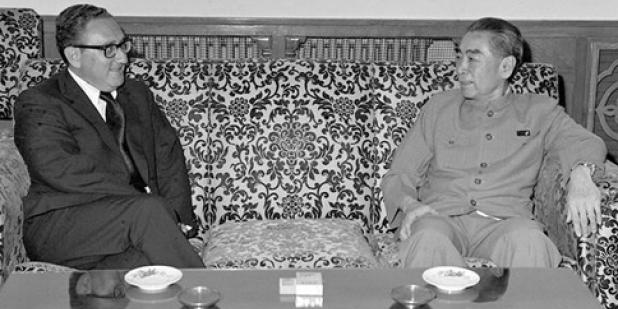
[Các phóng viên chụp ảnh khi các đại biểu đã ngồi vào
chỗ.]
Kissinger:
Chúng ta vẫn chưa hoàn toàn hồi phục sau bữa trưa vừa rồi.
Đặng Tiểu Bình:
Vâng, có vẻ như đó là một bữa trưa khá vất vả. Như ông biết đấy, món lẩu chỉ có
thể thưởng thức trong một bầu không khí thật thư thái, vì riêng việc ăn món này
cũng đã mất cả nửa tiếng đồng hồ rồi.
Kissinger:
Đã lâu lắm rồi, kể từ thời còn trong bộ binh hồi chiến tranh, tôi mới lại đi bộ
nhiều đến thế này. [Cười] Với tôi, đây chẳng khác nào một cuộc "Vạn
lý Trường chinh" vậy. [Cười]
Đặng Tiểu Bình:
Vâng, mà hồi tham gia Vạn lý Trường chinh, tôi đã đi bộ một nửa trong tổng số
25.000 dặm đường; nửa còn lại thì di chuyển trên lưng súc vật, chẳng hạn như ngựa.
Thời đó, sự xa xỉ tột bậc chính là mỗi người có được một con ngựa để cưỡi.
Kissinger:
Tôi có thể hình dung được điều đó.
[Các phóng viên rời đi.]
Đặng Tiểu Bình:
Vậy là hôm nay chúng ta vẫn còn chút thời gian. Dù không nhiều, nhưng chúng ta
vẫn có cơ hội để trao đổi quan điểm. Hôm qua, chúng ta đã có dịp thảo luận về
các vấn đề liên quan đến tình hình quốc tế, chính sách và chiến lược. Chúng tôi
cho rằng cuộc trao đổi đó diễn ra rất thẳng thắn, và chúng tôi tin rằng những
cuộc đối thoại như vậy sẽ giúp tăng cường sự hiểu biết lẫn nhau, đồng thời tạo
tiền đề cho việc phát triển hợp tác giữa hai bên trong tương lai.
Kissinger:
Tôi hoàn toàn đồng ý.
Đặng:
Về các vấn đề liên quan đến chiến lược, phía chúng tôi không có gì mới để trao
đổi. Nếu phía ông cũng không có ý kiến gì mới, thì có lẽ chúng ta có thể dừng
thảo luận về vấn đề này tại đây và chuyển sang chủ đề khác. Tuy nhiên, nếu ông
muốn chia sẻ thêm về vấn đề đó hoặc bất kỳ quan điểm nào khác, ông cứ tự nhiên.
Kissinger:
Tôi đồng ý là chúng ta đã thảo luận xong vấn đề chiến lược và nêu rõ các cách
tiếp cận khác nhau. Hôm qua tôi đã liệt kê một số chủ đề có thể thảo luận; tùy
ông Phó Thủ tướng quyết định xem chủ đề nào phù hợp nhất.
Đặng:
Trong năm qua, ông đã đi khắp thế giới. Chúng tôi sẵn sàng lắng nghe bất cứ điều
gì ông muốn chia sẻ, những gì ông thấy cần thiết phải nói với chúng tôi, hoặc bất
kỳ chủ đề nào mà ông thấy thú vị để cùng trao đổi quan điểm. Nếu ông muốn, có
thể bắt đầu với sườn phía nam của châu Âu.
Kissinger:
Được thôi. Ông Habib muốn tôi thuyết phục các ông bỏ phiếu cùng phía với
chúng tôi về vấn đề Triều Tiên, nhưng tôi e rằng mình không thể
làm được điều đó chỉ trong một giờ. [Cười] Ông ấy đã vận động tất cả mọi người,
trừ Đức Giáo hoàng. [Cười]
Về sườn phía nam châu Âu, chúng ta có Bồ Đào
Nha, Tây Ban Nha, Ý, Hy Lạp và Thổ Nhĩ Kỳ. Mỗi quốc gia đều có tình
hình riêng biệt.
Tại Bồ Đào Nha, sau bốn mươi năm dưới chế
độ độc tài, các lực lượng dân chủ vẫn chưa được tổ chức tốt, còn cấu trúc chính
trị thì rất yếu ớt. Quân đội nước này đã tiếp nhận một phần tư tưởng từ các
phong trào giải phóng châu Phi – những phong trào mà chính họ từng chiến
đấu chống lại suốt 25 năm. Đảng Cộng sản của Cunhal – người từng
sống lưu vong tại Tiệp Khắc (một lựa chọn nơi lưu vong khá kỳ lạ) – hiện chịu ảnh
hưởng sâu sắc từ Liên Xô. [Đặng cúi người xuống dưới
bàn và nhổ vào chiếc ống nhổ đặt cạnh ghế ngồi.]
Trong khoảng trống quyền lực đó, Đảng Cộng sản mà tôi
vừa nhắc đến đã giành được tầm ảnh hưởng vượt mức, và có thời điểm tưởng chừng
như họ sắp kiểm soát được tình hình. Tôi cho rằng xu hướng này hiện đã bị chặn lại.
Chúng tôi đang phối hợp với các đối tác Tây Âu của mình để củng cố các lực
lượng đối lập với Cunhal. Đáng tiếc là một số lực lượng này giỏi
hùng biện hơn là tổ chức. Tuy nhiên, chúng tôi cho rằng tình hình đã cải thiện
và chúng tôi sẽ tiếp tục thúc đẩy sự cải thiện đó.
Đặng:
Chúng tôi có nghe thông tin gần đây rằng một số sĩ quan quân đội từng dưới quyền…
Kiều:
…Gonçalves.
Đặng:
…đang chuẩn bị tiến hành một cuộc đảo chính.
Kissinger:
Vâng. Sáng nay chúng tôi nhận được báo cáo rằng họ từ chối giao nộp vũ khí.
Đặng:
Có tin đồn rằng họ đang chuẩn bị hành động vào ngày 11 tháng 11, đúng ngày Angola
giành độc lập. Những thông tin chi tiết như vậy khó có thể đáng tin cậy.
Kissinger:
Không, tôi không tin điều đó. Chúng tôi chỉ nhận được báo cáo về một đơn vị
quân đội từ chối giao nộp vũ khí. Chắc chắn rằng Gonçalves đứng về phía Liên
Xô. Nhưng chúng tôi hy vọng… Chúng tôi đã liên lạc với một số nhà lãnh
đạo quân sự khác; chúng tôi chắc chắn sẽ không ủng hộ một cuộc đảo chính như vậy
và sẽ kiên quyết phản đối nó.
Đặng:
Nhưng theo quan điểm của chúng tôi, Bồ Đào Nha sẽ còn trải qua
nhiều biến động.
Kissinger:
Tôi đồng ý.
Đặng:
Và nhiều cuộc đọ sức.[Trang 781]
Chúng tôi không ở vị thế có thể can thiệp thêm vào khu
vực đó trên thế giới. Tuy nhiên, có một việc chúng tôi đã thực hiện: họ từng
nhiều lần đề nghị thiết lập quan hệ ngoại giao với chúng tôi, nhưng chúng tôi
đã từ chối. Nguyên tắc của chúng tôi rất đơn giản: chúng tôi không muốn làm bất
cứ điều gì tạo lợi thế cho các lực lượng thân Liên Xô giành ưu thế.
Kissinger:
Tôi cho rằng đó là một chính sách rất khôn ngoan. Chúng tôi ủng hộ Antunes
và Soares. [Đặng Tiểu Bình cúi người xuống và lại nhổ nước bọt.]
Antunes đã đến Washington vài tuần trước và chúng tôi đang hợp
tác với ông ấy. Nhưng tôi đồng ý với ông rằng sẽ còn nhiều cuộc đọ sức cam go.
Khó khăn đối với những người bạn Tây Âu của chúng ta là họ thường lơi lỏng
sau khi đạt được một thành công tạm thời.
Khi chúng tôi quay lại đây vào tháng 12, tình hình sẽ
sáng tỏ hơn. Tuy nhiên, chúng tôi quyết tâm ngăn chặn việc Liên Xô
thâu tóm quyền lực tại đó, ngay cả khi điều đó dẫn đến xung đột vũ trang. Mọi
chuyện sẽ không dễ dàng đâu. Ý tôi là, nếu họ định thực hiện một cuộc đảo
chính, thì đó sẽ không phải là việc dễ dàng đối với họ.
Còn ở Tây Ban Nha, tình hình phức tạp
hơn. Một mặt, chúng ta có một chế độ đang ở giai đoạn cuối, vì Franco đã
rất già rồi. Mặt khác, chúng ta không muốn kịch bản tại Bồ Đào Nha lặp lại
ở Tây Ban Nha.
Đảng Cộng sản Tây Ban Nha
đã nhiều lần tiếp cận chúng tôi, nhưng chúng tôi cho rằng đảng này chịu sự kiểm
soát từ Moscow. Ông đánh giá thế nào về vấn đề này?
Đặng Tiểu Bình:
Giữa Đảng Cộng sản Tây Ban Nha và Liên Xô tồn tại những mâu thuẫn.
Trong số các đảng cộng sản theo đường lối xét lại ở châu Âu, có thể nói
rằng mâu thuẫn giữa Đảng Cộng sản Tây Ban Nha, Đảng Cộng sản Hà Lan với
Liên Xô là sâu sắc hơn cả.
Kissinger:
Như ông đã biết, chúng tôi đang đàm phán để gia hạn thỏa thuận về các căn cứ
quân sự với Tây Ban Nha. Nhiều khả năng chúng tôi sẽ hoàn tất thỏa
thuận này trong vòng sáu tuần tới. Chúng tôi làm vậy vì tin rằng việc thu hẹp
các lợi ích an ninh của Mỹ tại Địa Trung Hải không có lợi cho an ninh thế
giới. [Đặng Tiểu Bình lại nhổ nước bọt] Bên cạnh
đó, chúng tôi dự định thành lập một số ủy ban trong các lĩnh vực văn hóa và
kinh tế, để trong trường hợp tình hình thay đổi, chúng tôi vẫn duy trì được các
mối liên hệ thực chất với nhiều tầng lớp trong xã hội Tây Ban Nha.
Kiều (Ch’iao):
Ý ông là sau khi chính quyền được chuyển giao cho [Juan] Carlos? [Trang
782]
Kissinger:
Đúng vậy. Chúng tôi đang thành lập các ủy ban gắn liền với thỏa thuận về căn cứ
quân sự, để khi Franco rời đi, chúng tôi sẽ không rơi vào tình thế phải loay
hoay tìm kiếm các mối liên hệ như đã từng xảy ra ở Bồ Đào Nha.
Chúng tôi sẽ có cơ sở hạ tầng này.
Đặng:
Theo nhận định của chúng tôi, ảnh hưởng của cái gọi là “đảng xét lại” tại Tây
Ban Nha trong quân đội không sâu sắc bằng trường hợp ở Bồ Đào Nha.
Không rõ ông có cùng cách nhìn nhận như vậy không?
Kissinger:
Một lý do khiến chúng tôi cần thỏa thuận về căn cứ này là để duy trì liên lạc với
quân đội Tây Ban Nha. Theo đánh giá của chúng tôi, ở các cấp chỉ
huy cao hơn, ảnh hưởng từ cái mà ông gọi là “đảng xét lại” này là rất nhỏ. Còn ở
các cấp thấp hơn, chúng tôi có nhận được một số báo cáo cho thấy họ đang tiến
hành tuyển mộ thành viên.
Đặng:
Các cấp thấp nhất thì không đóng vai trò quá lớn.
Kissinger:
Chúng tôi có nghe nói là ở cấp đại úy. Nhưng tại các cấp chỉ huy, tầm ảnh hưởng
của họ không thể so sánh được với tình hình ở Bồ Đào Nha.
Đặng:
Nhưng trong các lực lượng quân sự tại châu Phi, một đại úy lại là nhân vật
rất quan trọng [cười], còn ở châu Âu thì có lẽ không hẳn như vậy.
Kissinger: Ở
châu Âu thì không hẳn như vậy. [Cười]
Đặng:
Ông có ấn tượng gì về vị Hoàng tử Tây Ban Nha?
Kiều:
Carlos.
Kissinger:
Ông ấy là một người tử tế, nhưng lại ngây thơ. Ông ấy không hiểu gì về cách mạng
và cũng chẳng hình dung được những gì mình sẽ phải đối mặt. Ông ấy nghĩ rằng chỉ
cần có thiện chí là đủ. Dù sao thì ý định của ông ấy cũng tốt. Ông ấy là một
người tử tế, nhưng tôi không nghĩ ông ấy đủ mạnh mẽ để tự mình kiểm soát các sự
kiện.
Đặng:
Chúng tôi nghe nói Franco định trao lại quyền lực cho ông ta.
Kissinger:
Chúng tôi cứ nghe tin đó sáu tháng một lần. Nhưng bà Franco thì
quá quyến luyến cung điện, chẳng muốn rời đi chút nào. [Cười]
Đặng:
Chắc giờ ông ta cũng đã ngoài 80 tuổi rồi nhỉ?
Kissinger:
Vâng, và ông ấy cũng chẳng còn nhanh nhẹn gì nữa. Thậm chí, ông ấy còn có thói
quen ngủ gật ngay cả khi đang trò chuyện với người khác. [Cười] Tôi từng đến đó
cùng hai vị Tổng thống, và cả hai lần ông ấy đều ngủ gật. Thật ra, hồi tôi đi
cùng Tổng thống Nixon, ông ấy còn có khả năng gây buồn ngủ cho người đối
diện nữa cơ! Thấy ông ấy ngủ, tôi cũng ngủ theo. Thế là chỉ còn Tổng thống
Nixon và Bộ trưởng Ngoại giao Tây Ban Nha là vẫn còn tỉnh táo. [Cười]
Dù sao thì, nếu ông ấy chịu trao lại quyền lực thì vẫn
tốt hơn.
Đặng:
Ông nghĩ sao về Nam Tư?
Kissinger:
Chúng tôi lo ngại về tình hình Nam Tư. Chúng tôi e rằng sau khi Tito
qua đời, nhiều chuyện có thể xảy ra. Chẳng hạn như phong trào ly khai ở một số
tỉnh, hay sự chia rẽ trong nội bộ Đảng Cộng sản Nam Tư. Cả hai kịch
bản này đều có thể nhận được sự hậu thuẫn từ Liên Xô, thậm chí dẫn
đến cả sự can thiệp quân sự của Liên Xô. [Trang 783]
Đặng:
Trong chuyến thăm gần đây của Thủ tướng Nam Tư, ông Bijedic,
chúng tôi nhận thấy — dù ông ấy diễn đạt bằng những từ ngữ khác — rằng chính
phía Nam Tư cũng đang rất lo ngại về những vấn đề này.
Kissinger: Ở
Montenegro — ông biết chuyện này chứ? — họ đã phát hiện ra các hoạt động
của Liên Xô ngay trong nước mình.
Đặng:
Vâng, nhưng sau đó họ đã kịp thời phát hiện ra toàn bộ các hoạt động gián điệp
này và có biện pháp ngăn chặn chúng.
Kissinger:
Vâng, nhưng điều đó cho thấy khuynh hướng trong chính sách của Liên Xô.
Đặng:
Đúng vậy.
Kissinger:
Chúng tôi rất quan tâm đến nền độc lập và chính sách độc lập của Nam Tư.
Ông hẳn cũng để ý thấy rằng trong năm vừa qua, cả Tổng thống và tôi đều đã có
những chuyến thăm riêng biệt tới Nam Tư. Và trong vài tuần tới, chúng
tôi sẽ bắt đầu bán thiết bị quân sự cho họ.
Đặng:
Như vậy thì rất tốt. Ông chắc cũng biết rằng đây là một dân tộc rất kiên cường,
dù vẫn tồn tại một số mâu thuẫn giữa các sắc tộc khác nhau. Theo tôi thấy, một
trong những điểm mạnh của họ là họ có cái nhìn khá tỉnh táo về tình hình mà
mình đang phải đối mặt.
Kissinger:
Vâng. Chắc chắn họ sẽ chiến đấu nếu xảy ra một cuộc xâm lược
Đặng:
Chúng tôi cũng từng đặt câu hỏi này với những người bạn châu Âu của mình: nếu Liên
Xô tiến hành xâm lược Nam Tư thì chuyện gì sẽ xảy ra? Họ cho rằng
đây là một vấn đề nan giải. Có lẽ chính ông cũng sẽ phải đối mặt với câu hỏi
tương tự. Tất nhiên, tôi không yêu cầu ông phải đưa ra câu trả lời ngay lúc
này. [Họ cùng cười.]
Kissinger:
Không, tôi có thể trả lời ông. Đây là một vấn đề khó. Xét về mặt chính trị thì
khó, mà xét về mặt chiến lược cũng khó. Hiện chúng tôi đang thực hiện một số kế
hoạch quân sự cho tình huống này. Tôi có thể tiết lộ với ông điều này—ông thì
giữ bí mật được, chứ các đồng nghiệp của tôi thì tôi không chắc lắm đâu [cười]—chúng
tôi đã yêu cầu Tướng Haig, với tư cách là Tư lệnh quân đội Mỹ, tiến
hành lập kế hoạch.
Đặng::
Về Nam Tư ư?
Kissinger:
Đúng vậy. [Phía Tầu cộng có chút xôn xao.]
Đặng:
Chủ tịch sẵn sàng gặp ông vào lúc 6 giờ 30. [Bộ trưởng và Đại sứ Bush
nhìn nhau.] Vậy… ông đang gặp khó khăn về lịch trình [do Đại sứ Bush có
tổ chức tiệc chiêu đãi Bộ trưởng tại Câu lạc bộ Quốc tế].
Kissinger:
Không đâu. Ông ấy [Đại sứ Bush] mới là người gặp khó khăn. Còn tôi thì rất
sẵn lòng. [Trang 784]
T’ang:
Ông dự định sẽ đưa những ai đi cùng?
Kissinger: Đại
sứ, ông Lord…
Vương: Vợ
ông có đi cùng không?
Kissinger:
Bà ấy có được mời không?
Vương: Tùy
ông quyết định thôi.
Đặng:
Chúng tôi sẵn sàng lắng nghe yêu cầu hoặc ý kiến của ông. Ông cứ đề nghị xem
muốn đưa những ai đi cùng, muốn ai tham gia cuộc họp và muốn ai cùng bắt tay.
Kissinger:
Vậy thì… tất cả những người có mặt ở đây, cùng với vợ tôi, có thể bắt tay được
không? Còn trong cuộc họp thì sẽ có Đại sứ Bush, ông Lord và ông
Habib.
Đặng:
Ý ông là tất cả những người đang ngồi đây và cả vợ ông nữa sao?
Kissinger:
Đúng vậy, nếu các ông tìm thấy vợ tôi. [Cười] Chắc giờ này bà ấy đang đi mua sắm
rồi.
Đặng: Chúng
tôi sẽ cố gắng tìm bà ấy.
Kissinger:
Nếu các ông tìm thấy bà ấy thì tôi đỡ tốn khối tiền đấy. [Cười]
Đặng: Vậy
là giờ này bà ấy đang đi mua sắm à? [Bộ trưởng thảo luận với Sonnenfeldt
xem bà ấy đang ở đâu hoặc liệu bà ấy đã rời đi để đến dự tiệc chiêu đãi hay
chưa.]
Kissinger:
Có lẽ chúng ta vẫn còn kịp gặp bà ấy.
[Vương Hải Dung đi ra ngoài.]
Đặng:
Vậy có lẽ chúng ta có thể tiếp tục thêm khoảng 15 phút nữa, rồi sau đó ông có
thể chuẩn bị các công việc cần thiết. [Ông nhổ nước bọt vào ống nhổ.]
Kissinger:
Những điều tôi đã trao đổi với ông về công tác chuẩn bị quân sự liên quan đến Nam
Tư chỉ có các nhà lãnh đạo cấp cao nhất của ba chính phủ châu Âu được
biết. Tất nhiên, Schmidt cũng biết về việc này. Tuy nhiên, xét về mặt hậu
cần, đây là một vấn đề rất phức tạp, bởi vì tuyến đường thuận lợi nhất để chúng
ta tiến vào là thông qua Ý, mà về mặt hậu cần thì điều đó lại vô cùng
khó khăn. Có lẽ chúng ta sẽ thảo luận kỹ hơn về vấn đề này khi chúng tôi quay lại
đây sau vài tuần nữa.
Đặng:
Vâng, hơn nữa gần đây Ý đã trao trả Khu B của Trieste cho Nam
Tư. Chúng tôi cho rằng đây là một diễn biến rất tích cực.
Kissinger:
Vâng.
[Nancy T’ang đứng dậy rời đi. Bà
Shih tiến về phía bàn.]
Shih:
Cô ấy đi chuẩn bị một số việc. Tôi sẽ thay cô ấy.
Đặng Chừng nào còn vũ
khí trong tay, người Nam Tư sẽ còn chiến đấu.
Kissinger:
Chúng tôi cũng nghĩ vậy. Nhưng như tôi đã nói, vài tuần nữa chúng tôi sẽ bắt đầu
bán cho họ một số vũ khí chống tăng cùng các thiết bị khác. [Trang 785]
Đặng Chúng tôi cho rằng
ở khu vực đó, vấn đề chính nằm ở vũ khí thông thường chứ không phải vũ khí hạt
nhân.
Kissinger:
Đúng vậy. Mặc dù bất kỳ cuộc xung đột nào liên quan đến chúng ta và Liên
Xô đều rất phức tạp, và chắc chắn sẽ kéo theo các mối đe dọa hạt nhân.
Tuy nhiên, số vũ khí chúng tôi bán cho Nam Tư là vũ khí thông thường.
Đặng Nếu Liên Xô
kiểm soát được Nam Tư, bàn cờ chiến lược của họ tại châu Âu sẽ trở
nên linh hoạt. Tiếp theo sẽ là Romania và Albania.
Kissinger:
Nếu Liên Xô thực hiện một hành động quân sự nhắm vào Nam Tư
mà không phải chịu hậu quả, chúng ta sẽ đối mặt với một tình thế vô cùng nghiêm
trọng. [Teng gật đầu mạnh mẽ tỏ ý đồng tình.] Điều đó đòi hỏi phải có các biện
pháp đối phó nghiêm túc.
Đặng Bởi vì vấn đề này
không chỉ liên quan đến chiến lược quân sự mà còn gây ra những tác động chính
trị hết sức nghiêm trọng. Ảnh hưởng của nó ít nhất sẽ lan rộng ra toàn bộ sườn
phía nam.
Kissinger:
Tôi nghĩ đúng là như vậy. Nó sẽ tác động đến Ý, Đức và Pháp.
Đặng Cả khu vực Địa
Trung Hải nữa. Và cả Trung Đông.
Kissinger:
Nếu điều đó xảy ra, bất kể chúng ta hành động thế nào tại Nam Tư
— tùy thuộc vào diễn biến thực tế — thì tình hình cũng sẽ trở nên vô cùng
nghiêm trọng. Chúng ta sẽ không chấp nhận điều đó. Ít nhất, nó sẽ dẫn đến các
biện pháp đối phó cứng rắn. Sẽ không giống như trường hợp Tiệp Khắc
đâu. [Teng liếc nhìn đồng hồ.]
Ông có nhận định gì về tình hình tại Ý?
Đặng: Thật
khó để nhìn ra xu hướng phát triển tình hình ở Ý. Đối với chúng tôi, mọi
thứ vẫn còn là một ẩn số. Chúng tôi chưa biết phải đánh giá tình hình đó ra
sao. Có lẽ ông nắm rõ hơn chăng?
Kissinger:
Có lẽ Bộ trưởng Ngoại giao nên ghé thăm Giáo hoàng trên đường từ Liên Hợp Quốc
trở về. Gromyko cũng đã đến đó vài tuần trước. [Cười]
Đặng:
Thật vậy sao?
Kissinger:
Thực ra, chúng tôi cho rằng ông có thể giúp ích ở Ý. Ít nhất là với một số
thành viên Đảng Xã hội. Đảng Dân chủ Cơ đốc giáo có bộ máy lãnh đạo rất yếu
kém. [Họ gật đầu đồng tình.] Thủ tướng của họ, ông Moro, còn có thói
quen ngủ gật mỗi khi gặp người khác. [Tiếng cười]
Đặng:
Họ thay Thủ tướng vài lần trong một năm. Tôi không rõ là bao nhiêu lần kể từ
sau chiến tranh đến nay.
Kissinger:
Đúng vậy, nhưng vẫn chỉ là nhóm người đó thôi. Tuy nhiên, nhóm lãnh đạo Đảng
Dân chủ Cơ đốc giáo lại thiếu kỷ luật.
Chúng tôi hoàn toàn phản đối cái gọi là “thỏa hiệp lịch
sử” tại Ý. Chúng tôi không cấp thị thực cho các đảng viên Cộng sản Ý
sang Hoa Kỳ.
[Bộ trưởng Kissinger và ông Sonnenfeldt trao đổi với
nhau.] [Trang 786]
Đặng: Theo
quan điểm của tôi, cái gọi là “thỏa hiệp lịch sử” đó không thể thành công được.
Kissinger:
Chà, nó có thể thành công, nhưng sẽ dẫn đến thảm họa cho các đảng phái không
thuộc phe Cộng sản.
Tôi vừa nhận được một bức điện báo cho biết họ đã đưa
một đảng viên Cộng sản vào phái đoàn Nghị viện Ý sắp tới Washington – một
người mà chúng tôi không hề lựa chọn.
Nhưng đó chỉ là vấn đề thứ yếu. Chúng tôi sẽ kiên quyết
phản đối điều đó.
Đặng:
Về tình hình tại Ý, điểm khác biệt giữa hai bên chúng ta là chúng tôi không quá
coi trọng việc liệu Đảng Cộng sản Ý có giành được quyền lực hay
không. Điều đó không quan trọng.
Kissinger:
Không, điều đó rất quan trọng vì nó sẽ gây ảnh hưởng đến Pháp và cả Cộng hòa
Liên bang Đức. Nó còn tác động đến mức độ ủng hộ mà Mỹ có thể dành cho NATO
nếu một chính phủ tại đó có sự tham gia của Đảng Cộng sản với vai
trò đáng kể.
Đặng:
[Cười] Một kiểu “thỏa hiệp lịch sử” như vậy từng được phía Pháp thực hiện. Đó
là thời kỳ ngay sau chiến tranh, khi De Gaulle còn nắm quyền. Ông ấy đã
để Đảng Cộng sản Pháp tham gia chính phủ, và Thorez khi đó đã nắm giữ
quyền lực.
Kissinger:
Nhưng tình thế lúc đó hoàn toàn khác. Khi ấy, họ đang trên đà suy yếu chứ không
phải đang lớn mạnh.
Teng: Đảng
Cộng sản Pháp đã giành được một số ghế trong Nội các Pháp. Một
trong số đó là vị trí Bộ trưởng Không quân, do một đảng viên Cộng sản đảm
nhiệm. [Ông cười.] Chính người này là người đã đưa ra quyết định ném
bom Algeria. Đây là điều mà chúng ta gọi là “màn trình diễn trên sân khấu”
của họ.
Chúng ta dừng cuộc trò chuyện ở đây hôm nay nhé? Rồi
chuẩn bị để gặp Chủ tịch?
Kissinger:
Chúng ta có thể rời đi từ đây được không?
Teng:
Được. Chúng ta có thể nghỉ ngơi một chút.
Kissinger:
Được.
Teng:
Nhưng chúng tôi sẽ rời đi ngay và gặp ông ở đó.
[Cuộc họp kết thúc. Phái đoàn Mỹ di chuyển đến một
phòng khác để chờ bà Kissinger, người đến ngay sau đó, và sau đó lên đường
đến Trường Nam Hải để gặp Chủ tịch Mao Trạch Đông.]
1. Nguồn:
Thư viện Ford, Cố vấn An ninh Quốc gia, Các báo cáo của Kissinger về các
cuộc thảo luận liên quan đến Liên Xô, Tầu cộng và Trung Đông, Hộp
2, Các biên bản hội đàm và báo cáo về Tầu cộng, ngày 19–23 tháng
10 năm 1975, Chuyến công tác của Kissinger. Tuyệt mật; Nodis
(không được phân phối rộng rãi). Cuộc họp diễn ra tại Đại lễ đường Nhân
dân. Tất cả các phần nằm trong dấu ngoặc vuông đều có trong văn bản gốc.↩
2. Vasco
dos Santos Gonçalves giữ chức Thủ tướng Bồ Đào Nha từ
ngày 18 tháng 7 năm 1974 đến ngày 19 tháng 9 năm 1975.↩
3. Mario
Soares là lãnh đạo Đảng Xã hội Bồ Đào Nha. Ernesto Antunes là Bộ trưởng
Ngoại giao Bồ Đào Nha trong năm 1975 và tiếp tục đảm nhiệm vị trí này trong
giai đoạn 1975–1976.↩
4. Tổng
tư lệnh tối cao (Generalissimo) Francisco Franco là người đứng đầu
chính phủ Tây Ban Nha từ năm 1938 và là nguyên thủ quốc gia từ năm 1939.↩
5. Juan
Carlos trở thành người kế vị được chỉ định của Franco
vào năm 1969, và được tuyên bố là Vua Tây Ban Nha vào ngày 22 tháng 11
năm 1975.↩
6. Đại
tướng Alexander M. Haig trở thành Tư lệnh Tối cao các lực lượng
Đồng minh tại châu Âu kiêm Tổng tư lệnh Bộ Tư lệnh Hoa Kỳ tại châu Âu
vào tháng 12 năm 1974.↩
7. Maurice
Thorez giữ chức Phó Thủ tướng Pháp từ năm 1946 đến năm 1947,
giai đoạn mà Đảng Cộng sản hợp tác với Đảng Xã hội để
thành lập chính phủ.↩
Historical Documents - Office of the Historian
https://history.state.gov/historicaldocuments/frus1969-76v18/sources
https://history.state.gov/historicaldocuments/frus1969-76v18/terms
https://history.state.gov/historicaldocuments/frus1969-76v18/persons
https://history.state.gov/historicaldocuments/frus1969-76v18/comp1
The Summit in Beijing, August–December 1975 (Documents 117–137)
https://history.state.gov/historicaldocuments/frus1969-76v18/ch4
1.
Document 123
Foreign Relations of the United States, 1969–1976, Volume
XVIII, China, 1973–1976
123.
Memorandum of Conversation1
Beijing,
October 20, 1975, 5:07–6:08 p.m.
PARTICIPANTS
· Teng
Hsiao-p’ing, Vice Premier of the State Council, People’s Republic of China
· Ch’iao
Kuan-hua, Minister of Foreign Affairs
· Amb.
Huang Chen, Chief of PRCLO, Washington
· Wang
Hai-jung, Vice Minister of Foreign Affairs
· Lin
P’ing, Director of American & Oceanic Affairs, MFA
· T’ang
Wen-sheng, Deputy Director of American & Oceanic Affairs, MFA,
(Interpreter)
· Chien
Ta-yung, Counselor, PRCLO, Washington
· Ting
Yüan-hung, Director for U.S. Affairs, American & Oceanic Affairs, MFA
· Chao
Chi-hua, Deputy Director for U.S. Affairs, American & Oceanic Affairs, MFA
· Mrs.
Shih Yen-hua, MFA, (Interpreter) (plus two notetakers)
· Dr.
Henry A. Kissinger, Secretary of State and Assistant to the President for
National Security Affairs
· Amb.
George H. W. Bush, Chief of USLO, Peking
· Helmut
Sonnenfeldt, Counselor of the Department
· Winston
Lord, Director, Policy Planning Staff
· Amb.
Philip C. Habib, Assistant Secretary for East Asian and Pacific Affairs
· William
H. Gleysteen, Jr., Deputy Assistant Secretary for East Asian and Pacific
Affairs
· Peter
W. Rodman, NSC Staff
· Miss
Anne Boddicker, White House (notetaker)
SUBJECT
· Southern
Flank of Europe
[The press takes photos while the group is seated.]
Kissinger: Not all of us have recovered from the luncheon
yet.
Teng: Yes, it seemed very arduous.
As you know, you cannot have a hot pot except in a very
relaxed atmosphere because that will take a half hour.
Kissinger: I have not walked so much since I was in the
infantry during the war. [Laughter] To me this is a Great March. [Laughter].
Teng: Yes, and when I was on the Long March I walked half
the 25,000 li on foot; the other half was on the back of some kind of animal, a
horse or such. At that time the highest luxury was to have one horse for each
man.
Kissinger: I can imagine.
[The press leaves.]
Teng: So today we still have a bit of time left. Although
it isn’t very great, we still have the opportunity to have an exchange of
views. Yesterday we had the opportunity to exchange opinions with you on
questions pertaining to the international situation, policy and strategic. We
think the exchange of views was frank, and we feel that such an exchange is
beneficial for mutual understanding and also to the further development of
possible cooperation between our two sides.
Kissinger: I agree.
Teng: So as for the questions pertaining to strategy, we
don’t have anything new to say on our side. And if you have nothing new to say
on your side, then we can perhaps stop right here on that issue and turn to
something else. But if you wish to tell us anything on that or any other
position, you can tell us that.
Kissinger: I agree we have covered the issue of strategy
and stated the various approaches. I have listed the possible topics yesterday
and it is up to the Vice Premier what he thinks is most suitable.
Teng: And you have travelled the world several times in the
past year and we are willing to listen to whatever you would like to say to us
or whatever you think necessary to tell us, or whatever you find interesting to
have an exchange of views on. If you are interested, you might begin with the
southern flank of Europe.
Kissinger: All right. Mr. Habib would like me to try to
convince you to vote with us on the Korean question, but I don’t think I can do
[Page 780]that in one hour.
[Laughter] He has approached everyone except the Pope on that. [Laughter].
Well, on the southern flank of Europe, we have Portugal,
Spain, Italy, Greece and Turkey. Each presenting a different situation.
In the case of Portugal, we find a situation where as a
result of forty years of authoritarian rule, the democratic forces are not well
organized, and where the political structure is very weak. The military have
adopted some of the philosophy of African liberation movements, which they
fought for 25 years. And the Communist Party of Cunhal, who spent his exile in
Czechoslovakia—which is a curious place as a choice of exile—is very much under
the influence of the Soviet Union. [Teng leans down beneath the table and spits
into the spittoon beside his chair.]
In this vacuum, the Communist Party that I described
achieved disproportionate influence, and for a while it seemed on the verge of
dominating the situation. I think this trend has been arrested. And we are
working with our West European friends to strengthen the forces that are
opposed to Cunhal. Some of these forces unfortunately are better at rhetoric
than at organization. But we think that the situation has improved, and we will
continue to improve it.
Teng: We heard recent news that some of the military
officers formerly under…
Chiao: …Gonçalves.2
Teng: … are prepared to stage a coup.
Kissinger: Yes. We had a report this morning they refused
to turn over their weapons.
Teng: The news goes that they are preparing to do something
on the 11th of November which is the date of the independence of Angola. News
so specific as this can’t be reliable.
Kissinger: No, I don’t believe this. We have the report
that there is one military unit that refuses to turn over its weapons. And
there is no question Gonçalves is on the side of the Soviet Union. But we hope
… We have been in touch with a number of other military leaders and we would
certainly not approve such a coup and we will certainly oppose it.
Teng: But it is in our view that Portugal will see many
reversals.
Kissinger: I agree.
Teng: And many trials of strength.
We are not in a position to do anything else in that part
of the world. There is one thing that we have done. They have approached us
many times for the establishment of diplomatic relations, which we have not
agreed to. Our point of departure is very simple: That is, we do not want to do
anything that would be helpful to any Soviet forces gaining the upper hand.
Kissinger: I think that is a very wise policy. We support
Antunes and Soares. [Teng leans down and spits again.] Antunes was in
Washington a few weeks ago and we are cooperating with him.3 But I
agree with you that there will be many trials of strength. And the difficulty
of our West European fiends is they relax after a temporary success.
When we come back here in December, we will see the
situation more clearly. But we are determined to resist a Soviet takeover
there, even if it leads to armed conflict. It will not go easily. I mean, if
they are planning a coup it will not be easy for them.
Now in Spain, the situation is more complicated. We have on
the one hand a regime on its last legs, because Franco is very old.4 But
on the other hand we do not want to repeat the situation of Portugal in Spain.
We have been approached on a number of occasions by the
Spanish Communist Party, but we consider it is controlled from Moscow. What is
your assessment?
Teng: There are contradictions between the Spanish
Communist Party and the Soviet Union. Among the revisionist Communist parties
in Europe it can be said that the contradictions between the Spanish Communist
Party and the Dutch Communist Party and the Soviet Union are comparatively
deeper.
Kissinger: We have been negotiating a continuation of our
base agreement with Spain, as you know. We will probably conclude this
agreement within the next six weeks. We do this because we do not believe a
shrinkage of American security interests in the Mediterranean is in the
security interest of the world. [Teng spits again] Together with this, we are
planning to set up a number of committees in the cultural and economic fields
so that in the case of a new situation we have organic contacts with many levels
of Spanish life.
Ch’iao: You mean after the regime is handed over to [Juan]
Carlos5
Kissinger: Yes. We are setting up committees now in
connection with the base agreement so that when Franco leaves we will not have
to start, as we did in Portugal, looking around for contacts. We will have this
infrastructure.
Teng: It is our impression that the influence of the
Spanish revisionist party is not so deep as that of the Portuguese in the armed
forces. I don’t know whether your understanding would be the same.
Kissinger: One reason we need this base agreement is to
stay in contact with the Spanish military. Our assessment is at the higher
levels there is very little impact of what you call this revisionist party. At
the lower levels, we have had some reports they are doing some recruiting.
Teng: The lowest levels do not play such a great role.
Kissinger: We have heard at the level of Captains. But at
the commanding levels their influence can’t be compared with the Portuguese
situation.
Teng: But a captain is a very important man in African
forces [laughter] but perhaps not so in Europe.
Kissinger: Not quite so in Europe. [Laughter]
Teng: What is your impression of the Spanish Prince?
Ch’iao: Carlos.
Kissinger: He is a nice man. Naive. He doesn’t understand
revolution and doesn’t understand what he will face. He thinks he can do it
with good will. But his intentions are good. He’s a nice man. I don’t think he
is strong enough to manage events by himself.
Teng: We heard that Franco was going to hand over power to
him.
Kissinger: We hear that every six months. But Mrs. Franco
likes the palace too much to leave. [Laughter]
Teng: He must be in his 80’s by now.
Kissinger: Yes, and not very active. In fact, he has a
tendency to fall asleep while you are talking to him. [Laughter] I’ve been
there with two Presidents, and he has fallen asleep both times. In fact, he
had—when I was there with President Nixon—a hypnotic effect. I saw him falling
asleep, so I fell asleep. So the only two people awake were President Nixon and
the Spanish Foreign Minister. [Laughter.
No, it would be better if he handed over the power.
Teng: What do you think of Yugoslavia?
Kissinger: We are concerned about Yugoslavia. We are
concerned that a number of things could happen after Tito’s death. There could
be a separatist movement from some of the provinces. There could be a split
within the Yugoslav Communist Party. Both of these could be supported by the
Soviet Union. And there could be Soviet military intervention.
Teng: During the recent visit of the Yugoslav Prime
Minister Mr. Bijedic, we gained from what he said, although in different words,
that they are also quite worried about such matters themselves.
Kissinger: In Montenegro—you know this—they discovered
Soviet activities within the country.
Teng: Yes, but then they were able to find out about all
these espionage activities and do something to end these activities.
Kissinger: Yes, but it shows the tendency of Soviet policy.
Teng: Indeed.
Kissinger: We are very interested in the independence and
independent policy of Yugoslavia. And you have noticed that in the last year
both the President and I have paid separate visits to Yugoslavia. And we are
going to begin selling them military equipment within the next few weeks.
Teng: That will be very good. You must know that this
nation is a very militant one. Although there are some contradictions among the
various nationalities. And it seems to me that one of their relatively strong
points is that they are comparatively clear-minded about the situation they
face.
Kissinger: Yes. They will certainly fight if there is an
invasion.
Teng: We have also posed this question to our European
friends. That is, if there occurs a Soviet invasion of Yugoslavia, what will
happen? And they felt that this was a difficult issue. And perhaps a similar
question will confront you. Of course I do not ask you for an answer now. [They
laugh.]
Kissinger: No, I can give you an answer. It is a difficult
question. It is politically a difficult question and it’s strategically a
difficult question. We are now doing some military planning for this
contingency. I can tell you this—you can keep secrets; I am not so convinced
about all of my colleagues [laughter]—we have asked General Haig, in his
capacity as American Commander, to do some planning.6
T’ang: About Yugoslavia?
Kissinger: Yes. [There is some commotion on the Chinese
side.]
Teng: The Chairman will be prepared to meet you at 6:30.
[The Secretary and Ambassador Bush exchange glances.] So, what … you are in a
dilemma about your program [because of Ambassador Bush’s reception for the
Secretary scheduled for the International Club].
Kissinger: No. He [Bush] has a dilemma. I would be
delighted.
T’ang: How many people would you be prepared to take with
you?
Kissinger: The Ambassador, Mr. Lord …
Wang: Would your wife be going?
Kissinger: Has she been invited?
Wang: It is up to you.
Teng: We are willing to listen to your request or your
opinion. It is up to you to suggest whom you would like to take on your side
and whom you would like participating in the meeting and whom you would like to
have shake hands.
Kissinger: Then I think … Can everyone here shake hands,
and my wife? And then for the meeting Ambassador Bush, Mr. Lord, and Mr. Habib.
Teng: You mean all those seated here and your wife?
Kissinger: Yes, if you can find my wife. [Laughter] She’s
probably out shopping.
T’ang: We will try to find her.
Kissinger: If you can find her, it will save me a lot of
money. [Laughter]
T’ang: So she is in the shops now?
[The Secretary discusses with Sonnenfeldt where she might
be or whether she will have departed for the reception.]
Kissinger: Maybe we can still catch her.
[Wang Hai-jung goes out.]
Teng: So perhaps we can continue for about 15 minutes, and
then perhaps you can make various preparations. [He spits into his spittoon.]
Kissinger: What I have said to you about military
preparations with respect to Yugoslavia is known only to the top leaders of
three European governments. Schmidt knows about it, of course. But it is a very
complicated problem logistically. Because our best means of entering is through
Italy and that is logistically very difficult. We can perhaps talk about this
again when we come back in a few weeks.
Teng: Yes, and recently Italy has returned the B Zone of
Trieste to Yugoslavia. We believe this is quite good.
Kissinger: Yes.
[Nancy T’ang gets up to leave. Mrs. Shih moves to the
table.]
Shih: She is going to make some preparations. I will take
her place.
Teng: So long as they have weapons in their hands, the
Yugoslavs will fight.
Kissinger: We think so too. But as I said, we are starting
in a few weeks to sell them some anti-tank weapons, and some other equipment.
Teng: We are thinking that in that area the main problem is
conventional weapons and not nuclear weapons.
Kissinger: That is correct. Though any conflict that
involves us and the Soviet Union is very complicated. It is bound to involve
nuclear threats anyway. But the weapons we are selling to Yugoslavia are
conventional weapons.
Teng: If the Soviet Union can control Yugoslavia, then the
chessboard of Soviet strategy in Europe will become alive. The next will be
Romania and Albania.
Kissinger: If the Soviet Union can get away with a military
move on Yugoslavia, we will face a very grave situation. [Teng nods
emphatically in agreement.] Which will require serious countermeasures.
Teng: For that not only involves military strategy; it will
also have a very serious political influence. Its impact at least will spread
to the whole of the southern flank.
Kissinger: I think that is correct. It will affect Italy
and Germany, and France.
Teng: Also the Mediterranean. And the Middle East.
Kissinger: If this happens, whatever we do in
Yugoslavia—which depends on the circumstances in which things develop—will lead
to a very serious situation. We would not accept it. It will lead at least to
serious countermeasures. It will not be like Czechoslovakia.
[Teng glances at his watch.]
What is your view on the Italian situation?
Teng: Well, one can hardly see the trend of the development
of the situation in Italy. To us, it is all blank. We don’t know how to look at
the situation. Perhaps you know more clearly.
Kissinger: Perhaps the Foreign Minister should stop on the
way back from the UN to call on the Pope. Gromyko was there a few weeks ago.
[Laughter]
Teng: Really?
Kissinger: Actually you could be helpful in Italy, we
think. At least with some of the Socialists. The Christian Democratic Party has
very weak leadership. [They nod in agreement.] Their Prime Minister, Moro, also
has a tendency to fall asleep when you meet him. [Laughter]
Teng: They change their Prime Ministers several times in a
year. I don’t know how many times since the War.
Kissinger: Yes, but it’s always the same group. But the
ruling group of the Christian Democratic Party is not very disciplined.
We totally oppose what is called in Italy the “historic
compromise.” We do not give visas to Italian Communists to come to the United
States.
[Secretary Kissinger and Mr. Sonnenfeldt confer.]
Teng: In my view the so-called “historic compromise” cannot
succeed.
Kissinger: Well, it can succeed, but it will lead to a
disaster for the non-Communist parties.
I’ve just been handed a telegram that they have put a
Communist into an Italian Parliamentary delegation that is coming to
Washington, that we didn’t select.
But that is a secondary issue. We will totally oppose it.
Teng: We think, with regard to the situation in Italy,
where our two sides differ is that we don’t attach so much importance to
whether the Communist Party of Italy gets the power. It is not significant.
Kissinger: No, it is of importance because it will have an
effect on France and even in the Federal Republic. And it is of significance to
the support that America can give to NATO if there is a government there with a
large Communist Party in the government.
Teng: [Laughs] Such a so-called “historic compromise” was
once effected by the French. That was shortly after the War, when De Gaulle was
in power. He let the Communist Party of France take part in the government, and
Thorez was in power.7
Kissinger: But that was in a totally different situation.
At that time they were declining, and not increasing.
Teng: The French Communist Party got several seats in the
French Cabinet. One of them was the Minister of the Air Force, who was a
Communist. [He laughs.] The decision to bomb Algeria was made by this man
exactly. This we call their “performance on the stage.”.
Shall we end our talk here today? And prepare to meet the
Chairman?
Kissinger: Can we leave from here?
Teng: Yes. We can take a short rest.
Kissinger: Okay.
Teng: But we will leave from here directly and meet you
there.
[The meeting ended. The American party moved to another
room to await Mrs. Kissinger, who arrived shortly, and then to depart for
Changnanhai for the meeting with Chairman Mao Tse-tung.]
1.
Source: Ford Library, National Security Adviser, Kissinger
Reports on USSR, China, and Middle East Discussions, Box 2, China Memcons and
Reports, October 19–23, 1975, Kissinger’s Trip. Top Secret; Nodis. The meeting
took place in the Great Hall of the People. All brackets are in the original.↩
2.
Vasco dos Santos Gonçalves was Prime Minister of Portugal
from July 18, 1974, to September 19, 1975.↩
3.
Mario Soares was the leader of the Portuguese Socialist
Party. Ernesto Antunes was the Portuguese Minister of Foreign Affairs during
1975 and again in 1975–1976.↩
4.
Generalissimo Francisco Franco had been the Spanish Head of
Government since 1938 and the Head of State since 1939.↩
5.
Juan Carlos became the designated successor to Franco in
1969, and was proclaimed King of Spain on November 22, 1975.↩
6.
General Alexander M. Haig became Supreme Allied Commander
Europe and Commander in Chief, U.S. European Command in December 1974.↩
7.
Maurice Thorez was the Deputy Premier of France from 1946
to 1947, a period during which the Communist Party cooperated with the
Socialist Party to form a government.↩
https://history.state.gov/historicaldocuments/frus1969-76v18/d123
https://history.state.gov/historicaldocuments/frus1969-76v18/pg_780
https://history.state.gov/historicaldocuments/frus1969-76v18/pg_781
https://history.state.gov/historicaldocuments/frus1969-76v18/pg_782
https://history.state.gov/historicaldocuments/frus1969-76v18/pg_783
https://history.state.gov/historicaldocuments/frus1969-76v18/pg_784
https://history.state.gov/historicaldocuments/frus1969-76v18/pg_785
https://history.state.gov/historicaldocuments/frus1969-76v18/pg_786
Thân thế (các) nhân vật
Head
of the U.S. Liaison Office in Beijing from October 21, 1974, until December 7,
1975
https://en.wikipedia.org/wiki/George_H._W._Bush
https://en.wikipedia.org/wiki/President_of_the_United_States
https://en.wikipedia.org/wiki/Vice_President_of_the_United_States
https://en.wikipedia.org/wiki/Director_of_Central_Intelligence
https://en.wikipedia.org/wiki/Chief_of_the_U.S._Liaison_Office_to_the_People%27s_Republic_of_China
https://en.wikipedia.org/wiki/Republican_National_Committee
https://en.wikipedia.org/wiki/United_States_Ambassador_to_the_United_Nations
https://en.wikipedia.org/wiki/United_States_House_of_Representatives
https://history.state.gov/departmenthistory/people/chiefsofmission/china
https://www.state.gov/biographies-list/
https://www.state.gov/resources-bureau-of-global-talent-management/#ambassadors
https://www.cnn.com/2018/12/01/asia/george-h-w-bush-china-intl/index.html
https://en.wikipedia.org/wiki/List_of_ambassadors_of_the_United_States_to_China
https://www.chinadaily.com.cn/china/09usofficials/2009-05/31/content_7956346.htm
https://bush41library.tamu.edu/audiovisual/photos/35
Chiao Kuan-hua, (Qiao Guanhua)
Vice
Foreign Minister, People’s Republic of China
https://en.wikipedia.org/wiki/Qiao_Guanhua
https://history.state.gov/historicaldocuments/frus1969-76ve13/d124
https://www.marxists.org/subject/china/china-reconstructs/1974/CR1974-12-Sup.pdf
SYND
25-11-71 CHINESE DELEGATE CHIAO KUAN HUA SPEAKS ABOUT DISARMAMENT AT THE UN
https://www.youtube.com/watch?v=bjnyWtitbrg
President of France
https://en.wikipedia.org/wiki/Charles_de_Gaulle
https://en.wikipedia.org/wiki/President_of_France
https://en.wikipedia.org/wiki/Prime_Minister_of_France
https://en.wikipedia.org/wiki/Provisional_Government_of_the_French_Republic
https://en.wikipedia.org/wiki/Free_France
https://en.wikipedia.org/wiki/Minister_of_Defense_(France)
https://en.wikipedia.org/wiki/Ministry_of_Algerian_Affairs
https://www.biography.com/political-figures/charles-de-gaulle
https://www.history.com/this-day-in-history/de-gaulle-elected
https://en.wikipedia.org/wiki/Presidency_of_Charles_de_Gaulle
https://www.bbc.co.uk/history/historic_figures/gaulle_charles_de.shtml
Ford, Gerald R.,
Republican Representative from Michigan until October 13, 1973; House
Minority Leader until October 13, 1973; Vice President of the United States
from October 13, 1973, until August 8, 1974; President of the United States
from August 8, 1974
https://en.wikipedia.org/wiki/Gerald_Ford
https://en.wikipedia.org/wiki/President_of_the_United_States
https://en.wikipedia.org/wiki/Vice_President_of_the_United_States
https://en.wikipedia.org/wiki/House_Minority_Leader
https://en.wikipedia.org/wiki/Leader_of_the_House_Republican_Conference
https://en.wikipedia.org/wiki/Chair_of_the_House_Republican_Conference
https://en.wikipedia.org/wiki/United_States_House_of_Representatives
https://www.whitehouse.gov/about-the-white-house/presidents/gerald-r-ford/
https://www.whitehouse.gov/administration/
https://geraldrfordfoundation.org/gerald-r-ford-biography/
https://www.fordlibrarymuseum.gov/grf/timeline.asp
https://en.wikipedia.org/wiki/Presidency_of_Gerald_Ford
https://www.fordlibrarymuseum.gov/library/guides/findingaid/ford_vp_papers.asp
Franco, Francisco,
Spanish head of state until 1975
https://en.wikipedia.org/wiki/Francisco_Franco
https://www.history.com/articles/francisco-franco
https://www.student-notes.net/spain-under-franco-1939-1975-dictatorship-isolation-and-transition/
https://en.wikipedia.org/wiki/Francoist_Spain
https://www.britannica.com/biography/Francisco-Franco
Gleysteen, William H., Jr.,
Deputy Director, Office of United Nations Political Affairs, Bureau of
International Organization Affairs, Department of State, from August 1966
https://en.wikipedia.org/wiki/William_H._Gleysteen
https://en.wikipedia.org/wiki/United_States_Ambassador_to_South_Korea
https://adst.org/OH%20TOCs/Gleysteen,%20William%20H.,%20Jr.toc.pdf
Soviet
Foreign Minister
https://en.wikipedia.org/wiki/Andrei_Gromyko
https://en.wikipedia.org/wiki/List_of_heads_of_state_of_the_Soviet_Union
https://en.wikipedia.org/wiki/27th_Politburo_of_the_Communist_Party_of_the_Soviet_Union
https://en.wikipedia.org/wiki/Ministry_of_Foreign_Affairs_(Soviet_Union)
https://en.wikipedia.org/wiki/Permanent_Representative_of_the_Soviet_Union_to_the_United_Nations
https://digitalarchive.wilsoncenter.org/search?f[0]=people:81473&fo[0]=81473
https://www.fordlibrarymuseum.gov/library/exhibits/vladivostok/gromyko.pdf
Habib, Philip C.,
member, U.S. Delegation to the Paris Peace
Talks from May 1968 until October 1971; Ambassador to Korea from September 30,
1971, until August 19, 1974; Assistant Secretary of State for East Asian and
Pacific Affairs from September 27, 1974
https://en.wikipedia.org/wiki/Philip_C._Habib
https://en.wikipedia.org/wiki/Under_Secretary_of_State_for_Political_Affairs
https://en.wikipedia.org/wiki/Assistant_Secretary_of_State_for_East_Asian_and_Pacific_Affairs
https://en.wikipedia.org/wiki/United_States_Ambassador_to_Korea
https://diplomacy.state.gov/u-s-diplomact-philip-c-habib-presidential-medal-of-freedom-winner/
https://nsuworks.nova.edu/nsudigital_forums/13/
https://www.arabamerica.com/arabamericans/philip-habib-3/
https://www.britannica.com/biography/Philip-Charles-Habib
Major General, USA, Deputy Assistant to the
President for National Security Affairs until January 1973; Army Vice Chief of
Staff from January until August 1973; Assistant to the President and White
House Chief of Staff from August 1973 until August 1974
https://en.wikipedia.org/wiki/Alexander_Haig
https://en.wikipedia.org/wiki/United_States_Secretary_of_State
https://en.wikipedia.org/wiki/Supreme_Allied_Commander_Europe
https://en.wikipedia.org/wiki/White_House_Chief_of_Staff
https://en.wikipedia.org/wiki/Deputy_National_Security_Advisor_(United_States)
https://history.state.gov/departmenthistory/people/haig-alexander-meigs
https://history.state.gov/departmenthistory/people/principalofficers/secretary
https://www.u-s-history.com/pages/h1971.html
Huang Zhen (Huang Chen),
PRC Ambassador to France until March 1973; Chief of the PRC Liaison
Office in the United States from March 1973
https://en.wikipedia.org/wiki/Huang_Zhen
https://en.wikisource.org/wiki/Author:Huang_Zhen
https://2001-2009.state.gov/documents/organization/72591.pdf
https://nsarchive2.gwu.edu/NSAEBB/NSAEBB79/BEBB23.pdf
https://www.fordlibrarymuseum.gov/sites/default/files/2024-06/1552743.pdf
https://www.britishpathe.com/asset/236303/
https://mediaclip.ina.fr/en/caf97507056-credentials-huang-chen-at-the-elysee.html
https://history.state.gov/historicaldocuments/frus1969-76ve13/d12
Henry A Kissinger
Assistant to the President for National Security Affairs until
November 3, 1975; also Secretary of State from September 21, 1973
https://www.theguardian.com/world/2023/may/20/bilderberg-meeting-group-lisbon-kissinger
https://www.theguardian.com/world/bilderberg
https://history.state.gov/historicaldocuments/frus1969-76ve13/summary
https://china.usc.edu/getting-beijing-henry-kissingers-secret-1971-trip
https://china.usc.edu/catalog/documents/us-china
http://www.archives.gov/press/press-releases/2001/nr01-47.html
https://china.usc.edu/talking-points-july-22-august-3-2011
https://china.usc.edu/getting-beijing-henry-kissingers-secret-1971-trip#meetings
https://china.usc.edu/getting-beijing-henry-kissingers-secret-1971-trip#nixon-announcement
https://china.usc.edu/getting-beijing-henry-kissingers-secret-1971-trip#chinese-accept
https://china.usc.edu/getting-beijing-henry-kissingers-secret-1971-trip#signals
https://china.usc.edu/getting-beijing-henry-kissingers-secret-1971-trip#the_aim
http://www.foreignaffairs.com/articles/23927/richard-m-nixon/asia-after-viet-nam
https://history.state.gov/historicaldocuments/frus1969-76v17/d4
https://history.state.gov/historicaldocuments/frus1969-76v17/d12
https://history.state.gov/historicaldocuments/frus1969-76v17/d13
https://history.state.gov/historicaldocuments/frus1969-76v17/d141
https://2001-2009.state.gov/documents/organization/100324.pdf
https://en.wikipedia.org/wiki/Henry_Kissinger_and_the_Vietnam_War
Lesson in Vietnam from
Kissinger to Nixon: “when we made it “our war” we would not let
the South Vietnamese fight it; when it again became “their war”, we would not
help them fight it.”
(We
also had trouble with excesses here: when we
made it “our war” we would not let the South Vietnamese fight it; when it again
became “their war,” we would not help them fight it. Ironically, we
prepared the South Vietnamese for main force warfare after 1954 (anticipating another Korean-type attack), and they faced a political war; they had prepared
themselves for political warfare after 1973 only to be faced with a main force
invasion 20 years after it had been expected.)
https://history.state.gov/historicaldocuments/frus1969-76v10/d280
Lesson of Vietnam May 12 1975 by Henry A. Kissinger
https://www.fordlibrarymuseum.gov/library/exhibits/vietnam/032400091-002.pdf
https://thebattleofkontum.com/extras/kissinger.html
“Richard M. Nixon and Kissinger on 3 August 1972,” Conversation 760-006,
Presidential Recordings Digital Edition [Fatal Politics, ed. Ken Huges]
(Charlottesville: University of Virginia Press, 2014-). URL:https://prde.upress.virginia.edu/conversations/4006748
https://player.vimeo.com/video/889937807?h=e44572c8f3&color=e57200&title=0&byline=0&portrait=0
https://player.vimeo.com/video/889937807?h=e44572c8f3&color=e57200&title=0&byline=0&portrait=0
Discover the Truth at:
https://www.theblackvault.com/documentarchive/the-cias-vietnam-document-cd-rom/
The secret life of Henry
Kissinger minutes of a 1975 meeting with Lawrence Eagleburger
https://etan.org/news/kissinger/secret.htm
Henry Kissinger and the Truth About Negotiations In Vietnam
https://www.youtube.com/watch?v=Z5fxxKVfX5g
Henry Kissinger - Secrets of a superpower | DW Documentary
https://www.youtube.com/watch?v=bWVMTKeAwlA
The Untold Truth of Henry Kissinger
https://www.youtube.com/watch?v=0iheZdvWdbI&t=1s
Was Henry Kissinger a War Criminal?
https://www.youtube.com/watch?v=COqq7862wcU&t=25s
member, National Security Council staff until
1973; Director of the Policy Planning Staff, Department of State from October
1973 until January 1977
https://en.wikipedia.org/wiki/Winston_Lord
https://en.wikipedia.org/wiki/Assistant_Secretary_of_State_for_East_Asian_and_Pacific_Affairs
https://en.wikipedia.org/wiki/List_of_ambassadors_of_the_United_States_to_China
https://en.wikipedia.org/wiki/Council_on_Foreign_Relations
https://en.wikipedia.org/wiki/Director_of_Policy_Planning
https://www.brookings.edu/wp-content/uploads/2016/07/19981208.pdf
https://www.brookings.edu/wp-content/uploads/2016/07/19991104.pdf
https://nsarchive.gwu.edu/document/22669-document-04-winston-lord-director-policy
https://www.ncafp.org/about-us/faps-board-of-advisors/ambassador-winston-lord/
Chairman
of the Central Committee of the People’s Republic of China
https://en.wikipedia.org/wiki/Mao_Zedong
https://en.wikipedia.org/wiki/Chairman_of_the_Communist_Party_of_China
https://en.wikipedia.org/wiki/Chairman_of_the_People%27s_Republic_of_China
https://en.wikipedia.org/wiki/Chairman_of_the_Central_Military_Commission_(China)
https://www.biography.com/political-figures/mao-tse-tung
https://www.newworldencyclopedia.org/entry/Mao_Zedong
https://en.wikipedia.org/wiki/Red_Guards
Nixon Richard M.,
Vice President of the United States
https://www.history.com/topics/us-presidents/richard-m-nixon
https://www.britannica.com/event/Watergate-Scandal
https://soundcloud.com/the-miller-center-at-uva/14-nov-68-lbj-and-nixon
https://en.wikipedia.org/wiki/Richard_Nixon
https://soundcloud.com/the-miller-center-at-uva
https://www.britannica.com/event/Vietnam-War
https://en.wikipedia.org/wiki/Richard_Nixon
http://www.pbs.org/wgbh/amex/honor/peopleevents/e_paris.html
https://www.britannica.com/event/Vietnam-War
http://www.nytimes.com/2016/12/31/opinion/sunday/nixons-vietnam-treachery.html
http://www.nytimes.com/interactive/2016/12/31/opinion/sunday/haldeman-notes.html
http://www.bbc.com/news/magazine-21768668
https://www.nixonlibrary.gov/index.php
https://history.state.gov/historicaldocuments/frus1964-68v07/ch5
https://www.lovethetruth.com/books/13_bloodlines/bundy.htm
https://www.lovethetruth.com/books/13_bloodlines/toc.htm
Nixon, Richard M.,
President of the United States
https://2001-2009.state.gov/documents/organization/100324.pdf
https://www.history.com/topics/us-presidents/richard-m-nixon
https://www.britannica.com/event/Watergate-Scandal
https://soundcloud.com/the-miller-center-at-uva/14-nov-68-lbj-and-nixon
https://en.wikipedia.org/wiki/Richard_Nixon
https://soundcloud.com/the-miller-center-at-uva
https://www.britannica.com/event/Vietnam-War
https://en.wikipedia.org/wiki/Richard_Nixon
http://www.pbs.org/wgbh/amex/honor/peopleevents/e_paris.html
https://www.britannica.com/event/Vietnam-War
http://www.nytimes.com/2016/12/31/opinion/sunday/nixons-vietnam-treachery.html
http://www.nytimes.com/interactive/2016/12/31/opinion/sunday/haldeman-notes.html
http://www.bbc.com/news/magazine-21768668
https://www.nixonlibrary.gov/index.php
https://history.state.gov/historicaldocuments/frus1964-68v07/ch5
https://www.lovethetruth.com/books/13_bloodlines/bundy.htm
https://www.lovethetruth.com/books/13_bloodlines/toc.htm
Nixon
had a Trip to China from February 21 to 28 1972,
https://www.nixonlibrary.gov/nixons-trip-china
http://www.presidentialtimeline.org/
https://www.nixonlibrary.gov/sites/default/files/virtuallibrary/tapeexcerpts/china-656-10a.pdf
https://www.nixonlibrary.gov/sites/default/files/virtuallibrary/tapeexcerpts/china-656-10b.pdf
https://www.nixonlibrary.gov/sites/default/files/virtuallibrary/tapeexcerpts/china-92-1a.pdf
https://www.nixonlibrary.gov/sites/default/files/virtuallibrary/tapeexcerpts/china-92-1b.pdf
https://www.nixonlibrary.gov/sites/default/files/virtuallibrary/tapeexcerpts/china-21-56.pdf
https://www.nixonlibrary.gov/sites/default/files/virtuallibrary/tapeexcerpts/china-656-10a.mp3
https://www.nixonlibrary.gov/sites/default/files/virtuallibrary/tapeexcerpts/china-656-10b.mp3
https://www.nixonlibrary.gov/sites/default/files/virtuallibrary/tapeexcerpts/china-92-1a.mp3
https://www.nixonlibrary.gov/sites/default/files/virtuallibrary/tapeexcerpts/china-92-1b.mp3
https://www.nixonlibrary.gov/sites/default/files/virtuallibrary/tapeexcerpts/china-21-56.mp3
https://nsarchive.gwu.edu/briefing-book/nuclear-vault-vietnam/2023-03-24/movement-and-madman
The Vietnam War Johnson
and Nixon Administrations Videos
March 2, 2016 Last
Aired May 5, 2016
https://www.c-span.org/program/the-presidency/reflections-on-richard-nixon/431130
July 16, 1973 Last
Aired July 22, 2013
Senate Watergate Committee Testimony
https://www.c-span.org/program/vignette/senate-watergate-committee-testimony/316346
April 26, 2016 Last Aired June 5, 2016
Vietnam War Commander in Chief
https://www.c-span.org/program/american-history-tv/vietnam-war-commanders-in-chief/439971
June 12, 2008 Last
Aired July 22, 2013
Alexander Butterfield Oral History Interview, Part 2
June 12, 2008 Last
Aired July 15, 2013
Alexander Butterfield Oral History Interview, Part 1
January 27, 2012
Last Aired June 11, 2012
President Nixon's Secret White House Tapes
https://www.c-span.org/program/american-history-tv/president-nixons-secret-white-house-tapes/277123
July 25, 1994 Last
Aired June 20, 2008
Watergate: Corruption of American Politics
https://www.c-span.org/program/public-affairs-event/watergate-corruption-of-american-politics/119480
February 16, 2003
Last Aired December 25, 2003
Presidential Tapes: Taping Systems History
https://www.c-span.org/program/public-affairs-event/presidential-tapes-taping-systems-history/122572
Alexander
Butterfield: The 60 Minutes Watergate Interview (1975)
https://www.youtube.com/watch?v=ss9AkLUmM4g
Watergate Hearing:
Alexander Butterfield Testimony
Alexander
Butterfield Was ‘Worried To Death’ Testifying Against Nixon
https://www.youtube.com/watch?v=c52oIe3Gj6w
How Nixon’s Invasion
of Cambodia Triggered a Check on Presidential Power
Vietnam War Cambodia
and Laos
https://www.history.com/articles/nixon-war-powers-act-vietnam-war-cambodia
Nixon's Vietnam Visit 1965, Rare Film Unearthed
https://www.youtube.com/watch?v=RaTi8OEpINI
Nixon on LBJ and Vietnam: Where Did It All Go Wrong?
https://www.youtube.com/watch?v=-n-4o3vOYD4
1969 July 30_Tổng Thống Hoa Kỳ 🇺🇸 Richard M. Nixon Thăm Việt Nam Cộng Hoà.
https://www.youtube.com/watch?v=ZRp4v6M6YJw&t=19s
member, National Security Council staff
https://georgewbush-whitehouse.archives.gov/government/rodman-bio.html
https://www.fordlibrarymuseum.gov/library/guides/findingaid/nsarodmanfiles.asp
https://www.henryakissinger.com/remembrances/eulogy-for-peter-w-rodman/
https://en.wikipedia.org/wiki/Peter_Rodman
Schmidt, Helmut,
West German Minister of Finance until May 6, 1974; Chancellor from
1974
https://en.wikipedia.org/wiki/Helmut_Schmidt
https://www.britannica.com/biography/Helmut-Schmidt
https://www.helmut-schmidt.de/en/ueber-uns/helmut-schmidt/life-and-work
https://www.ebsco.com/research-starters/politics-and-government/helmut-schmidt/
https://www.helmut-schmidt.de/en/ueber-uns/helmut-schmidt/life-and-work
https://www.bundesregierung.de/breg-en/service/archive/archive/chancellor-and-crisis-manager-463824
Schumann, Maurice,
French Foreign Minister from June 1969 until April 1973
https://en.wikipedia.org/wiki/Maurice_Schumann
https://historica.fandom.com/wiki/Maurice_Schumann
https://dbpedia.org/page/Maurice_Schumann
https://content.time.com/time/specials/packages/article/0,28804,2025752_2025466_2025452,00.html
https://history.state.gov/historicaldocuments/frus1969-76v04/persons
https://www.encyclopedia.com/religion/encyclopedias-almanacs-transcripts-and-maps/schumann-maurice
Sonnenfeldt, Helmut,
member, National Security Council
Operations staff/Europe until January 1974
https://www.adst.org/OH%20TOCs/Sonnenfeldt,%20Helmut.toc.pdf
https://history.state.gov/historicaldocuments/frus1969-76ve15p2Ed2/ch7
https://www.brookings.edu/wp-content/uploads/2016/07/19981208.pdf
https://history.state.gov/historicaldocuments/frus1969-76v38p2/ch4
https://www.nixonlibrary.gov/finding-aids/national-security-council-files
https://www.jewishvirtuallibrary.org/sonnenfeldt-helmut
https://www.brookings.edu/articles/the-sonnenfeldt-doctrine-that-wasnt/
https://nsarchive2.gwu.edu/NSAEBB/NSAEBB173/index.htm
Deng Xiaoping (Teng Hsiao-p’ing),
Vice Premier of State Council after 1973
https://en.wikipedia.org/wiki/Deng_Xiaoping
https://www.britannica.com/biography/Deng-Xiaoping
https://www.britannica.com/summary/Deng-Xiaoping
https://www.ebsco.com/research-starters/history/deng-xiaoping
http://www.cppcc.gov.cn/zxww/2012/07/03/ARTI1341300716750109.shtml
https://www.encyclopedia.com/people/history/chinese-and-taiwanese-history-biographies/deng-xiaoping
https://simple.wikipedia.org/wiki/Deng_Xiaoping
Tito, Josip Broz,
President of
Yugoslavia
https://en.wikipedia.org/wiki/Josip_Broz_Tito
https://www.britannica.com/biography/Josip-Broz-Tito



No comments:
Post a Comment