20261004 CDTL NRM D96 27 November 1974 96. Bản ghi nhớ cuộc Hội đàm
https://history.state.gov/historicaldocuments/frus1969-76v18/d96
Google Translated
Tài liệu số 96
Quan hệ Đối ngoại của Hoa Kỳ, 1969–1976, Tập
XVIII, Trung Quốc, 1973–1976
96. Bản ghi nhớ cuộc Hội đàm.
Bắc Kinh, ngày 27 tháng 11 năm 1974, 11:40 sáng –
12:20 trưa.
THÀNH PHẦN THAM DỰ
Đặng Tiểu Bình, Phó Thủ tướng Quốc vụ viện, Cộng hòa
Nhân dân Trung Hoa
Kiều Quán Hoa, Bộ trưởng Ngoại giao
Đại sứ Hoàng Trấn, Trưởng Văn phòng Liên lạc CHND
Trung Hoa tại Washington
Vương Hải Dung, Thứ trưởng Bộ Ngoại giao
Đường Văn Sinh, Phó Vụ trưởng Vụ Châu Mỹ và Châu Đại
Dương, Bộ Ngoại giao
Tiền Đại Dung, Tham tán, Văn phòng Liên lạc CHND Trung
Hoa tại Washington
Đinh Nguyên Hồng, Vụ trưởng Vụ Hoa Kỳ, Vụ Châu Mỹ và
Châu Đại Dương, Bộ Ngoại giao
Chương Hàm Chi, Phiên dịch viên
Liên Chính Bảo, Thư ký ghi chép
Tiến sĩ Henry A. Kissinger, Ngoại trưởng kiêm Trợ lý Tổng
thống phụ trách An ninh Quốc gia
Đại sứ George Bush, Trưởng Văn phòng Liên lạc Hoa Kỳ tại
Bắc Kinh
Đại sứ Robert Anderson, Trợ lý đặc biệt của Ngoại trưởng
phụ trách Quan hệ Báo chí
Winston Lord, Giám đốc Ban Hoạch định Chính sách, Bộ
Ngoại giao
Philip C. Habib, Trợ lý Ngoại trưởng phụ trách các vấn
đề Đông Á và Thái Bình Dương
William H. Gleysteen, Phó Trợ lý Ngoại trưởng phụ
trách các vấn đề Đông Á và Thái Bình Dương
Richard H. Solomon, Chuyên viên cấp cao, Hội đồng An
ninh Quốc gia
Bonnie Andrews, Thư
ký ghi chép
CHỦ ĐỀ
Quan hệ Trung - Xô;
Châu Âu
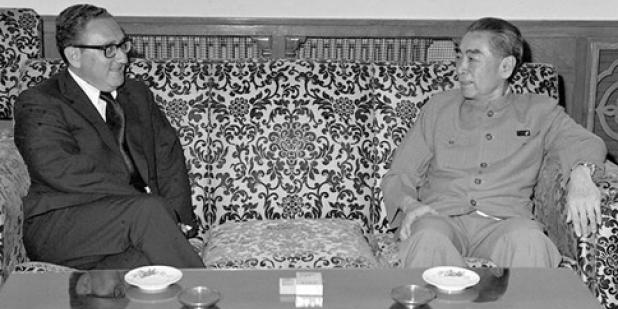
Phó Thủ tướng Đặng: Tối nay tôi mời ông dùng bữa tại Bắc Kinh.
Ngoại trưởng
Kissinger: Cảm ơn ông.
Phó Thủ tướng Đặng: Ông Bush đã từng thưởng thức món này rồi.
Đại sứ Bush: Ở cả Bắc Kinh và Quảng Châu!
Phó Thủ tướng Đặng: Nhưng ở Bắc Kinh thì có hai món ngon nhất. Một là Vịt
quay Bắc Kinh, và món kia là Lẩu.
Ngoại trưởng
Kissinger: Tôi chưa từng ăn lẩu
Bắc Kinh bao giờ. Tôi rất mong chờ được thưởng thức món này. Cảm ơn ông rất nhiều.
Ông nói là ăn tại nhà hàng phải không?
Phó Thủ tướng Đặng: Đúng vậy, ở bất cứ nơi nào khác thì món ăn cũng đều nhạt
nhẽo cả. [Trang 602]
Bộ trưởng Kissinger: Tôi chưa từng dùng bữa tại nhà hàng nào ở đây cả.
Phó Thủ tướng Đặng: Vậy tối nay chúng tôi xin mời ông đến một nhà hàng.
Bộ trưởng Kissinger: Ông biết không, tôi nhớ có lần nhận được cuộc gọi sau một
chuyến công du đến đây. Một nữ ca sĩ muốn biểu diễn tại hộp đêm [ở Bắc Kinh].
Tôi bảo cô ấy là ở đây không có hộp đêm nào cả. Cô ấy không thể tin được điều
đó. Giờ thì tôi chuyển những cuộc gọi kiểu này cho Đại sứ [Hoàng Trấn]. Ông ấy
thuyết phục họ rằng... không hề có nước Trung Quốc nào cả. [Cười]
Phó Thủ tướng Đặng: Chúng ta tiếp tục nhé? Chúng tôi muốn cảm ơn Tiến sĩ đã
kể cho chúng tôi nghe về các chuyến công du toàn cầu của ông—hay nói theo cách
của người Trung Quốc là về những chuyến "chu du khắp các vùng đất" của
ông.
Tôi xin tóm tắt ngắn
gọn quan điểm của chúng tôi về một số vấn đề. Tôi nghĩ vấn đề đầu tiên mà Tiến
sĩ quan tâm hẳn là Liên Xô và quan hệ Trung-Xô.
Bộ trưởng Kissinger: Tôi sẽ học theo cách của ông và nói rằng: tùy ông quyết
định. [Cười]
Phó Thủ tướng Đặng: Ông biết đấy, những bất đồng giữa Liên Xô và Trung Quốc
rất sâu sắc. Và ông cũng biết là sau khi rời Vladivostok, Brezhnev đã bay tới
Ulan Bator để dự lễ kỷ niệm ngày thành lập Cộng hòa Nhân dân Mông Cổ và có bài
phát biểu tại đó. Tôi đã đọc các bản tin báo chí—đoạn nói về quan hệ Trung-Xô,
và thấy ông ta có chút khoe khoang về những thỏa thuận mà ông và ông ta đã đạt
được tại Vladivostok.
Bộ trưởng Kissinger: Tôi đã giải thích những điều đó cho ông rồi mà.
Phó Thủ tướng Đặng: Ông ta vẫn lặp lại những luận điệu cũ về Trung Quốc và
Liên Xô. Điểm quan trọng nhất [trong số đó] là việc ông ta tuyên bố rằng giữa
Trung Quốc và Liên Xô không hề tồn tại tranh chấp biên giới nào. Và khi nói về
"khu vực tranh chấp", ông ta thậm chí không hề đề cập đến phần diện
tích lớn hơn—vốn rộng tới một triệu rưỡi km vuông. Ông ta chỉ nhắc đến những
khu vực nhỏ, nằm rải rác dọc theo biên giới. Như vậy, nội dung của cái gọi là
hiệp ước "không xâm lược" hay cam kết không sử dụng vũ lực thậm chí
còn không bao hàm được bản chất của vấn đề tranh chấp biên giới.
Bộ trưởng Kissinger: Phân tích của chúng tôi cũng giống như vậy. Tôi có để ý
thấy ông ta đã dành lời khen ngợi cho Bộ trưởng Ngoại giao. Điều này thì tôi
hoàn toàn tán thành.
Phó Thủ tướng Đặng: Ý ông là cái nào?
Bộ trưởng Kissinger Của họ, và của chúng ta! [Cười]
Phó Thủ tướng Đặng: Điều đó có nghĩa là chính vấn đề mà hai bên đang đàm
phán hoàn toàn không tồn tại. Điều đó cũng có nghĩa là thỏa thuận tạm thời mà
các Thủ tướng – hay nói cách khác là giữa hai nước chúng ta – đã đạt được vào
năm 1969, nay đã tan thành mây khói. Nó cũng đồng nghĩa với việc những lời họ
nói về việc cải thiện quan hệ chỉ là sáo rỗng. Tất nhiên, họ vẫn nói suông về
chuyện “cải thiện quan hệ”. Và trong suốt những năm qua, thái độ hay cách hành
xử của họ đã thể hiện qua nhiều khía cạnh và hình thức đa dạng, bao gồm cả việc
nhờ phía Cuba và Romania làm trung gian hòa giải. Tôi nhớ rằng Chủ tịch Mao đã
thảo luận vấn đề này với ông. Và ông cũng sẽ nhớ rằng Chủ tịch Mao đã đưa ra những
nhượng bộ mang tính lịch sử – những nhượng bộ của cả hai ngàn năm qua – và
tuyên bố rằng sẽ không có thêm bất kỳ sự nhượng bộ nào nữa.
Bộ trưởng Kissinger Chúng tôi sẽ giải thích điều đó cho Đại sứ của chúng
tôi. Chuyện này sẽ tiếp thêm cho ông ấy sự can đảm. (Ngoại trưởng lặng lẽ giải
thích câu chuyện cho Đại sứ Bush.)
Phó Thủ tướng Đặng: Như vậy, qua đó chúng ta có thể thấy rằng những bàn luận
gần đây về việc công khai bức điện tín mà chúng ta đã gửi cho Liên Xô nhân dịp...
...về Ngày Quốc khánh thì không hoàn toàn đúng với thực tế.
Bộ trưởng Kissinger: Ông công bố hay họ công bố?
Phó Thủ tướng Đặng: Chúng tôi không công bố. Nhưng họ đã lược bớt một phần
[trong văn bản tiếng Trung] khi họ công bố. Thực ra, trong bức điện, chúng tôi
có gửi lời chúc mừng và chỉ đưa vào nội dung thỏa thuận đã đạt được giữa hai Thủ
tướng vào năm 1969; chúng tôi chỉ đề cập đến cốt lõi của thỏa thuận đó: duy trì
nguyên trạng biên giới, ngăn chặn xung đột vũ trang và tránh va chạm tại biên
giới; đồng thời bao gồm cả những gì họ đề xuất về một thỏa thuận không xâm lược
và không sử dụng vũ lực.
Bộ trưởng Kissinger: Điều này là mới sao?
Phó Thủ tướng Đặng: Không mới. Đó cũng là một phần trong sự hiểu biết chung
từ năm 1969.
Bộ trưởng Kissinger: Nhưng nếu họ thành công, thì đó sẽ là hiệp ước không xâm
lược đầu tiên giữa các nước đồng minh.
Phó Thủ tướng Đặng: Các đề xuất của họ được đưa ra trong bối cảnh hiệp ước
vẫn còn hiệu lực—hiệp ước tương trợ lẫn nhau giữa chúng tôi vẫn còn hiệu lực.
Vì vậy, có vẻ như chính sách thù địch của Liên Xô đối với Trung Quốc vẫn không
thay đổi. Và tất nhiên, điều này không loại trừ khả năng họ sẽ dùng thêm các
chiêu trò khác, chẳng hạn như nhờ người này người kia đến làm trung gian hòa giải,
nhưng bản chất [của cuộc tranh chấp giữa Trung Quốc và Liên Xô] thì không thay
đổi. Các phương thức mà họ tiếp tục sử dụng là đe dọa quân sự và lật đổ. Họ
cũng sẽ tiếp tục các chiêu trò như hệ thống An ninh Tập thể Châu Á. Đó cũng là
điều đã được [Brezhnev] đề cập tại Ulan Bator.
Bộ trưởng Kissinger: Hình như ông ta đã thảo luận chuyện đó với Bhutto, nhưng
Bhutto đã từ chối. Brezhnev cũng đã thảo luận vấn đề này với Quốc vương Iran
(Shah) tại Moscow.
Phó Thủ tướng Đặng: Vẫn là cái điệp khúc cũ đó thôi. Những người khác có thể
tỏ ra ủng hộ ở mức độ nào đó, nhưng...
Bộ trưởng Kissinger: Quốc vương Iran sẽ không tán thành đâu.
Phó Thủ tướng Đặng: Chúng tôi cũng có cùng quan điểm đó. Ngay cả Ấn Độ cũng
không dám công khai chấp nhận nó. Thực ra, hệ thống An ninh Tập thể Châu Á, dù
trên danh nghĩa là nhắm vào Trung Quốc, nhưng thực chất lại nhằm mục đích chia
rẽ và kiểm soát các nước trong khu vực. Điều này cũng giống như [chiêu bài] Hội
nghị An ninh Châu Âu vậy. Mục đích là để giúp các lực lượng Liên Xô [tiếp cận] Ấn
Độ Dương và Thái Bình Dương. [Trang 604]
Bộ trưởng Kissinger: Tôi nghĩ đến thời điểm này thì phía Liên Xô... Hội nghị
An ninh Châu Âu thật nực cười. Nó không còn có thể đạt được bất kỳ kết quả đáng
kể nào nữa.
Phó Thủ tướng Đặng: Chủ tịch đã hỏi ông Heath khi ông ấy ở Trung Quốc rằng
liệu ông ấy có nghĩ Hội nghị An ninh Châu Âu sẽ thành công hay không. Ông ấy trả
lời rằng thay vì hỏi liệu nó có thành công hay không, người ta nên hỏi
"khi nào thì nó kết thúc?". Ông đánh giá thế nào về hội nghị này? Liệu
nó sẽ thành công, hay chỉ đơn thuần là kết thúc?
Bộ trưởng Kissinger: Nó không thể thành công được. Quan điểm của chúng tôi là
nó nên kết thúc. Chúng tôi cảm thấy rằng nếu nó cứ tiếp diễn, nó sẽ tạo ra ấn
tượng về sự thành công, điều không hề xác đáng. Cần phải tránh điều này. Sẽ
không có bất kỳ thỏa thuận thực chất nào cả. Họ đang thảo luận về các nguyên tắc—một
trong những vấn đề họ đang tranh luận là về việc thay đổi biên giới bằng biện
pháp hòa bình. Phía Liên Xô muốn khẳng định rằng biên giới là bất khả xâm phạm.
Phía Đức lại muốn nói rằng biên giới chỉ có thể thay đổi bằng các biện pháp hòa
bình.
Một vấn đề khác là
phía Liên Xô nói rằng tất cả các nguyên tắc cần được áp dụng một cách bình đẳng.
Phía Đức lại muốn nói rằng tất cả [các nguyên tắc] đều có giá trị ngang nhau.
Tôi đã cố gắng giải thích sự khác biệt [giữa hai cách diễn đạt này] cho Tổng thống,
nhưng chính bản thân tôi cũng không hiểu nổi. Đây là kiểu vấn đề mà họ đang thảo
luận tại Hội nghị An ninh lúc này.
Phó Thủ tướng Đặng: Với tôi thì chuyện này rất khó hiểu.
Bộ trưởng Kissinger: Chỉ thị dành cho các thành viên phái đoàn chúng tôi là
đứng ngoài những chuyện như vậy. Để hiểu được những điều này, người ta cần phải
có tư duy kiểu Đức hoặc kiểu Liên Xô.
Phó Thủ tướng Đặng: Có lẽ vào lúc này, người ta chỉ có thể viết về những điều
này bằng tiếng Đức mà thôi.
Bộ trưởng Kissinger:
Đúng vậy. Nhưng hiện tại không thể có kết cục nào được coi là thành công cả.
Ông không thể thay đổi lịch sử chỉ bằng những câu chữ trong một hiệp ước! Tuy
nhiên, tôi nghĩ nó sẽ kết thúc vào đầu năm sau.
Phó Thủ tướng Đặng:
Còn về mối đe dọa từ Liên Xô, như chúng tôi đã nói nhiều lần, chúng tôi không
quá bận tâm. Chúng tôi không cho rằng một triệu quân đó có thể gây ra hậu quả
gì lớn. Sức mạnh quân sự của Liên Xô ở phía Đông không chỉ nhằm vào Trung Quốc.
Nó cũng nhắm vào Nhật Bản và Hạm đội 7, cũng như lực lượng không quân và hải
quân của các ông chứ? Và nếu họ định tấn công Trung Quốc, như Chủ tịch đã thảo
luận [với ông], thì không thể nào chiếm được Trung Quốc chỉ với một triệu quân.
Họ sẽ phải tăng thêm một triệu quân nữa, và ngay cả như vậy cũng vẫn chưa đủ; bởi
vì nếu đã quyết tâm giao chiến với Trung Quốc, họ cũng phải xác định tư tưởng
là sẽ phải đánh trong suốt 20 năm. Người Trung Quốc không có đức tính gì quá đặc
biệt, nhưng họ lại có đức tính kiên nhẫn. [Trang 605]
Bộ trưởng Kissinger:
Họ còn có vài đức tính khác nữa.
Phó Thủ tướng Đặng:
Họ còn có cả chiến lược "gạo kê và súng trường" — và hệ thống đường hầm.
Bộ trưởng Kissinger:
Tôi chưa từng nhìn thấy những đường hầm đó.
Phó Thủ tướng Đặng:
Đại sứ Bush chưa làm việc này cho ông sao? Ông ấy đang trốn tránh trách nhiệm của
mình đấy.
Đại sứ Bush:
Chưa ạ. Tôi rất vui khi biết mình có thể gặp họ.
Phó Thủ tướng Đặng:
Lần tới, ông có thể viết báo cáo gửi Tiến sĩ về vấn đề các đường hầm.
Bộ trưởng Kissinger Đừng
khuyến khích ông ấy. Giữa ông ấy và vị Đại sứ tại Ấn Độ [Patrick Moynihan], tôi
chẳng còn việc gì khác ngoài việc đọc các bức điện tín—mặc dù vị Đại sứ tại Ấn
Độ lại công khai chúng trên báo chí.
Phó Thủ tướng Đặng:
Tình hình quan hệ giữa Liên Xô và Trung Quốc là như vậy. Còn về trọng tâm chiến
lược của Liên Xô, chúng tôi coi đó là chiêu bài "dương đông kích
tây"—tức là tấn công ở châu Âu. Việc chúng ta có quan điểm khác nhau cũng
không quan trọng, cứ chờ xem sự việc diễn biến thế nào đã.
Bộ trưởng Kissinger Tôi
nghĩ tình hình chiến lược là như nhau. Nếu họ tấn công ở phía Đông, đó sẽ là mối
đe dọa đối với phía Tây, và nếu họ tấn công ở phía Tây, đó sẽ là mối đe dọa đối
với phía Đông. Mối nguy hiểm là như nhau trong cả hai trường hợp. Chúng ta
không cần phải quyết định vấn đề này một cách trừu tượng.
Phó Thủ tướng Đặng:
Nhưng đánh giá chiến lược này cũng có khía cạnh thực tiễn, đặc biệt là đối với
các nước Tây Âu. Chúng ta đã nhiều lần trao đổi quan điểm về vấn đề này.
Bộ trưởng Kissinger Tôi
không tin rằng châu Âu có thể thờ ơ trước một cuộc tấn công ở phía Đông. Tôi
cũng không tin rằng các ông có thể thờ ơ trước một cuộc tấn công ở phía Tây.
Phó Thủ tướng Đặng:
Chúng tôi đồng ý với quan điểm này. Một cuộc tấn công ở bất kỳ hướng nào cũng đều
có ý nghĩa quan trọng đối với các khu vực khác. Tuy nhiên, việc xác định quan
điểm chiến lược và công tác chuẩn bị là vô cùng quan trọng, đặc biệt là đối với
các đồng minh của các ông ở châu Âu. Bởi vì nếu thiếu [những sự chuẩn bị này],
họ sẽ phải gánh chịu hậu quả. Khi chúng tôi nói trọng tâm nằm ở phía Tây, điều
đó không có nghĩa là chúng tôi sẽ bỏ bê việc phòng thủ của chính mình.
Bộ trưởng Kissinger Chúng
tôi đồng ý và cũng sẽ tăng cường công tác chuẩn bị của mình. Đáng tiếc là, như
ông đã biết, một số nhà lãnh đạo ở châu Âu hiện nay không hẳn là những người
dũng cảm nhất. Ông đã gặp họ và có thể tự đưa ra nhận định của mình. Nhưng
chúng tôi sẽ cố gắng hết sức.
Tôi xin nói thêm một chút về vấn đề dầu mỏ: Hoa Kỳ có
hai lựa chọn. Xét về mặt kinh tế, chúng ta có thể tự mình giải quyết vấn đề tốt
hơn là hợp tác với các bên khác. Tuy nhiên, lý do tôi đưa ra một số đề xuất và
kiến nghị cụ thể là vì tôi tin rằng nếu châu Âu tiếp tục chịu cảnh thâm hụt
cán cân thanh toán, họ sẽ mất niềm tin đến mức không thể chống lại áp lực từ
Liên Xô. Và nếu họ nhận tiền từ các quốc gia như Libya và Algeria, quá trình
suy giảm tinh thần chính trị của họ sẽ tiếp diễn. Vì vậy, ông cần hiểu rằng các
đề xuất tôi đưa ra cũng như các chính sách của chúng tôi không liên quan gì đến
những cân nhắc về kinh tế; xét về mặt kinh tế, chúng ta sẽ có lợi hơn nếu ký kết
các thỏa thuận song phương với Ả Rập Xê Út và mặc kệ châu Âu. Chúng ta làm điều
này vì cảm thấy rằng khả năng phòng thủ của phương Tây sẽ bị suy yếu nếu các quốc
gia này bị suy sụp tinh thần do tình trạng kinh tế của họ.
Phó Thủ tướng Đặng:
Vậy là chúng ta đã dành khá nhiều thời gian cho buổi sáng nay rồi. Chúng ta cần
phải ăn chút gì đó, nếu không thì "dạ dày sẽ làm cách mạng" mất.
Chúng ta sẽ gặp lại nhau lúc 3:30 chiều tại Đại lễ đường Nhân dân nhé? Tại
Phòng Nguyên thủy (Original Hall). Được chứ?
Bộ trưởng Kissinger:
Tôi không biết Phòng Nguyên thủy là phòng nào, nhưng chắc chắn sẽ có người dẫn
chúng ta đến đó.
Phó Thủ tướng Đặng:
Đó là Phòng Tân Cương (Sinkiang Room).
Bộ trưởng Kissinger:
Cảm ơn ông.
[Cuộc họp kết thúc lúc 12:20 trưa.]
1. Nguồn:
Thư viện Ford, Cố vấn An ninh Quốc gia, Các báo cáo của Kissinger về thảo luận
với Liên Xô, Trung Quốc và Trung Đông, Hộp 2, Các biên bản và báo cáo về Trung
Quốc, ngày 25–29 tháng 11 năm 1974, Chuyến công du của Kissinger. Tuyệt mật; Nhạy
cảm; Chỉ dành cho người có thẩm quyền xem (Exclusively Eyes Only). Cuộc họp diễn
ra tại Nhà khách Chính phủ số 18. Tất cả các phần trong ngoặc vuông đều có
trong văn bản gốc.↩
2. Tại
cuộc họp với Ford và Scowcroft vào ngày 11 tháng 11, Kissinger nói: "Chúng
ta sẽ phải kìm bước George Bush lại. Chúng ta cần giữ cho tình hình ở đó được
êm ả—ông ấy đang nói rằng chúng ta đã bỏ bê phía Trung Quốc." (Biên bản cuộc
trò chuyện, ngày 11 tháng 11; tài liệu đã dẫn, Các biên bản cuộc trò chuyện, Hộp
7, tháng 10–tháng 12 năm 1974)↩
Historical Documents - Office of the Historian
https://history.state.gov/historicaldocuments/frus1969-76v18/sources
https://history.state.gov/historicaldocuments/frus1969-76v18/terms
https://history.state.gov/historicaldocuments/frus1969-76v18/persons
https://history.state.gov/historicaldocuments/frus1969-76v18/comp1
Move Toward Normalization of Relations, October 1974–July 1975 (Documents 88–116)
https://history.state.gov/historicaldocuments/frus1969-76v18/ch3
1.
Document 96
Foreign Relations of the United States, 1969–1976, Volume
XVIII, China, 1973–1976
96.
Memorandum of Conversation1
Beijing, November 27, 1974, 11:40
a.m.–12:20 p.m.
PARTICIPANTS
· Teng
Hsiao-p’ing, Vice Premier of the State Council, People’s Republic of China
· Ch’iao
Kuan-hua, Minister of Foreign Affairs
· Ambassador
Huang Chen, Chief of the PRC Liaison Office, Washington
· Wang
Hai-jung, Vice Minister of Foreign Affairs
· T’ang
Wen-sheng, Deputy Director, Department of American and Oceanic Affairs,
Ministry of Foreign Affairs
· Tsien
Ta-yung, Counselor, PRC Liaison Office, Washington
· Ting
Yuan-hung, Director, United States Office, Department of American and Oceanic
Affairs, Ministry of Foreign Affairs
· Chang
Han-chih, Translator
· Lien
Cheng-pao, Notetaker
· Dr.
Henry A. Kissinger, Secretary of State and Assistant to the President for
National Security Affairs
· Ambassador
George Bush, Chief of the United States Liaison Office, Peking
· Ambassador
Robert Anderson, Special Assistant to the Secretary of State for Press
Relations
· Winston
Lord, Director, Policy Planning Staff, Department of State
· Philip
C. Habib, Assistant Secretary of State for East Asian and Pacific Affairs
· William
H. Gleysteen, Deputy Assistant Secretary of State for East Asian and Pacific
Affairs
· Richard
H. Solomon, Senior Staff Member, National Security Council
· Bonnie
Andrews, Notetaker
SUBJECT
· Sino-Soviet
Relations; Europe
Vice Premier Teng: This evening I invite you to a Peking
meal.
Secretary Kissinger: Thank you.
Vice Premier Teng: Mr. Bush has had it [this type of meal].
Ambassador Bush: In Peking and in Canton!
Vice Premier Teng: But Peking—there are two best meals
here. One is Peking Duck, and the other is the Hot Pot.
Secretary Kissinger: I have never had a Peking Hot Pot
before. I look forward to it very much. Thank you very much. Did you say in a
restaurant?
Vice Premier Teng: Yes, it is tasteless anywhere else.
Secretary Kissinger: I have never had a meal in a
restaurant here.
Vice Premier Teng: Then tonight we invite you to a
restaurant.
Secretary Kissinger: Yo? know I remember receiving a call
after one of my trips here. A singer wanted to perform in a night club [in
Peking]. I told her there were none. She couldn’t belive it. Now I turn these
calls over to the Ambassador [Huang Chen]. He convinces them there is no China.
[Laughter]
Vice Premier Teng: Shall we continue? We would like to
thank the Doctor for telling us about your global trips—or, to use a Chinese
phrase, about your “travels to various lands.”
I would like to give a brief summary of our understanding
of some issues. I should think the first matter that the Doctor would be
concerned about is the Soviet Union and Sino-Soviet relations.
Secretary Kissinger: I will adopt your method and say it is
up to you. [Laughter]
Vice Premier Teng: You know that the differences between
the Soviet Union and China are profound. And you know that after Brezhnev left
Vladivostok, he flew to Ulan Bator to attend the anniversary of the People’s
Republic of Mongolia, and he made a speech. I read the press reports—the part
relating to Sino-Soviet relations, and he was boasting a little about the
agreements you reached in Vladivostok.
Secretary Kissinger: I explained those to you.
Vice Premier Teng: He still repeated the old words about
China and the Soviet Union. The most important [of these] was that he said
between China and the Soviet Union there does not exist any border dispute. And
by “disputed area” he wasn’t even speaking of the larger part—the one and
one-half million kilometers. He only mentioned the smaller, spotted area along
the border. So the content of the so-called “non-aggression” treaty,
non-use-of-force, doesn’t even include the essence of the border dispute.
Secretary Kissinger: Our analysis is the same. I noticed he
praised the Foreign Minister. This I approve of highly.
Vice Premier Teng: Which one?
Secretary Kissinger: His, and ours! [Laughter]
Vice Premier Teng: That means that the very issue the two
sides are negotiating about doesn’t exist at all. That means also that the
provisional agreement reached by the Prime Ministers, reached between our two
countries in 1969, is gone with the wind. It also means that the words they
mouth about improvements in relations are all empty. Of course, they pay lip
service to “improving relations.” And over the years the postures they have
struck have many aspects, varied forms, including mediation by the Cubans and
the Romanians. I recall that Chairman Mao discussed this with you. And you will
also recall that [Page 603]Chairman Mao made the
concessions of 2,000 years and said that no further concession would be made.
Secretary Kissinger: We will explain that to our
Ambassador. It will give him courage. (The Secretary quietly explains the story
to Ambassador Bush.)
Vice Premier Teng: So we can see from that that the recent
talk about the publicization of the telegram we sent to the Soviet Union on its
National Day is not quite in accord with facts.
Secretary Kissinger: Did you publish it, or did they?
Vice Premier Teng: We did not. But they deleted a bit [from
the Chinese text] when they did. Actually, we put congratulations in the cable,
we put in just the content of the agreement reached between the two Premiers in
1969, we just mentioned the essence of the agreement between the two Premiers:
that we should maintain the status quo on the border; prevent armed conflict
and avoid clashes on the border; and it has what they put forward about an
agreement on non aggression and non-use-of-force.
Secretary Kissinger: This is new?
Vice Premier Teng: It is not new. It was also part of the
understanding of 1969.
Secretary Kissinger: But if they should succeed—it will be
the first such non-aggression treaty among allies.
Vice Premier Teng: Their proposals were put forward under
the circumstances that the treaty still exists, our treaty of mutual assistance
still exists. So it seems that the Soviet policy of hostility against China has
not changed. And, of course, this doesn’t exclude more tricks, such as asking
this person or that person to come and mediate, but it doesn’t change the
essence [of China’s dispute with the Soviets]. The methods that they continue
to use are military threat and subversion. And they will continue their tricks
such as the Asian Collective Security system. That also was something mentioned
[by Brezhnev] in Ulan Bator.
Secretary Kissinger: Apparently, he discussed that with
Bhutto, but he rejected it. Brezhnev also discussed it with the Shah in Moscow.
Vice Premier Teng: It was the same old theme. Others
expressed a certain degree of favor for it, but—
Secretary Kissinger: The Shah will not go along with it.
Vice Premier Teng: That is also our opinion. Even India
hasn’t dared to openly accept it. Actually the Asian Collective Security
system, although in name is directed against China, it is really aimed at
dividing and controlling the countries of the area. This is the same [tactic]
as the European Security Conference. It is to help Soviet forces [gain access]
into the Indian Ocean and Pacific.
Secretary Kissinger: I think by now the Soviets—the
European Security Conference is ridiculous. It can no longer achieve anything
significant.
Vice Premier Teng: And the Chairman asked Mr. Heath when he
was in China if he thought the European Security Conference would be a success.
He replied that rather than ask if it would be successful one should ask “when
will it be finished?” What is your assessment of the conference? Will it be a
success, or will it be concluded?
Secretary Kissinger: It cannot be a success. Our view is
that it should be concluded. We feel that if it goes on it will create the
impression of success, which is not warranted. This should be avoided. There
will be no substantive agreement of any kind. They are discussing
principles—one of the issues they are now debating is about the peaceful change
of frontiers. The Soviets want to say that frontiers are inviolable. The
Germans want to say that frontiers can be changed only by peaceful means.
The other issue is that the Soviets say that all principles
should be equally applied. The Germans want to say that all [principles] have
equal validity. I have tried to explain the difference [between these two
formulations] to the President, but I do not understand it myself. This is the
sort of thing they are discussing at the Security Conference right now.
Vice Premier Teng: It is very confusing to me.
Secretary Kissinger: The instructions to the members of our
delegation are to stay out of such things. For this, one must have a German or
Soviet mind.
Vice Premier Teng: One can probably only write this now in
German.
Secretary Kissinger: That is right. But there is no
possible conclusion now that can be called a success. You cannot change history
by sentences in a treaty! However, I think it will be finished in the early
part of next year.
Vice Premier Teng: As for the Soviet threat, as we have
said many times, we don’t pay much attention. We don’t think those one million
troops can be of much consequence. The Soviet military strength in the East is
not just directed against China. It is also directed against Japan and your
Seventh Fleet, your air and naval force?. And if they are going to attack
China, as the Chairman has discussed [with you], it will be impossible to take
over China with just one million troops. They will have to increase their
troops by one million, and even that would not be sufficient because if they
are going to make up their minds to fight with China, they will have to make up
their minds to fight for 20 years. The Chinese have no great virtue, but they
do have [the virtue of] patience.
Secretary Kissinger: They have a few other virtues.
Vice Premier Teng: They also have “millet plus rifles”—and
tunnels.
Secretary Kissinger: I have never seen the tunnels.
Vice Premier Teng: Hasn’t Ambassador Bush done this for
you? He is shirking his responsibilities.
Ambassador Bush: Not yet. I am delighted to know that I can
see them.
Vice Premier Teng: The next time you can write a report to
the Doctor about the tunnels.
Secretary Kissinger: Don’t encourage him.2
Between him and the Ambassador in India [Patrick Moynihan] I have nothing to do
but read cables—although the Ambassador in India publishes his in the
newspapers.
Vice Premier Teng: So that is the order of relations
between the Soviet Union and China. As for the strategic emphasis of the Soviet
Union, we see it as “a feint toward the East to attack in the West”—to attack
in Europe. It doesn’t matter if we have different views, we can see what
happens.
Secretary Kissinger: I think the strategic situation is the
same. If they attack in the East it will be a threat to the West, and if they
attack in the West it will be a threat to the East. The danger is the same
either way. We don’t need to decide this abstractly.
Vice Premier Teng: But this strategic assessment has its
practical side, especially with the Western European countries. We have
exchanged views on this many times.
Secretary Kissinger: I don’t believe Europe could be
indifferent to an attack in the East. I don’t believe you could be indifferent
to an attack in the West.
Vice Premier Teng: We agree to this view. An attack in any
quarter is of significance to other areas too. But to establish a strategic
point of view and preparations will be of significant importance, especially to
your allies in Europe. Because without [these preparations], they will suffer.
When we say the emphasis is in the West, it does not mean we will ignore our
own defenses.
Secretary Kissinger: We agree, and we will add to our
preparations too. Unfortunately, as you know, some of the leaders in Europe are
not [Page 606]the most heroic right
now. You have met them and can form your own opinions. But we will do our best.
I might add something about the oil problem: The U.S. has
two options. Economically, we can deal with the problem on our own better than
in cooperation with others. But the reason I have made several specific
suggestions and proposals is because I believe if Europe continues to suffer a
balance of payments drain, they will lose so much confidence that they will not
be able to resist Soviet pressures. And if they take money from countries like
Libya and Algeria, this will continue the process of their political
demoralization. So you should understand that the proposals I have made, and
our policies, have nothing to do with economic considerations, because
economically we would be better off making bilateral agreements with the
Saudis, and we could leave Europe alone. We do this because we feel the defense
of the West will be weakened if these countries are demoralized by their
economic condition.
Vice Premier Teng: So, I think we spent quite a lot of time
this morning. We must have something to eat, otherwise our stomachs will make
revolution. Shall we meet again at 3:30 p.m. in the Great Hall of the People?
In the Original Hall. All right?
Secretary Kissinger: I don’t know what the Original Hall
is, but I am sure someone will take us there.
Vice Premier Teng: It is the Sinkiang Room.
Secretary Kissinger: Thank you.
[The meeting adjourned at 12:20 p.m.]
1.
Source: Ford Library, National Security Adviser, Kissinger
Reports on USSR, China, and Middle East Discussions, Box 2, China Memcons and
Reports, November 25–29, 1974, Kissinger’s Trip. Top Secret; Sensitive;
Exclusively Eyes Only. The meeting took place at Government Guest House 18. All
brackets are in the original.↩
2.
At a meeting with Ford and Scowcroft on November 11,
Kissinger said, “We will have to slow George Bush down. We need to keep things
quiet there—he is saying we have been neglecting the Chinese.” (Memorandum of
conversation, November 11; ibid., Memoranda of Conversation, Box 7,
October–December 1974)↩
https://history.state.gov/historicaldocuments/frus1969-76v18/d96
https://history.state.gov/historicaldocuments/frus1969-76v18/pg_602
https://history.state.gov/historicaldocuments/frus1969-76v18/pg_603
https://history.state.gov/historicaldocuments/frus1969-76v18/pg_604
https://history.state.gov/historicaldocuments/frus1969-76v18/pg_605
https://history.state.gov/historicaldocuments/frus1969-76v18/pg_606
Thân thế (các) nhân vật
General Secretary of the Communist Party of
the Soviet Union
https://en.wikipedia.org/wiki/Leonid_Brezhnev
https://www.britannica.com/biography/Leonid-Ilich-Brezhnev
https://en.wikipedia.org/wiki/General_Secretary_of_the_Communist_Party_of_the_Soviet_Union
https://www.britannica.com/place/Soviet-Union/The-Brezhnev-era
Bush George H W.,
Head of the U.S. Liaison Office in Beijing from October 21, 1974,
until December 7, 1975
https://en.wikipedia.org/wiki/George_H._W._Bush
https://en.wikipedia.org/wiki/President_of_the_United_States
https://en.wikipedia.org/wiki/Vice_President_of_the_United_States
https://en.wikipedia.org/wiki/Director_of_Central_Intelligence
https://en.wikipedia.org/wiki/Chief_of_the_U.S._Liaison_Office_to_the_People%27s_Republic_of_China
https://en.wikipedia.org/wiki/Republican_National_Committee
https://en.wikipedia.org/wiki/United_States_Ambassador_to_the_United_Nations
https://en.wikipedia.org/wiki/United_States_House_of_Representatives
https://history.state.gov/departmenthistory/people/chiefsofmission/china
https://www.state.gov/biographies-list/
https://www.state.gov/resources-bureau-of-global-talent-management/#ambassadors
https://www.cnn.com/2018/12/01/asia/george-h-w-bush-china-intl/index.html
https://en.wikipedia.org/wiki/List_of_ambassadors_of_the_United_States_to_China
https://www.chinadaily.com.cn/china/09usofficials/2009-05/31/content_7956346.htm
https://bush41library.tamu.edu/audiovisual/photos/35
Deng Xiaoping (Teng Hsiao-p’ing),
Vice Premier of State Council after 1973
https://en.wikipedia.org/wiki/Deng_Xiaoping
https://www.britannica.com/biography/Deng-Xiaoping
https://www.britannica.com/summary/Deng-Xiaoping
https://www.ebsco.com/research-starters/history/deng-xiaoping
http://www.cppcc.gov.cn/zxww/2012/07/03/ARTI1341300716750109.shtml
https://www.encyclopedia.com/people/history/chinese-and-taiwanese-history-biographies/deng-xiaoping
https://simple.wikipedia.org/wiki/Deng_Xiaoping
Ford, Gerald R.,
Republican Representative from Michigan until October 13, 1973; House
Minority Leader until October 13, 1973; Vice President of the United States
from October 13, 1973, until August 8, 1974; President of the United States
from August 8, 1974
https://en.wikipedia.org/wiki/Gerald_Ford
https://en.wikipedia.org/wiki/President_of_the_United_States
https://en.wikipedia.org/wiki/Vice_President_of_the_United_States
https://en.wikipedia.org/wiki/House_Minority_Leader
https://en.wikipedia.org/wiki/Leader_of_the_House_Republican_Conference
https://en.wikipedia.org/wiki/Chair_of_the_House_Republican_Conference
https://en.wikipedia.org/wiki/United_States_House_of_Representatives
https://www.whitehouse.gov/about-the-white-house/presidents/gerald-r-ford/
https://www.whitehouse.gov/administration/
https://geraldrfordfoundation.org/gerald-r-ford-biography/
https://www.fordlibrarymuseum.gov/grf/timeline.asp
https://en.wikipedia.org/wiki/Presidency_of_Gerald_Ford
https://www.fordlibrarymuseum.gov/library/guides/findingaid/ford_vp_papers.asp
Gleysteen, William H., Jr.,
Deputy Director, Office of United Nations Political Affairs, Bureau of
International Organization Affairs, Department of State, from August 1966
https://en.wikipedia.org/wiki/William_H._Gleysteen
https://en.wikipedia.org/wiki/United_States_Ambassador_to_South_Korea
https://adst.org/OH%20TOCs/Gleysteen,%20William%20H.,%20Jr.toc.pdf
member, U.S. Delegation to the Paris Peace
Talks from May 1968 until October 1971; Ambassador to Korea from September 30,
1971, until August 19, 1974; Assistant Secretary of State for East Asian and
Pacific Affairs from September 27, 1974
https://en.wikipedia.org/wiki/Philip_C._Habib
https://en.wikipedia.org/wiki/Under_Secretary_of_State_for_Political_Affairs
https://en.wikipedia.org/wiki/Assistant_Secretary_of_State_for_East_Asian_and_Pacific_Affairs
https://en.wikipedia.org/wiki/United_States_Ambassador_to_Korea
https://diplomacy.state.gov/u-s-diplomact-philip-c-habib-presidential-medal-of-freedom-winner/
https://nsuworks.nova.edu/nsudigital_forums/13/
https://www.arabamerica.com/arabamericans/philip-habib-3/
https://www.britannica.com/biography/Philip-Charles-Habib
Heath, Edward,
British Prime Minister until March 4, 1974
https://en.wikipedia.org/wiki/Prime_Minister_of_the_United_Kingdom
https://en.wikipedia.org/wiki/Leader_of_the_Opposition_(United_Kingdom)
https://en.wikipedia.org/wiki/Leader_of_the_Conservative_Party_(UK)
https://simple.wikipedia.org/wiki/Edward_Heath
https://www.gov.uk/government/history/past-prime-ministers/edward-heath
https://history.blog.gov.uk/2014/02/28/hung-parliament-february-1974/
https://www.theguardian.com/politics/2010/may/04/1974-hung-parliament-edward-heath
Huang Zhen (Huang Chen),
PRC Ambassador to France until March 1973; Chief of the PRC Liaison
Office in the United States from March 1973
https://en.wikipedia.org/wiki/Huang_Zhen
https://en.wikisource.org/wiki/Author:Huang_Zhen
https://2001-2009.state.gov/documents/organization/72591.pdf
https://nsarchive2.gwu.edu/NSAEBB/NSAEBB79/BEBB23.pdf
https://www.fordlibrarymuseum.gov/sites/default/files/2024-06/1552743.pdf
https://www.britishpathe.com/asset/236303/
https://mediaclip.ina.fr/en/caf97507056-credentials-huang-chen-at-the-elysee.html
https://history.state.gov/historicaldocuments/frus1969-76ve13/d12
Henry A Kissinger
Assistant to the President for National Security Affairs until
November 3, 1975; also Secretary of State from September 21, 1973
https://www.theguardian.com/world/2023/may/20/bilderberg-meeting-group-lisbon-kissinger
https://www.theguardian.com/world/bilderberg
https://history.state.gov/historicaldocuments/frus1969-76ve13/summary
https://china.usc.edu/getting-beijing-henry-kissingers-secret-1971-trip
https://china.usc.edu/catalog/documents/us-china
http://www.archives.gov/press/press-releases/2001/nr01-47.html
https://china.usc.edu/talking-points-july-22-august-3-2011
https://china.usc.edu/getting-beijing-henry-kissingers-secret-1971-trip#meetings
https://china.usc.edu/getting-beijing-henry-kissingers-secret-1971-trip#nixon-announcement
https://china.usc.edu/getting-beijing-henry-kissingers-secret-1971-trip#chinese-accept
https://china.usc.edu/getting-beijing-henry-kissingers-secret-1971-trip#signals
https://china.usc.edu/getting-beijing-henry-kissingers-secret-1971-trip#the_aim
http://www.foreignaffairs.com/articles/23927/richard-m-nixon/asia-after-viet-nam
https://history.state.gov/historicaldocuments/frus1969-76v17/d4
https://history.state.gov/historicaldocuments/frus1969-76v17/d12
https://history.state.gov/historicaldocuments/frus1969-76v17/d13
https://history.state.gov/historicaldocuments/frus1969-76v17/d141
https://2001-2009.state.gov/documents/organization/100324.pdf
https://en.wikipedia.org/wiki/Henry_Kissinger_and_the_Vietnam_War
Lesson in Vietnam from
Kissinger to Nixon: “when we made it “our war” we would not let
the South Vietnamese fight it; when it again became “their war”, we would not
help them fight it.”
(We
also had trouble with excesses here: when we
made it “our war” we would not let the South Vietnamese fight it; when it again
became “their war,” we would not help them fight it. Ironically, we
prepared the South Vietnamese for main force warfare after 1954 (anticipating another Korean-type attack), and they faced a political war; they had prepared
themselves for political warfare after 1973 only to be faced with a main force
invasion 20 years after it had been expected.)
https://history.state.gov/historicaldocuments/frus1969-76v10/d280
Lesson of Vietnam May 12 1975 by Henry A. Kissinger
https://www.fordlibrarymuseum.gov/library/exhibits/vietnam/032400091-002.pdf
https://thebattleofkontum.com/extras/kissinger.html
“Richard M. Nixon and Kissinger on 3 August 1972,” Conversation 760-006,
Presidential Recordings Digital Edition [Fatal Politics, ed. Ken Huges]
(Charlottesville: University of Virginia Press, 2014-). URL:https://prde.upress.virginia.edu/conversations/4006748
https://player.vimeo.com/video/889937807?h=e44572c8f3&color=e57200&title=0&byline=0&portrait=0
https://player.vimeo.com/video/889937807?h=e44572c8f3&color=e57200&title=0&byline=0&portrait=0
Discover the Truth at:
https://www.theblackvault.com/documentarchive/the-cias-vietnam-document-cd-rom/
The secret life of Henry
Kissinger minutes of a 1975 meeting with Lawrence Eagleburger
https://etan.org/news/kissinger/secret.htm
Henry Kissinger and the Truth About Negotiations In Vietnam
https://www.youtube.com/watch?v=Z5fxxKVfX5g
Henry Kissinger - Secrets of a superpower | DW Documentary
https://www.youtube.com/watch?v=bWVMTKeAwlA
The Untold Truth of Henry Kissinger
https://www.youtube.com/watch?v=0iheZdvWdbI&t=1s
Was Henry Kissinger a War Criminal?
https://www.youtube.com/watch?v=COqq7862wcU&t=25s
Lord, Winston,
member, National Security Council staff until 1973; Director of the
Policy Planning Staff, Department of State from October 1973 until January 1977
https://en.wikipedia.org/wiki/Winston_Lord
https://en.wikipedia.org/wiki/Assistant_Secretary_of_State_for_East_Asian_and_Pacific_Affairs
https://en.wikipedia.org/wiki/List_of_ambassadors_of_the_United_States_to_China
https://en.wikipedia.org/wiki/Council_on_Foreign_Relations
https://en.wikipedia.org/wiki/Director_of_Policy_Planning
https://www.brookings.edu/wp-content/uploads/2016/07/19981208.pdf
https://www.brookings.edu/wp-content/uploads/2016/07/19991104.pdf
https://nsarchive.gwu.edu/document/22669-document-04-winston-lord-director-policy
https://www.ncafp.org/about-us/faps-board-of-advisors/ambassador-winston-lord/
Chiao Kuan-hua, (Qiao
Guanhua)
Vice Foreign Minister, People’s Republic of China
https://en.wikipedia.org/wiki/Qiao_Guanhua
https://history.state.gov/historicaldocuments/frus1969-76ve13/d124
https://www.marxists.org/subject/china/china-reconstructs/1974/CR1974-12-Sup.pdf
SYND 25-11-71 CHINESE DELEGATE CHIAO KUAN HUA SPEAKS ABOUT DISARMAMENT
AT THE UN
https://www.youtube.com/watch?v=bjnyWtitbrg
General, USAF, Military Assistant to the
President until 1973; Deputy Assistant to the President for National Security
Affairs from August 1973 until 1975
https://warontherocks.com/2020/08/brent-scowcroft-and-american-military-intervention/
https://warontherocks.com/2020/08/blame-it-on-the-blob-how-to-evaluate-american-grand-strategy/
https://www.aspeninstitute.org/programs/aspen-strategy-group/about-asg/
https://www.whitehouse.gov/piab/
https://www.publicaffairsbooks.com/titles/bartholomew-sparrow/the-strategist/9781586489632/
http://web1.millercenter.org/poh/transcripts/ohp_1999_1112_scowcroft.pdf
https://www.nytimes.com/2020/08/12/us/politics/brent-scowcroft.html
https://www.foreignaffairs.com/articles/united-states/2020-08-13/scowcroft-model
https://archive.org/stream/towercommission00unit?ref=ol#mode/2up
https://www.twelvebooks.com/titles/philip-zelikow/to-build-a-better-world/9781538764688/
https://yalebooks.yale.edu/book/9780300233827/post-wall-post-square
https://yalebooks.yale.edu/book/9780300233827/post-wall-post-square
https://www.simonandschuster.com/books/War-in-a-Time-of-Peace/David-Halberstam/9781501141508
https://www.adst.org/OH%20TOCs/Inderfurth,Karl%20F.toc.pdf
https://www.wsj.com/articles/SB1029371773228069195
https://www.nytimes.com/2002/08/25/opinion/the-right-way-to-change-a-regime.html
https://www.penguinrandomhouse.com/books/592622/to-start-a-war-by-robert-draper/
https://pdfs.semanticscholar.org/de9b/be3fa428073b76a05fbb58739bf3279c3664.pdf
https://www.ft.com/content/de843f6e-0be1-4667-8a9f-f397cf840e72
https://www.houseofnames.com/brent-family-crest
https://www.houseofnames.com/dpreview/BRENT/EN/Brent/family-crest-coat-of-arms.png
https://www.houseofnames.com/cdn/webp/i/prod/520x520/surnamecomplete_gold.webp
https://www.aspeninstitute.org/programs/aspen-strategy-group/lt-general-brent-scowcroft/
https://dpaa-mil.sites.crmforce.mil/dpaaProfile?id=a0Jt000000sxxIFEAY
https://www.fordlibrarymuseum.gov/library/document/0204/7505562.pdf
https://news.virginia.edu/content/uvas-miller-center-releases-secret-brent-scowcroft-oral-history
Solomon, Richard H.,
member, National Security Council
staff
https://en.wikipedia.org/wiki/Richard_H._Solomon
https://www.academyofdiplomacy.org/members-1/solomon/richard-h.
https://carnegiecouncil.org/people/richard-h-solomon
https://www.c-span.org/person/richard-h-solomon/9004/
https://www.chinafile.com/contributors/richard-h-solomon
https://findingaids.lib.umich.edu/catalog/umich-bhl-2008034
https://www.presidency.ucsb.edu/documents/nomination-richard-h-solomon-be-assistant-secretary-state


No comments:
Post a Comment