20260901 CDTL NRM D63 19 November 1973 63. Biên bản cuộc họp nội bộ của Ngoại trưởng Kissinger.
https://history.state.gov/historicaldocuments/frus1969-76v18/d63
Google Translated
Tài liệu 63
Quan hệ đối ngoại của Hoa Kỳ, 1969–1976, Tập
XVIII, Trung Quốc, 1973–1976
63. Biên bản cuộc họp nội bộ của Ngoại trưởng
Kissinger.
Washington, ngày 19 tháng 11 năm 1973, 12:05 chiều
[Những bình luận không liên quan đến Tầu cộng
đã được lược bỏ.]
[Bộ trưởng Kissinger:] Giờ thì—nói về Tầu
cộng.
Báo chí đưa tin rằng chúng tôi đến Tầu cộng
để thiết lập quan hệ ngoại giao và rằng chúng tôi đã không đạt được mục tiêu
đó. Điều này hoàn toàn vô lý. Thiết lập quan hệ ngoại giao với Tầu cộng
là điều cuối cùng mà chúng tôi muốn thực hiện vào lúc này. Đất nước chúng ta hiện
đang có thừa những vấn đề gây tranh cãi trong nước rồi. Vì vậy, việc dàn xếp mối
quan hệ giữa Đài Loan, Bắc Kinh và Hoa Kỳ là điều hoàn toàn không nằm
trong ý định của chúng tôi khi đến Tầu cộng.
Trước hết, quan hệ ngoại giao với Tầu cộng chỉ
là vấn đề hình thức. Thông qua các văn phòng liên lạc và những cuộc trao đổi định
kỳ, mối quan hệ của chúng tôi với phía Tầu cộng còn sâu sắc và
toàn diện hơn so với quan hệ của chúng tôi với hầu hết các chính phủ mà chúng
ta đã có quan hệ ngoại giao chính thức. Tôi không thấy có bất kỳ thiếu sót nào
trong quan hệ với Tầu cộng do việc chưa thiết lập quan hệ ngoại
giao chính thức gây ra. Do đó, vấn đề quan hệ ngoại giao chính thức chưa bao giờ
được đề cập đến trong các cuộc thảo luận.
Mục đích của cuộc thảo luận, trước hết, là để trao đổi—thực
ra, về phía mình, chúng tôi chỉ làm việc với ba nhân vật: Mao Trạch Đông,
Chu Ân Lai và Sài Thành Văn (Chai Cheng-wen). Chưa có
quan chức cấp cao nào của Mỹ làm việc với bất kỳ nhân vật có thẩm quyền
nào khác ngoài ba người đó.
Do đó, điều cốt yếu là chúng ta cần gặp gỡ họ định kỳ
để thực hiện kiểu rà soát về mặt quan điểm mà phía Tầu cộng coi
trọng; qua đó, chúng ta nhận thấy những cam kết của họ trong quá khứ hoàn toàn
đáng tin cậy—nghĩa là chúng ta có thể hoàn toàn tin tưởng rằng những gì họ
tuyên bố tại các cuộc họp này sẽ được họ thực hiện trong khoảng thời gian sáu
tháng hoặc một năm sau đó.
Vì vậy, mục đích của cuộc gặp là để đánh giá tình
hình quốc tế dựa trên những sự kiện diễn ra kể từ lần gặp trước. Thứ hai là
để duy trì đà phát triển trong quan hệ song phương, xét cả về mặt biểu tượng lẫn
thực chất.
Tôi khuyến khích bất kỳ ai quan tâm hãy so sánh Thông
cáo Thượng Hải với bản thông cáo được công bố vào tuần trước. Tuy
nhiên, vì nhiều lý do, chúng tôi không muốn thu hút quá nhiều sự chú ý của báo
chí vào những điểm khác biệt giữa Thông cáo Thượng Hải và [Trang 443] bản
thông cáo này, bởi chúng tôi không muốn dính líu hoặc gây thêm xáo trộn cho Moscow
so với những gì đã xảy ra trong vài tuần gần đây. Tôi tin rằng nếu so sánh
các đoạn quan trọng của Thông cáo Thượng Hải với các đoạn tương ứng
trong bản thông cáo này, quý vị sẽ thấy một bước tiến về ưu thế ở hầu hết các
khía cạnh cốt yếu.
Các mục tiêu chung trong Thông cáo Thượng Hải chỉ
giới hạn ở khu vực Đông Bắc Thái Bình Dương. Trong bản thông cáo
này, phạm vi đó đã được mở rộng ra quy mô toàn cầu. Tại Thông cáo Thượng
Hải, chúng ta chỉ đề cập đến việc tham vấn một cách chung chung; còn trong
bản thông cáo này, chúng ta nói về các cuộc trao đổi cấp cao có thẩm quyền và
các cuộc tham vấn cụ thể. Ngoài ra, lập trường của Tầu cộng cũng
có sự thay đổi lớn về vấn đề công nhận ngoại giao: trước đây, họ đặt ra
hàng loạt điều kiện rất cụ thể cho việc này, nhưng trong bản thông cáo hiện tại,
họ chỉ yêu cầu sự chấp nhận nguyên tắc "một nước Tầu cộng ".
Về căn bản, chúng tôi đã đi xa hơn những gì tôi thực sự
nghĩ trong chuyến đi này. Và chúng tôi đã đi đến mức tối đa có thể, xét đến
tình hình quốc tế và tình hình trong nước.
[Những bình luận không liên quan đến Tầu cộng đã
được lược bỏ.]
Về vấn đề Tầu cộng, chính sách đó về căn
bản đang đi đúng hướng. Nhưng chúng ta đã thiết lập nó với hai nhà lãnh đạo lớn
tuổi, và chúng ta hoàn toàn không biết bất kỳ ai khác ở Tầu cộng nghĩ
gì về điều đó, ngoại trừ việc những yêu cầu của vị trí của họ sẽ thúc đẩy họ
theo đuổi hướng đi hiện tại, mặc dù liệu những người kế nhiệm có kỹ năng chiến
thuật đó hay không thì vẫn chưa rõ.
[Những bình luận không liên quan đến Tầu cộng đã
được lược bỏ.]
1. Nguồn:
Cơ quan Lưu trữ Quốc gia, RG 59, Bản ghi chép các cuộc họp của ban tham
mưu Ngoại trưởng Kissinger, 1973–1977, Mục 5177, Hộp 1, Các cuộc họp của
ban tham mưu Ngoại trưởng. Mật. Kissinger chủ trì cuộc họp với sự tham dự
của tất cả các quan chức chủ chốt của Bộ hoặc người được ủy quyền thay thế họ.↩
2. Người
ghi chép không chắc chắn về cái tên thứ ba mà Kissinger đã nhắc đến. Nhiều
khả năng Kissinger đang đề cập đến Kiều Quán Hoa (Qiao Guanhua).↩
https://history.state.gov/historicaldocuments/frus1969-76v18/sources
https://history.state.gov/historicaldocuments/frus1969-76v18/terms
https://history.state.gov/historicaldocuments/frus1969-76v18/persons
https://history.state.gov/historicaldocuments/frus1969-76v18/comp1
Political Turmoil in the United States, June 1973–September
1974 (Documents 35–87)
https://history.state.gov/historicaldocuments/frus1969-76v18/ch2
1.
Document 63
Foreign Relations of the United
States, 1969–1976, Volume XVIII, China, 1973–1976
63. Minutes of Secretary of State
Kissinger’s Staff Meeting1
Washington, November
19, 1973, 12:05 p.m.
[Omitted here are comments unrelated to China.]
[Secretary Kissinger:] Now—about China.
The newspapers report that we came to China in order to establish
diplomatic relations, and that we did not achieve that objective. That is total
nonsense. The last thing we could afford at this moment is diplomatic relations
with China. It is not that we are short of domestic debates at this moment in
this country. So that the absolutely last thing we attempted to do in China is
to settle the relationship between Taiwan, Peking and the United States.
First of all, the diplomatic relations with China are a surface
phenomenon. Between the liaison offices and these periodic exchanges, our
relations with the Chinese are fuller than with most governments in the world
with which we do have diplomatic relations. I can think of nothing that we are
missing in our relations with the Chinese as a result of not having formal
diplomatic relations. So that at no stage in the discussion did the issue of
formal diplomatic relations come up.
The purpose of the discussion was, first, to exchange—well, as far as we
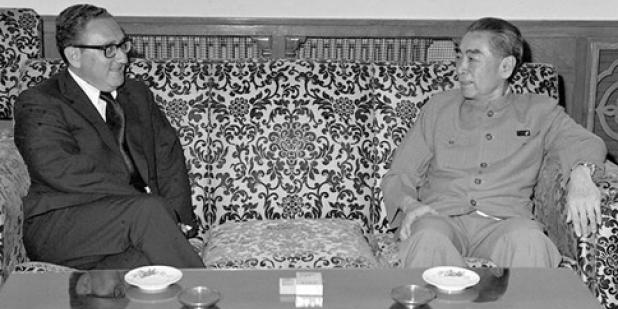
are concerned, we have dealt only with three men; with Mao, Chou and Chai
Cheng-wen (?).2 No senior American has ever dealt
with any authoritative person other than those three.
It is therefore essential that we meet with them periodically for the
sort of conceptual review that the Chinese appreciate, and in which we have
found their assurances in the past absolutely reliable—that what they say at
these meetings they will do over a six-month period or a year’s period, we have
found one could absolutely rely upon.
So the purpose was to review the international situation in the light of
events since our last meeting. Secondly, to maintain the momentum in our
relationships, both symbolically and substantively.
I would urge any of you who are interested to compare the Shanghai
Communiqué with the communiqué that was published last week. Now, for a variety
of reasons we were not eager to get too much press attention to the differences
between the Shanghai Communiqué and [Page 443] this communiqué,
because we did not want to get involved or we didn’t want to shake up Moscow
more than has already been the case in recent weeks. I think if you take the
key paragraphs of the Shanghai Communiqué and the key paragraphs of this
communiqué, you will see a qualitative advance in almost every essential
category.
The common objectives in the Shanghai Communiqué were confined to the
Northeast Pacific. In this communiqué, they were extended to a global basis. In
the Shanghai Communiqué we talked in a general way about consultations. In this
one we talked about authoritative exchanges and concrete consultations. And
there was a major change in the Chinese position with respect to diplomatic
recognition, which in the past they have made dependent on a whole series of
very concrete conditions, and which in this communiqué they made dependent only
on the acceptance of one China.
So essentially we went further than I actually thought we would go on
this trip. And we went to the absolute maximum of where we could go, given the
international situation and given our domestic situation.
[Omitted here are comments unrelated to China.]
With respect to China, that policy is essentially on a good track. But we
have established it with two aged leaders, and we have absolutely no clue as to
what anyone else in China thinks about it, except that the necessities of their
position would tend to drive them in the direction that they are now pursuing,
although whether successors will have the tactical skill is not so clear.
[Omitted here are comments unrelated to China.]
1. Source: National
Archives, RG 59, Transcripts of Secretary of State Kissinger’s Staff Meetings,
1973–1977, Entry 5177, Box 1, Secretary’s Staff Meetings. Secret. Kissinger
chaired the meeting, which was attended by all the principal officers of the
Department or their designated alternates.↩
2. The notetaker was
unsure of the third name that Kissinger mentioned. Kissinger was likely
referring to Qiao Guanhua.↩
https://history.state.gov/historicaldocuments/frus1969-76v18/d63
https://history.state.gov/historicaldocuments/frus1969-76v18/pg_443
Thân thế (các) nhân vật
Chou En-lai, (Zhou Enlai)
Premier of the People’s Republic of China; member, Standing Committee of
the Chinese Communist Party’s Political Bureau
https://en.wikipedia.org/wiki/Zhou_Enlai
https://en.wikipedia.org/wiki/Premier_of_the_People%27s_Republic_of_China
https://en.wikipedia.org/wiki/Minister_of_Foreign_Affairs_of_the_People%27s_Republic_of_China
https://en.wikipedia.org/wiki/Vice_Chairman_of_the_Chinese_Communist_Party
https://en.wikipedia.org/wiki/Vice_Chairman_of_the_Chinese_Communist_Party
https://en.wikipedia.org/wiki/Chairman_of_the_Chinese_People%27s_Political_Consultative_Conference
https://history.state.gov/historicaldocuments/frus1969-76v17/d139
https://digitalarchive.wilsoncenter.org/document/zhou-enlai-talking-ho-chi-minh
https://digitalarchive.wilsoncenter.org/search?f[0]=topics:86538&fo[0]=86538
Tài liệu Chu Ân Lai yêu cầu Hoa Kỳ loại bỏ Tổng Thống Nguyễn Văn Thiệu
và dùng Dương Văn Minh để lật đổ hai nền Đệ I và Đệ II VNCH.
https://digitalarchive.wilsoncenter.org/document/discussion-between-zhou-enlai-and-le-duc-tho
https://digitalarchive.wilsoncenter.org/document/89367/download
Henry A Kissinger
Assistant to the President for National Security Affairs until
November 3, 1975; also Secretary of State from September 21, 1973
https://www.theguardian.com/world/2023/may/20/bilderberg-meeting-group-lisbon-kissinger
https://www.theguardian.com/world/bilderberg
https://history.state.gov/historicaldocuments/frus1969-76ve13/summary
https://china.usc.edu/getting-beijing-henry-kissingers-secret-1971-trip
https://china.usc.edu/catalog/documents/us-china
http://www.archives.gov/press/press-releases/2001/nr01-47.html
https://china.usc.edu/talking-points-july-22-august-3-2011
https://china.usc.edu/getting-beijing-henry-kissingers-secret-1971-trip#meetings
https://china.usc.edu/getting-beijing-henry-kissingers-secret-1971-trip#nixon-announcement
https://china.usc.edu/getting-beijing-henry-kissingers-secret-1971-trip#chinese-accept
https://china.usc.edu/getting-beijing-henry-kissingers-secret-1971-trip#signals
https://china.usc.edu/getting-beijing-henry-kissingers-secret-1971-trip#the_aim
http://www.foreignaffairs.com/articles/23927/richard-m-nixon/asia-after-viet-nam
https://history.state.gov/historicaldocuments/frus1969-76v17/d4
https://history.state.gov/historicaldocuments/frus1969-76v17/d12
https://history.state.gov/historicaldocuments/frus1969-76v17/d13
https://history.state.gov/historicaldocuments/frus1969-76v17/d141
https://2001-2009.state.gov/documents/organization/100324.pdf
https://en.wikipedia.org/wiki/Henry_Kissinger_and_the_Vietnam_War
Lesson in Vietnam from
Kissinger to Nixon: “when we made it “our war” we would not let
the South Vietnamese fight it; when it again became “their war”, we would not
help them fight it.”
(We
also had trouble with excesses here: when we
made it “our war” we would not let the South Vietnamese fight it; when it again
became “their war,” we would not help them fight it. Ironically, we
prepared the South Vietnamese for main force warfare after 1954 (anticipating another Korean-type attack), and they faced a political war; they had prepared
themselves for political warfare after 1973 only to be faced with a main force
invasion 20 years after it had been expected.)
https://history.state.gov/historicaldocuments/frus1969-76v10/d280
Lesson of Vietnam May 12 1975 by Henry A. Kissinger
https://www.fordlibrarymuseum.gov/library/exhibits/vietnam/032400091-002.pdf
https://thebattleofkontum.com/extras/kissinger.html
“Richard M. Nixon and Kissinger on 3 August 1972,” Conversation 760-006,
Presidential Recordings Digital Edition [Fatal Politics, ed. Ken Huges]
(Charlottesville: University of Virginia Press, 2014-). URL:https://prde.upress.virginia.edu/conversations/4006748
https://player.vimeo.com/video/889937807?h=e44572c8f3&color=e57200&title=0&byline=0&portrait=0
https://player.vimeo.com/video/889937807?h=e44572c8f3&color=e57200&title=0&byline=0&portrait=0
Discover the Truth at:
https://www.theblackvault.com/documentarchive/the-cias-vietnam-document-cd-rom/
The secret life of Henry
Kissinger minutes of a 1975 meeting with Lawrence Eagleburger
https://etan.org/news/kissinger/secret.htm
Henry Kissinger and the Truth About Negotiations In Vietnam
https://www.youtube.com/watch?v=Z5fxxKVfX5g
Henry Kissinger - Secrets of a superpower | DW Documentary
https://www.youtube.com/watch?v=bWVMTKeAwlA
The Untold Truth of Henry Kissinger
https://www.youtube.com/watch?v=0iheZdvWdbI&t=1s
Was Henry Kissinger a War Criminal?
https://www.youtube.com/watch?v=COqq7862wcU&t=25s
Chiao Kuan-hua, (Qiao Guanhua)
Vice Foreign Minister, People’s Republic of China
https://en.wikipedia.org/wiki/Qiao_Guanhua
https://history.state.gov/historicaldocuments/frus1969-76ve13/d124
https://www.marxists.org/subject/china/china-reconstructs/1974/CR1974-12-Sup.pdf
SYND 25-11-71 CHINESE DELEGATE CHIAO KUAN HUA SPEAKS ABOUT DISARMAMENT
AT THE UN
https://www.youtube.com/watch?v=bjnyWtitbrg


No comments:
Post a Comment