20261112 CDTL NRM D135 2 December1975 135. Biên bản Hội đàm.
https://history.state.gov/historicaldocuments/frus1969-76v18/d135
Google Translated
Tài liệu 135
Quan hệ Đối ngoại Hoa Kỳ, 1969–1976, Tập XVIII, Trung Quốc, 1973–1976
135. Biên bản Hội đàm.
Bắc Kinh, ngày 2 tháng 12 năm 1975, 23 giờ – 24 giờ.
THÀNH PHẦN THAM DỰ
Kiều Quán Hoa, Bộ trưởng Ngoại giao CHND Trung Hoa
Lâm Bình, Vụ trưởng Vụ châu Mỹ và châu Đại Dương, Bộ Ngoại giao
Đường Văn Sinh, Phó Vụ trưởng Vụ châu Mỹ và châu Đại Dương, Bộ Ngoại giao
Đinh Nguyên Hồng, Vụ trưởng Vụ châu Mỹ và châu Đại Dương (phụ trách văn phòng Hoa Kỳ), Bộ Ngoại giao
Triệu Chí Hoa, Phó Vụ trưởng Vụ châu Mỹ và châu Đại Dương (phụ trách văn phòng Hoa Kỳ), Bộ Ngoại giao
Thạch Yến Hoa (Phiên dịch)
Liên Chính Bảo (Thư ký ghi chép)
Henry A. Kissinger, Bộ trưởng Ngoại giao Hoa Kỳ
Brent Scowcroft, Trợ lý Tổng thống phụ trách An ninh Quốc gia
Joseph P. Sisco, Thứ trưởng Ngoại giao phụ trách các vấn đề chính trị
Philip C. Habib, Trợ lý Bộ trưởng Ngoại giao phụ trách các vấn đề Đông Á và Thái Bình Dương
Winston Lord, Giám đốc Ban hoạch định chính sách, Bộ Ngoại giao
William H. Gleysteen, Phó Trợ lý Bộ trưởng Ngoại giao phụ trách các vấn đề Đông Á và Thái Bình Dương
Richard H. Solomon, Chuyên viên cao cấp, Hội đồng An ninh Quốc gia
CHỦ ĐỀ
Thảo luận về khả năng ra một thông cáo chung; sự ủng hộ của báo chí và công chúng Mỹ đối với quan hệ Hoa Kỳ – CHND Trung Hoa
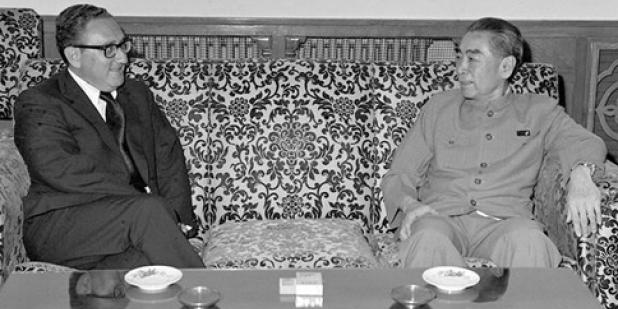
Bộ trưởng Kissinger (nhìn về phía Scowcroft): Scowcroft đang đẩy tôi vào thế khó đây. Mọi người thấy anh ấy đang ép tôi không?!
Bộ trưởng Ngoại giao Kiều Quán Hoa: Còn về thông cáo chung thì sao? Tôi tin rằng cả hai bên đều đã nắm rõ các thông điệp trao đổi trước đây. Và vì Tổng thống Ford đã nêu vấn đề này, tôi rất muốn lắng nghe xem phía các ông có ý tưởng mới nào không.
Bộ trưởng Kissinger: Tôi chỉ nghĩ rằng chúng ta nên sớm quyết định xem liệu có cần một văn kiện tổng kết nào hay không. Nếu không có văn kiện nào, chúng ta nên thông báo với báo giới rằng sẽ không có văn kiện đó, để tránh tạo ra ấn tượng rằng đang có một cuộc khủng hoảng trong khi thực tế thì không. Tôi nghĩ việc trao đổi quan điểm về cách thức kết thúc chuyến thăm này sẽ rất hữu ích. Chúng tôi không nhất thiết đòi hỏi phải có văn kiện, nhưng tôi cho rằng chúng ta nên thảo luận về vấn đề này. [Trang 869]
Tôi cũng chợt nghĩ rằng, vì các ông đã sử dụng một phần dự thảo thông cáo [được đưa ra tại cuộc họp ngày 22 tháng 10] trong bài phát biểu chúc rượu [của Phó Thủ tướng], thì có lẽ chúng ta có thể chấp nhận phần còn lại chăng? (Cười)
Ông Lord: Ông ấy sẽ dùng nửa còn lại trong bài phát biểu tại tiệc chiêu đãi đáp lễ.
Bộ trưởng Ngoại giao Kiều: Chúng ta có thể gộp cả bốn bài phát biểu chúc rượu lại với nhau. Như vậy sẽ thành một văn kiện hoàn chỉnh đấy. (Cười)
Bộ trưởng Kissinger: Phần còn lại thì để dành cho bài phát biểu của các ông tại Liên Hợp Quốc sắp tới vậy. (Cười)
Bộ trưởng Ngoại giao Kiều: Đó chính là nguyên lý [vật lý] rằng vật chất không tự nhiên mất đi.
Bộ trưởng Kissinger: Hiện nay, các ông suy nghĩ thế nào về khả năng có một văn kiện kết thúc chuyến thăm? Chúng ta có nên đưa ra một tuyên bố không? Nếu có, thì đó sẽ là loại tuyên bố như thế nào? Hay chúng ta chỉ cần nêu ra những lĩnh vực mà hai bên sẽ cùng hợp tác? Chúng tôi chưa soạn thảo văn bản nào cả; chúng tôi nghĩ rằng nên trao đổi quan điểm trước khi đưa ra quyết định.
Bộ trưởng Ngoại giao Kiều: Quan điểm của chúng tôi vẫn như những gì đã trao đổi với các ông vào tháng 10 và trong các thông điệp giữa hai bên sau đó. Chúng tôi vẫn giữ nguyên quan điểm của mình. Nếu có một thông cáo, thì nó phải là một bước tiến so với Thông cáo Thượng Hải.
Bộ trưởng Kissinger: Nhưng các ông định nghĩa thế nào là một bước tiến? Về ý tưởng đó thì chúng tôi đồng ý.
Bộ trưởng Ngoại giao Kiều: Chẳng hạn, mỗi bên có thể trình bày quan điểm riêng của mình về tình hình quốc tế.
Bộ trưởng Kissinger: Chúng ta đã làm điều đó trước đây rồi. Đó không phải là một bước tiến.
Ngoại trưởng Kiều: Vì tình hình đang thay đổi—mặc dù lập trường cơ bản của chúng tôi vẫn giữ nguyên, nhưng trước tình hình đang biến chuyển, chúng tôi có những quan điểm mới. Đây chính là điều chúng tôi muốn nói đến khi nhắc tới một bước tiến so với Thông cáo Thượng Hải.
Về những điểm tương đồng, tôi không rõ liệu chúng ta có thể bổ sung thêm nội dung gì vào Thông cáo Thượng Hải hay không. Nói một cách đơn giản, tôi tin rằng bản dự thảo mà chúng tôi đã trao cho phía các ông vào ngày 22 tháng 10, xét trên nhiều phương diện, đã thể hiện một bước tiến so với Thông cáo Thượng Hải.
Bộ trưởng Kissinger: Điều đó còn tùy thuộc vào cách nhìn nhận về phương hướng. (Cười)
Tôi nghĩ vấn đề nằm ở chỗ—tôi cho rằng chúng ta không nên tranh luận [lúc này] vì trước đây chúng ta đã từng tranh luận rồi—chúng tôi không nhất thiết đòi hỏi phải có một thông cáo hay bất kỳ tuyên bố công khai nào. Thực tế, chúng tôi thấy rằng việc không có văn bản nào cả cũng có những lợi thế riêng. [Trang 870]
Nghiêm túc mà nói, vấn đề là các ông nhìn nhận sự tiến triển theo hướng biện chứng, như là sự vận động của lịch sử. Trong khi đó, công chúng của chúng tôi lại nhìn nhận sự tiến triển theo hướng tuyến tính; họ sẽ so sánh trực tiếp với Thông cáo Thượng Hải. Chính điều này tạo nên sự khó khăn.
Ngoại trưởng Kiều: Vâng, dưới góc nhìn của chúng tôi, có thể nói rằng theo cách tiếp cận biện chứng, nếu chúng ta không tạo ra bước tiến nào—nếu một văn bản [mới] không tốt bằng Thông cáo Thượng Hải—thì thực chất, nó sẽ làm giảm đi ý nghĩa của chính Thông cáo Thượng Hải đó. Vì vậy, tôi nghĩ có lẽ tốt hơn là không nên có bất kỳ thông cáo nào cả.
Bộ trưởng Kissinger: Tôi nghĩ điều đó có thể đúng. Ý của ông là cuối cùng sẽ không có bất kỳ tuyên bố nào sao? Hay chúng ta nên đưa ra một thông cáo báo chí đơn giản?
Ngoại trưởng Kiều: Như ông vừa đề cập, ông cũng thấy được những lợi ích của việc không ra thông cáo chung. Tôi nhớ trong cuộc trao đổi lần trước tại tòa nhà kia [Nhà khách số 5, đêm 22–23 tháng 10], tôi đã nói rằng việc không có thông cáo chung có thể mang lại một số thuận lợi. Chẳng hạn, Chủ tịch Mao đã nói với Tổng thống Ford rằng phía Mỹ có thể thông tin cho báo giới mà không bị ràng buộc bởi bất kỳ thông cáo chung nào. Nếu có một thông cáo chung nhưng lại quá khô khan, thiếu nội dung, thì chính các ông sẽ bị gò bó.
Bộ trưởng Kissinger: Tôi đồng ý với điều đó.
Ngoại trưởng Kiều: Ngoài ra, tôi cho rằng sự hiểu biết giữa hai bên có thể sâu sắc hơn nhiều so với những gì các đối thủ của chúng ta suy đoán. Cách thể hiện mối quan hệ giữa hai nước như vậy thật tinh tế, khiến họ không thể đoán biết được bản chất thực sự là gì.
Bộ trưởng Kissinger: Thực ra, cách tiếp cận này phức tạp đến mức ngay cả các cộng sự của tôi cũng không hiểu nổi. Ông biết không, những gì ông phát biểu [trong bài diễn văn tại tiệc chiêu đãi tối thứ Hai] chính là sự lặp lại nội dung bản dự thảo thông cáo chung mà phía Trung Quốc đã trao cho chúng tôi hồi tháng 10. Thế nhưng, chỉ có năm người [phía chúng tôi] hiểu được điều đó. Tôi nhớ lại câu nói của Palmerston về hiệp ước Schleswig-Holstein: trong ba người thực sự hiểu hiệp ước này, một người đã qua đời, một người đang ở trong bệnh viện tâm thần, còn người thứ ba—chính là ông ấy—thì đã quên mất ý nghĩa của nó rồi. (Cười)
Tôi xin được chia sẻ thẳng thắn về giới báo chí của chúng tôi. Tôi tin rằng ông hiểu—dù có thể không đồng tình với mọi chi tiết—định hướng cơ bản trong chính sách đối ngoại của chúng tôi. Tuy nhiên, trong chuyến thăm trước—lần này tôi chưa trao đổi với họ—giới báo chí Mỹ lại có ấn tượng rằng phía Trung Quốc đang công kích lập trường của Hoa Kỳ. Điều này giải thích cho nhiều bài tường thuật [Trang 871] mà Chủ tịch Mao đã nhắc đến, tạo ra cảm giác rằng mối quan hệ giữa hai nước đang ngày càng trở nên lạnh nhạt hơn.
Tình hình của chúng tôi có phần phức tạp. Cá nhân tôi, về mặt tư duy, hoàn toàn đồng tình với cách phân tích tình hình của ông. Nhưng với tư cách là Bộ trưởng Ngoại giao, tôi phải đảm bảo định vị đất nước mình sao cho có khả năng ứng phó tốt nhất trước mọi cuộc khủng hoảng. Vấn đề lớn nhất của chúng ta tại Mỹ là vụ Watergate đã châm ngòi cho một cuộc tấn công nhắm vào thẩm quyền trung ương. Chúng ta cần cẩn trọng xây dựng lại thẩm quyền trung ương này, đồng thời tránh tham gia vào những cuộc đối đầu mà tại đó chúng ta không thể bảo vệ được lập trường của mình. Nói một cách thẳng thắn, nhiều đối thủ của chúng ta sẽ lợi dụng bất kỳ vấn đề nào để làm suy giảm uy tín đối với những gì chúng ta đang thực hiện — chẳng hạn như việc họ sử dụng các thông tin nghe được từ phía Trung Quốc để phục vụ mục đích riêng. Điều này hoàn toàn không có lợi trong mối quan hệ với Liên Xô, nhất là khi chính những đối tượng đó cũng đang công kích chúng ta vì các hành động của chúng ta tại Angola, Bồ Đào Nha, Chile và Iraq.
Vì vậy, nếu chúng ta muốn tạo ra ấn tượng như đã đề cập chiều nay, cần phải hiểu rõ tác động của điều đó đối với báo chí của chúng tôi. Mặc dù tôi đồng tình với phân tích của ông — và cá nhân tôi cũng không phản đối những gì Phó Thủ tướng đã phát biểu — nhưng trong khi cả hai bên cùng hướng tới một giải pháp chung, thì mỗi bên lại có phương pháp riêng. Nếu phân tích kỹ tình hình trong nước của chúng tôi, ông sẽ thấy rằng chúng tôi đang thực thi chính sách chống Liên Xô mạnh mẽ nhất có thể. Tuy nhiên, việc khẳng định quan hệ giữa hai nước đang tốt đẹp không hoàn toàn phụ thuộc vào phía chúng tôi; bởi lẽ, nếu chúng tôi tuyên bố như vậy, trong khi báo chí của chúng tôi lại diễn giải các phát biểu của phía ông — vốn có mục đích khác — theo một cách riêng, thì những tuyên bố đó sẽ chỉ bị coi là kiểu tuyên truyền phục vụ lợi ích cá biệt. Chúng tôi đang thúc đẩy chính sách chống Liên Xô mạnh mẽ nhất trong khả năng của mình trước thềm các cuộc bầu cử.
Bộ trưởng Ngoại giao Kiều Quán Hoa: Một thực tế ai cũng biết là giữa hai bên vẫn tồn tại những khác biệt căn bản về các vấn đề then chốt. Chúng ta không nên đánh đồng những khác biệt này. Thông cáo Thượng Hải đã được soạn thảo trên tinh thần đó. Những năm gần đây, nhiều người bạn Mỹ đã đến Trung Quốc — từ các Thượng nghị sĩ, Hạ nghị sĩ, cho đến những người làm báo và đại diện các tầng lớp xã hội khác nhau. Chúng tôi đều khẳng định với họ rằng quan hệ giữa Trung Quốc và Hoa Kỳ về cơ bản là tốt đẹp. Chúng tôi chưa bao giờ nói ngược lại. Ngược lại, những thông tin cho rằng quan hệ giữa hai nước đang trở nên lạnh nhạt không hề xuất phát từ phía Tầu cộng, mà đến từ phía Hoa Kỳ.
Bộ trưởng Kissinger: Có nhiều lý do dẫn đến tình trạng này, và chúng ta cần phân tích để hiểu rõ hơn. Chẳng hạn, những người phản đối chính quyền hiện tại hoặc phản đối cá nhân tôi thường tuyên bố rằng quan hệ giữa hai nước đang lạnh nhạt, nhằm tạo ra một điểm công kích. Đó là lý do tại sao sau chuyến thăm gần đây nhất của tôi, đã xuất hiện nhiều bài báo với mục đích hạ thấp chính sách này, nhằm ngăn cản chuyến thăm hoặc làm mất đi ý nghĩa của nó. Điều quan trọng là ông cần hiểu rằng những thông tin này không xuất phát từ chính quyền, mà đến từ các đối thủ của chính quyền—và đôi khi là từ những kẻ ngốc nghếch ngay trong nội bộ chính quyền, những người đang theo đuổi các mục đích cá nhân bằng cách bịa đặt những câu chuyện đi ngược lại lợi ích quốc gia. Ngoài ra—tôi nói điều này không phải với ý chỉ trích—một số phân tích mà các nhà báo của chúng tôi được nghe khi họ ở đây lần trước cũng tạo ra ấn tượng tương tự. Như vậy, cả hai yếu tố này đã cộng hưởng với nhau.
Ngoại trưởng Kiều: Họ không hề nghe những điều đó từ phía chúng tôi.
Bộ trưởng Kissinger: Họ đã hình thành ấn tượng như vậy—ý tôi là các nhà báo. Một phần lý do là khi ông đưa ra phân tích về tình hình Liên Xô—ví dụ, cá nhân tôi không coi đó là nhắm vào Hoa Kỳ mà là nhắm vào chính Liên Xô—thì một số nhà báo của chúng tôi lại diễn giải đó như một đòn tấn công vào chính sách đối ngoại của Hoa Kỳ, nhất là khi họ nghe những phân tích đó ngay tại đất nước của ông—chứ không phải ở nơi nào khác.
Tôi xin nói thẳng với ông rằng—tôi hoàn toàn không phản đối, cũng chẳng hề bận tâm về điều đó; thực tế, tôi cho rằng việc ông bày tỏ quan điểm về Liên Xô là một điều lành mạnh. Việc ông trao đổi với người châu Âu theo cách đó cũng là điều lành mạnh. Điều này phù hợp với lợi ích chung của cả hai bên. Điểm duy nhất tôi không đồng tình là khi ông ám chỉ rằng chúng tôi có thể rút khỏi châu Âu nếu xảy ra khủng hoảng. Sự thật là chúng tôi sẽ vẫn tiếp tục chiến đấu tại châu Âu ngay cả khi người châu Âu đã ngừng chiến từ lâu.
Ngoại trưởng Kiều: Có lẽ vấn đề thực chất này nên để dành thảo luận vào ngày mai.
Chính sách hòa dịu (détente) của chúng tôi vẫn nhất quán kể từ năm 1971. Không đúng khi cho rằng quan điểm này chỉ mới xuất hiện trong các tuyên bố gần đây. Chúng tôi đã nhiều lần bày tỏ lập trường của mình về chính sách hòa dịu, cả công khai lẫn riêng tư. Tuy nhiên, cũng phải thừa nhận rằng những luận điệu về việc quan hệ giữa Trung Quốc và Hoa Kỳ đang trở nên nguội lạnh mới chỉ xuất hiện trong thời gian gần đây. Cần hiểu rõ rằng những luận điệu đó không hề xuất phát từ chính phủ chúng tôi.
Bộ trưởng Kissinger: Điều đó đúng, nhưng cũng đúng là các nhà báo của chúng tôi thường lấy không khí trong những chuyến thăm này làm thước đo cho mối quan hệ giữa hai bên. Chẳng hạn, lần trước có nhiều bài báo cho rằng ông tỏ thái độ lạnh nhạt tại tiệc chiêu đãi chia tay. Tôi không cảm thấy như vậy và đã bác bỏ thông tin đó. Chúng tôi luôn được đón tiếp với sự lịch thiệp đặc biệt, nên chúng tôi không có gì để phàn nàn cả. Tuy nhiên, chúng tôi muốn tạo ấn tượng rằng quan hệ giữa hai nước đang tốt đẹp và ngày càng cải thiện hơn. Lúc đầu ông có nói đùa rằng hay là chúng ta công bố cả bốn bài phát biểu chúc rượu; thực ra ý tưởng đó cũng có lý. Ví dụ, tại bữa tiệc cuối cùng, nếu cả hai bên cùng đề cập đến những ý mà Chủ tịch Mao đã nêu chiều nay — rằng quan hệ giữa hai nước về cơ bản là tốt đẹp và đang trên đà cải thiện — thì mọi người đều sẽ nghe thấy điều đó và…
Bộ trưởng Ngoại giao Kiều: Nhưng Chủ tịch Mao cũng nói rằng việc cải thiện quan hệ giữa hai nước chúng ta sẽ diễn ra dần dần. [Trang 873]
Bộ trưởng Kissinger: Một quá trình dần dần. Chúng tôi đồng ý. Tôi đang xem xét xem ông có…
Bộ trưởng Ngoại giao Kiều: Tôi tin rằng trong bài phát biểu chúc rượu tối qua, chúng tôi cũng đã đưa vào một câu khẳng định rằng quan hệ giữa hai nước về cơ bản là tốt đẹp.
Bộ trưởng Kissinger: Vâng, Tổng thống và tôi đều nhận ra điều đó, mặc dù tôi không chắc báo chí của chúng tôi có để ý hay không. Họ còn đang bận chú ý đến mấy khẩu đại bác rồi.
Bộ trưởng Ngoại giao Kiều: Chúng tôi buộc phải bắn đại bác chứ.
Bộ trưởng Kissinger: Vấn đề là làm sao để truyền tải thông điệp đó tới báo chí của chúng tôi theo cách giúp họ vượt qua khuynh hướng nhìn nhận mọi thứ một cách tiêu cực, hư vô.
(Các nhân viên phục vụ phía Tầu cộng bước vào phòng, đặt các đĩa bánh quy và đồ ngọt lên bàn.)
Tôi bắt đầu thấy đuối sức rồi.
Bộ trưởng Ngoại giao Kiều: Nhưng xem chừng ông lại sắp “phát tướng” ra đấy. Ông tăng cân nhiều quá.
Bộ trưởng Kissinger: Chính ông phải chịu trách nhiệm về chuyện đó đấy.
Vậy hay là chúng ta thống nhất không ra thông cáo chung nữa nhé!?
Bộ trưởng Ngoại giao Kiều: Chúng tôi cho rằng nếu không thể soạn thảo một văn bản tốt hơn Thông cáo Thượng Hải, thì tốt nhất là không nên có thông cáo chung nào cả.
Bộ trưởng Kissinger: Vậy là sẽ hoàn toàn không có tuyên bố nào sao?
Bộ trưởng Ngoại giao Kiều: Chúng tôi đã bày tỏ quan điểm của mình trong tất cả các bài phát biểu tại các buổi tiệc chiêu đãi.
Bộ trưởng Kissinger: Vậy ý ông là không cần đưa ra tuyên bố nào cả?
Bộ trưởng Ngoại giao Kiều: Nếu chúng ta không thể có một thông cáo mang tính tiến bộ hơn so với Thông cáo Thượng Hải.
Bộ trưởng Kissinger: Phía chúng tôi chấp nhận điều đó. Ông Lâm [Bình] và ông Lord chắc hẳn đang thấy nhẹ nhõm lắm. Họ có thể ngủ ngon rồi. (Cười)
Bộ trưởng Ngoại giao Kiều: Cả hai bên chúng ta đều trút bỏ được gánh nặng lớn. Hầu như lần nào ông sang, chúng ta cũng phải thảo luận về một bản thông cáo. Tôi nghĩ có lẽ nên khuyến khích cách tiếp cận mới mà chúng ta vừa áp dụng: hoặc là có một thông cáo quan trọng hơn cả Thông cáo Thượng Hải, hoặc là không cần thông cáo nào cả.
Bộ trưởng Kissinger: Tôi nghĩ sẽ chẳng ích gì nếu tiết lộ điều này với báo giới, vì dù sao chúng ta cũng không đạt được thông cáo mới nào—(Cười)
Bộ trưởng Ngoại giao Kiều: Tôi hy vọng nội dung cuộc trò chuyện tối nay sẽ không bị rò rỉ.
Bộ trưởng Kissinger: Theo ông, chúng ta nên nói gì với báo giới—không phải về cuộc trò chuyện này, mà về kết quả đạt được?
Bộ trưởng Ngoại giao Kiều: Ông có ý tưởng gì không? Chúng tôi không thực sự hiểu rõ về giới báo chí phía ông. Ông vốn là người khéo léo hơn trong việc ứng xử với báo chí mà. [Trang 874]
Bộ trưởng Kissinger: Ông cứ nhìn vào những bài báo họ viết là biết tôi khéo léo đến mức nào rồi! (Cười)
Bộ trưởng Ngoại giao Kiều: Tôi nhớ hồi ở Thượng Hải, ông từng bảo với tôi rằng ông có thể nói chuyện với báo giới suốt một tiếng rưỡi đồng hồ mà chẳng hề tiết lộ bất cứ nội dung thực chất nào. Ông đã chứng minh điều đó ngay tại Thượng Hải rồi còn gì.
Tôi vẫn nhớ ông từng hỏi tôi rằng chúng ta nên nói gì với báo chí, và tôi đã bảo ông cứ nói bất cứ điều gì ông muốn.
Bộ trưởng Kissinger: Để tôi suy nghĩ… bắt đầu từ ngày mai, chúng ta nên giải thích với báo chí rằng sẽ không có thông cáo hay tuyên bố chung nào cả. Tôi sẽ giải thích rằng chúng ta quyết định tập trung vào nội dung thực chất của các cuộc đàm phán thay vì dành thời gian soạn thảo những chi tiết vụn vặt. Chúng ta cũng sẽ nói rằng hai bên đã tái khẳng định những định hướng chính trong chính sách của mình.
Tôi sẽ thông tin cho báo chí vào tối thứ Năm, sau buổi tiệc chiêu đãi. Tôi sẽ bày tỏ sự hài lòng về chuyến thăm này và nói rằng, theo quan điểm của chúng tôi, quan hệ giữa hai bên về cơ bản là tốt và đang dần cải thiện. Đó sẽ là chủ đạo trong những gì tôi phát biểu.
Bộ trưởng Ngoại giao Kiều: Ông có thể nói rằng quan hệ giữa chúng ta về cơ bản là tốt và sẽ dần cải thiện. Đừng dùng thì tiếp diễn, vì dùng thì tương lai sẽ sát với thực tế hơn.
Bộ trưởng Kissinger: Tôi thậm chí còn chẳng phân biệt được sự khác nhau đó. Nhưng như vậy cũng được thôi. (Cười)
Bộ trưởng Ngoại giao Kiều: Chủ tịch Mao đã trao đổi với ông một cách rất thẳng thắn. Ông ấy nói rằng sẽ không có thay đổi lớn nào [trong quan hệ giữa hai bên] trong năm nay, năm tới, hay năm kế tiếp nữa. Tổng thống của ông cũng đồng tình với điều này.
Bộ trưởng Kissinger: Tôi nghĩ ý ông ấy là đến năm kế tiếp nữa thì có thể sẽ có thay đổi.
Bộ trưởng Ngoại giao Kiều: Về cơ bản là vậy…
Bộ trưởng Kissinger: Có một vấn đề liên quan đến ý kiến của ông về việc báo chí viết rằng quan hệ hai bên đang nguội lạnh. Đó là nếu không có bất kỳ tiến triển nào trong các vấn đề mà ông Habib và ông Lâm Bình đang thảo luận, thì giới báo chí và công chúng Mỹ sẽ coi đó là dấu hiệu của sự trì trệ. Điều này có thể gây ảnh hưởng nếu những tình huống mà ông lo ngại trên thế giới thực sự xảy ra. Nhưng việc cân nhắc điều đó là tùy thuộc vào phía các ông.
Đối với tôi, việc có bảy chương trình trao đổi hay chỉ hai chương trình thì cũng chẳng quan trọng gì cả. Trái ngược với nhiều đồng bào của tôi, tôi tin rằng Trung Quốc đã tồn tại 2.000 năm mà không có sự tiếp xúc văn hóa với Mỹ, và hoàn toàn có thể tiếp tục tồn tại thêm 2.000 năm nữa mà không cần đến sự tiếp xúc đó. Tuy nhiên, đây là vấn đề tùy quý vị cân nhắc; chúng ta không nhất thiết phải giải quyết ngay lúc này, mà có thể dành thời gian để suy ngẫm thêm.
Tôi muốn nói rằng trong phần lớn khoảng thời gian 2.000 năm đó, nước Mỹ thậm chí còn chưa tồn tại. Với sự hiểu biết hạn hẹp của tôi về lịch sử Trung Quốc... có lẽ chúng ta nên xem xét liệu có vấn đề nào thuộc phạm trù này [Trang 875] đáng để nghiên cứu hay không; nếu có, chúng ta có thể thảo luận về nó, chẳng hạn như sau chuyến thăm này. Nếu kết quả đó được xem là bắt nguồn từ chuyến thăm thì sẽ rất tốt, nhưng chỉ khi cả hai bên đều thấy điều đó hữu ích. Về phía chúng tôi, chúng tôi không nhất thiết cần đến điều đó.
Bộ trưởng Ngoại giao Kiều: Chúng tôi cũng vậy. Vấn đề là chúng ta cần có cách tiếp cận thực tế đối với quan hệ song phương. Thực tế mà nói, trở ngại lớn nhất là trước khi quan hệ giữa hai nước được bình thường hóa, các chương trình trao đổi giữa hai bên buộc phải ở mức hạn chế. Tôi đã từng trao đổi với ông, thưa Ngài Bộ trưởng, cũng như với nhiều người bạn Mỹ khác về điều này. Xét về mặt logic, lập luận cho rằng nên mở rộng các hoạt động trao đổi trước khi bình thường hóa quan hệ là không thỏa đáng.
Như cả hai bên đều hiểu rõ, vấn đề Đài Loan chính là nút thắt then chốt ngăn cản việc bình thường hóa quan hệ. Một khi quan hệ giữa hai nước được bình thường hóa, tình hình sẽ hoàn toàn khác biệt. Dẫu vậy, chúng tôi vẫn sẵn sàng lắng nghe nếu quý vị có bất kỳ ý tưởng mới nào về quan hệ song phương.
Bộ trưởng Kissinger: Tôi nghĩ vấn đề này đã được ông Habib và ông Lâm Bình thảo luận với nhau. Chúng tôi luôn sẵn sàng – khi sản lượng dầu của các ông tăng lên – nếu các ông muốn bàn về việc mua bán, chúng tôi hoàn toàn cởi mở. Các ông cứ cho chúng tôi biết nhé. Hôm qua trong bữa tối, chúng tôi cũng đã trao đổi với Phó Thủ tướng về vấn đề này – hoặc là về việc bán một số thiết bị đặc thù.
Bộ trưởng Ngoại giao Kiều: Vấn đề này đành để dành cho tương lai vậy.
Bộ trưởng Kissinger: Quyết định thế nào là tùy ở các ông.
Bộ trưởng Ngoại giao Kiều: Tôi không thấy có vấn đề gì mới trong quan hệ song phương giữa hai nước chúng ta, ngoại trừ vấn đề những người mất tích trong chiến tranh (MIA).
Bộ trưởng Kissinger: Các ông từng nói là trong chuyến thăm này, có thể các ông sẽ cung cấp cho chúng tôi một số thông tin mới về vấn đề đó.
Bộ trưởng Ngoại giao Kiều: Vâng, chúng tôi sẽ làm như vậy.
Bộ trưởng Kissinger: Phó Thủ tướng sẽ trao đổi trực tiếp với Tổng thống, hay các ông sẽ cung cấp thông tin đó cho chúng tôi ngay tại đây? Các ông muốn thực hiện theo cách nào?
Bộ trưởng Ngoại giao Kiều: Chưa phải lúc này. Cách nào cũng được cả, tùy các ông thôi. Chúng tôi thấy tốt nhất là để Phó Thủ tướng trao đổi với Tổng thống của các ông.
Bộ trưởng Kissinger: Tôi nghĩ như vậy là tốt nhất. Thế chúng ta chuyển sang bàn về triết học nhé? (Cười)
Phụ tá Bộ trưởng Habib: Để dành cho phần còn lại của buổi tối chăng?
Bộ trưởng Ngoại giao Kiều: Hay là chúng ta dừng lại ở đây nhỉ? Nếu tiếp tục bàn về các vấn đề triết học thì chắc chẳng ai được đi ngủ mất. Có lần tôi từng thảo luận về triết học với vài người bạn châu Âu, chúng tôi tranh cãi gay gắt đến mức cuối cùng tôi đành bỏ cuộc. Tốt nhất là không nên bàn về chủ đề đó nữa. [Trang 876]
Bộ trưởng Kissinger: Vậy hẹn gặp lại các ông vào lúc 9 giờ 30 sáng mai tại đây nhé?
Bộ trưởng Ngoại giao Kiều: Chắc hẳn ông sẽ có nhiều điều thú vị để chia sẻ với báo giới về chuyến thăm Tầu cộng lần này.
Bộ trưởng Kissinger: Tôi sẽ giải thích cho họ thấy tất cả những dấu hiệu tiến triển trong quan hệ giữa hai nước chúng ta. À, mà này, nếu các ông cho phép thêm một giáo sư nữa từ Đại học Michigan sang đây, thì ông Solomon chắc sẽ vui lắm đấy.
Đường Văn Sinh (Nancy Tang): Gần đây chúng tôi có đón một vị giáo sư như vậy, hình như tên là Whiting thì phải. Bộ trưởng Kissinger: Nếu để Allen Whiting vào, thì đừng cho ông ta rời đi!
1. Nguồn: Thư viện Ford, Cố vấn An ninh Quốc gia, Các báo cáo của Kissinger về các cuộc thảo luận liên quan đến Liên Xô, Tầu cộng và Trung Đông, Hộp 2, Các biên bản hội đàm và báo cáo về Tầu cộng, ngày 1–5 tháng 12 năm 1975, Chuyến thăm Bắc Kinh của ông Ford. Tài liệu Mật; Nhạy cảm. Cuộc họp diễn ra tại Nhà khách số 18. Tất cả các phần nằm trong dấu ngoặc vuông đều có trong văn bản gốc.↩
2. Xem Tài liệu 126 và chú thích số 2 của tài liệu đó.↩
3. Xem Tài liệu 26.↩
Historical Documents - Office of the Historian
https://history.state.gov/historicaldocuments/frus1969-76v18/sources
https://history.state.gov/historicaldocuments/frus1969-76v18/terms
https://history.state.gov/historicaldocuments/frus1969-76v18/persons
https://history.state.gov/historicaldocuments/frus1969-76v18/comp1
The Summit in Beijing, August–December 1975 (Documents 117–137)
https://history.state.gov/historicaldocuments/frus1969-76v18/ch4
1. Document 135
Foreign Relations of the United States, 1969–1976, Volume XVIII, China, 1973–1976
135. Memorandum of Conversation1
Beijing, December 2, 1975, 11 p.m.–midnight.
PARTICIPANTS
· Ch’iao Kuan-hua, PRC Foreign Minister
· Lin P’ing, Director, Department of American and Oceanic Affairs, Ministry of Foreign Affairs
· T’ang Weng-sheng, Deputy Director, Department of American and Oceanic Affairs, Ministry of Foreign Affairs
· Ting Yuan-hung, Director, United States Office, Department of American and Oceanic Affairs, Ministry of Foreign Affairs
· Chao Chi-hua, Deputy Director, United States Office, Department of American and Oceanic Affairs, Ministry of Foreign Affairs
· Shih Yen-hua (Interpreter)
· Lien Cheng-pao (Notetaker)
· Henry A. Kissinger, Secretary of State
· Brent Scowcroft, Assistant to the President for National Security Affairs
· Joseph P. Sisco, Under Secretary of State for Political Affairs
· Philip C. Habib, Assistant Secretary of State for East Asian and Pacific Affairs
· Winston Lord, Director, Policy Planning Staff, Department of State
· William H. Gleysteen, Deputy Assistant Secretary of State for East Asian and Pacific Affairs
· Richard H. Solomon, Senior Staff Member, National Security Council
SUBJECT
· Discussion of a Possible Communiqué American Press and Public Support for U.S.–PRC Relations
Secretary Kissinger (looking at Scowcroft): Scowcroft has me in a dilemma. Notice him moving in on me?!
Foreign Minister Ch’iao: What about the communiqué? I believe the two sides are clear about the messages exchanged in the past. And since President Ford raised this matter, I would like to listen to any new ideas you have.
Secretary Kissinger: I simply thought we should decide at an early stage whether we should have any concluding document. If we do not, we should tell our press there will not be one and thus avoid the impression of a crisis where there is not one. I thought some exchange of views on how the visit might conclude would be useful. We do not insist there be something, but I thought there should be some discussion about it.
It also occurred to me that as you have already used part of your draft communiqué [tabled at the October 22 meeting]2 in the [Vice Premier’s] toast, perhaps we might be able to accept the remainder. (Laughter)
Mr. Lord: He’ll use the second half in the toast at the return banquet.
Foreign Minister Ch’iao: We can lump the four toasts together. That would be a good document. (Laughter)
Secretary Kissinger: Any remainder will then appear in your next UN speech. (Laughter)
Foreign Minister Ch’iao: That is the principle [of physics] that the substance will not vanish.
Secretary Kissinger: What are your considerations now about the possibility of a concluding document? Should we have a statement? If so, what sort of a statement? Or should we simply indicate areas in which we will seek to work together? We have no draft for you; we thought we should have an exchange of views before we make any decision.
Foreign Minister Ch’iao: Our ideas remain what we told you in October and in the messages exchanged between our two sides later on. We still maintain our views. If there is any communiqué, it should be a step forward from the Shanghai Communiqué.
Secretary Kissinger: But what is your definition of a step forward? In that [idea] we agree.
Foreign Minister Ch’iao: For instance, each side should state its own views on the international situation.
Secretary Kissinger: That we did before. That is not a step forward.
Foreign Minister Ch’iao: Because the situation is changing— although our basic position remains the same, in the face of the changing situation we have new views. This is what we mean by a step forward from the Shanghai Communiqué.
About the points we have in common, I don’t know whether we can add something to the Shanghai Communiqué. To put it in a simple way, I believe that the draft we handed to you on October 22 has in many ways made a step forward from the Shanghai Communiqué.
Secretary Kissinger: It depends on one’s sense of direction. (Laughter)
I think the problem is—I don’t think we should have a debate [now] because we have debated it before—we do not insist on a communiqué or on any public statement. In fact, we can see the advantages of having nothing.
Seriously, the problem is that you look at forward movement in a somewhat dialectic sense, as the movement of history. Our public will look at forward movement in a more linear sense; and they will make a specific comparison with the Shanghai Communiqué. This is what makes it a difficult problem.
Foreign Minister Ch’iao: Well, from our point of view, you can say that a dialectical way of looking at things is that if we do not make a step forward, if a [new] document is not as good as the Shanghai Communiqué, then in fact it will dilute the significance of the Shanghai Communiqué. So that I think it might be more advisable to have no communiqué at all.
Secretary Kissinger: I think that may be true. Is it your idea that there should be no statement at all at the end? Or should we have a simple press statement?
Foreign Minister Ch’iao: As you mentioned just now, you also see the advantages of no communiqué and I remember at our last talk in the other building [Guest House #5, on the night of October 22–23] I mentioned there might be some advantages in having no communiqué.3 For instance, Chairman Mao told President Ford that you could brief your newsmen and without a communiqué you will not be constrained in that respect. If there is a communiqué which is very dry, devoid of content, you will be constrained.
Secretary Kissinger: I agree with that.
Foreign Minister Ch’iao: Apart from this, I think the understanding between us may be more profound than what our opponents will think. That is such a subtle way of indicating our relations that they cannot guess what they are.
Secretary Kissinger: In fact that is so complicated [an approach] that my associates cannot figure it out. You know what you said [in the Vice Premier’s toast on Monday evening] was a repeat of the draft communiqué you handed us in October. But there are only five people [on our side] who understood that. I remember what Palmerston said of the Schleswig-Holstein agreement: of the three men who really understood it, one was dead, one was in an asylum, and he—the third—had forgotten what it meant. (Laughter)
Let me say something candidly about our press. I think you understand—whether you agree with it in all details or not—the basic thrust of our foreign policy. But our press got the impression on the last trip—I have not talked with them on this trip—that the Chinese side was attacking the U.S. position. And this explains many of the stories [Page 871]to which the Chairman referred about the impression of an increasing coolness in our relations.
Our situation is somewhat complex. I personally, intellectually, agree with your analysis of the situation. But as Secretary of State I must make sure to position our country in such a way that we have the greatest ability to respond to a crisis. Our biggest problem in America is that Watergate started an attack on central authority. We have to rebuild this central authority with care, and we must not fight battles where we cannot support our position. Therefore, speaking quite frankly, many of our opponents will use any issue to undermine the credibility of what we are doing—articles they may hear from the Chinese side and which are useful to them—and that would not be very helpful vis-à-vis the Soviet Union because these same people are attacking us for what we are doing in Angola, Portugal, Chile, and Iraq.
Therefore, if we want to create the impression of which we spoke this afternoon, one has to understand the impact on our press, even though I agree with your analysis with which—personally, I do not disagree with what the Vice Premier has said. But while we each seek the same solution, you have your method and we must have our method, because a careful analysis of our domestic situation will show you that we are pursuing the strongest anti-Soviet policy that is possible. But it is not entirely up to us to say our relations are good, because if we say if and then our press interprets your statements which have a different purpose in a certain way, if [our statements] will simply be taken as self-serving propaganda. We are promoting the strongest policy against the Soviet Union that we can before the elections.
Foreign Minister Ch’iao: It is a well-known fact that there exist fundamental differences between our two sides on key issues. Now we should not confuse these differences. The Shanghai Communiqué was written in this spirit. In recent years many American friends have come to China—whether they be Senators, Congressmen, or friends from the press, and people from all walks of life. We have told them the relations between China and the United States are basically good. We have not stated to the contrary. Instead the sources of the stories about the cooling off of the relations between our two countries do not originate from the Chinese side but from the United States side.
Secretary Kissinger: There are a variety of reasons and we have to analyse it so that we understand. It is true that, for example, opponents of the Administration or opponents of myself will say our relations are cooling in order to have a point of attack. And therefore after my last trip there were many articles in newspapers which were written for the purpose of discrediting the policy and for either preventing the trip or depriving it of significance. It is important for you to understand that these do not come from the Administration but from opponents [Page 872]of the Administration—and occasionally from fools within the Administration who were fighting personal battles by making up stories that are contrary to the national interest. Also— and I do not say this in a critical spirit— some of the analyses our newsmen heard when they were here last time gave the same impression. So these two things came together.
Foreign Minister Ch’iao: They have not heard them from our side.
Secretary Kissinger: They got the impression—it is newsmen. Part of the reason is that when you give your analysis of the Soviet situation—I, for example, do not consider it directed against the United States but directed against the Soviet Union—but some of our newsmen interpret it as an attack on our foreign policy, especially when they hear it in your country—not otherwise.
I tell you this—I do not at all object—this does not bother me at all, in fact I think it is healthy for you to say the things you do about the Soviet Union. It is healthy for you to talk to the Europeans as you do. It is in our common interest. The only point on which I don’t agree is when you imply that we might withdraw from Europe in the face of a crisis. The fact is that we will be fighting in Europe long after the Europeans.
Foreign Minister Ch’iao: Perhaps this issue of substance can be discussed tomorrow.
Our policy of détente has been the same since 1971. It is not true that this is only in our recent statements. We have been stating our position on détente publicly and privately on many occasions. But it is also true that the argument we hear of a cooling off of relations between China and the United States has been in circulation only in a recent period. It is important to understand that it did not come from our government.
Secretary Kissinger: This is true, but it is also true that our newsmen have used the mood of their visits here as a peg to gauge our relationship. There were many stories last time that you were cold at the farewell banquet, for example. I did not feel this, and I have denied it. We have always been treated with extraordinary courtesy, so we have no complaints. But we would like the impression that our relations are good and getting better. Maybe—you joked at the beginning that maybe we should publish our four toasts, but there is some sense in this. If, for example, at the final dinner each of our sides said among other things what Chairman Mao said this afternoon—that our relations are basically good and we are improving them, then everybody would hear it and—
Foreign Minister Ch’iao: But Chairman Mao also said about the improvement of relations between our two countries, that they would be gradually improving.
Secretary Kissinger: A gradual process. We agree. I am looking to see what you have—
Foreign Minister Ch’iao: I believe that in our toast last night we also included a sentence that relations between our two countries are basically good.
Secretary Kissinger: Yes, the President and I noticed it, although I am not sure our press noticed it. They were distracted by the cannons.
Foreign Minister Ch’iao: We have to fire our cannons.
Secretary Kissinger: The problem is to get it across to our press in a way that overcomes their nihilistic tendencies.
(Chinese service personnel enter the room and place dishes of cookies and other sweets on the table.)
I was getting weak.
Foreign Minister Ch’iao: But you tendencies are that you will get bigger. You have put on a lot of weight.
Secretary Kissinger: You are actually responsible for it.
Then let us agree not to have a communiqué!?
Foreign Minister Ch’iao: We believe it might be more advisable if we cannot have a communiqué better than the Shanghai Communiqué.
Secretary Kissinger: Should there be no statement at all?
Foreign Minister Ch’iao: We have put what we think in all our toasts.
Secretary Kissinger: So then you recommend no statement at all?
Foreign Minister Ch’iao: If we cannot have a communiqué which is a step forward from the Shanghai Communiqué.
Secretary Kissinger: That is acceptable to our side. Mr. Lin [P’ing] and Mr. Lord are very relieved. They can get some sleep. (Laughter)
Foreign Minister Ch’iao: We are both also relieved of the heavy burden. Almost every time you come we have to have discussions about a communiqué and actually I think it might be more advisable to encourage the new style we have adopted now. Either we have a communiqué which is more weighty than the Shanghai Communiqué or we do not have a communiqué at all.
Secretary Kissinger: I do not think it will be helpful to tell this to our press since we cannot get a new communiqué—(Laughter)
Foreign Minister Ch’iao: I hope that our conversation tonight will not be leaked.
Secretary Kissinger: What do you think we should tell the press— not about our conversation, but about our conclusion?
Foreign Minister Ch’iao: But what ideas do you have, because we do not quite know your press? You are more skilled in handling the press.
Secretary Kissinger: You can tell my skill with the press from the articles they write! (Laughter)
Foreign Minister Ch’iao: I remember that in Shanghai you told me you could talk to the press for as long as one and one half hours without really giving any substance. You proved you could do it in Shanghai.
I still remember that you asked me what we should tell to the press, and I told you [to say] whatever you would like.
Secretary Kissinger: I will think about … we will, starting tomorrow we should explain to the press that there will not be a communiqué or a statement. I will explain that we decided to concentrate on the substance of the talks rather than take time out to draft fine points. And we will say that we reaffirmed the main lines of our policy.
I will brief the press on Thursday night after the banquet. I will express our gratification at the visit and say that from our point of view our relations are basically good and gradually improving. That will be the theme of what I will say.
Foreign Minister Ch’iao: You may say that our relations are basically good and they will be gradually improving. Not in a progressive tense, because it conforms more to the reality [to put it in the future tense].
Secretary Kissinger: I don’t even understand the difference. But it is acceptable to us. (Laughter)
Foreign Minister Ch’iao: Chairman Mao talked to you in a very frank way. He said there will not be major changes [in our relationship] either this year, next year, or the year after next. Your President also agreed with this.
Secretary Kissinger: I think he meant the year after next he thinks there can be.
Foreign Minister Ch’iao: Basically that is—
Secretary Kissinger: There is one problem related to your point about the press writing that our relations are cooling. It is that if nothing at all happens in our relations on the sorts of issues that Habib and Lin P’ing are discussing, it will be taken in America by the press and public as a sign of stagnation. This should reflect on—may have some impact if the things you fear in the world happen. But it is up to you to consider.
I could not care less if there are seven exchange programs, or two. Contrary to many of my compatriots, I believe China lived 2,000 years without cultural contact with America and can live another 2,000 years without contact with America. But this is up to you to consider; we don’t have to settle it now, it is something to reflect about.
I was going to say that during most of those 2,000 years America did not even exist. In my limited knowledge of Chinese history— Maybe we could think about whether there is anything in this category [Page 875]that could be examined and if so we could take it up, perhaps following the visit. If it could be said to have come out of the visit it would be helpful, but only if it is considered helpful to both sides. We do not need it.
Foreign Minister Ch’iao: It is the same case with us. The problem is that we have to take a realistic approach to our bilateral relations. As a matter of fact, the biggest problem is that before the normalization of relations between our two countries the various programs for exchange between our two countries will have to be limited. I have told you this, Mr. Secretary, as well as many other American friends. Logically speaking, the argument about expanding exchanges before normalization is not tenable.
As the two sides are well aware, the issue of Taiwan is the key problem preventing normalization of relations. Once the relations between our two countries are normalized, the situation will be quite different. But we are ready to listen to your new ideas about the bilateral relations if you have any.
Secretary Kissinger: I think they have been discussed between Habib and Lin P’ing. And we are always prepared, when your oil production increases, we will be prepared if you want to discuss some purchases. But you will let us know. We discussed it with the Vice Premier at dinner yesterday—or to sell some equipment of a special nature.
Foreign Minister Ch’iao: This is a question which we have to leave to the future.
Secretary Kissinger: It is up to you to decide.
Foreign Minister Ch’iao: I do not think there are any new problems in our bilateral relations except the MIA s.
Secretary Kissinger: You told us you might give us some new information on this visit.
Foreign Minister Ch’iao: Yes, we will do that.
Secretary Kissinger: Will the Vice Premier do that with the President, or will you give it us us here? Or how do you want to do it?
Foreign Minister Ch’iao: Not at the moment. Either way we will do it. It is up to you. We prefer the Vice Premier telling your President.
Secretary Kissinger: I think that would be best. Shall we then discuss philosophy? (Laughter)
Assistant Secretary Habib: For the rest of the evening.
Foreign Minister Ch’iao: Shall we call it an evening? We could go on to discuss the philosophical problems, but everybody would not be able to go to bed. Once I discussed philosophy with some European friends. We had a big fight and then at the end I gave it up. We should not discuss it any more.
Secretary Kissinger: We will see you then at 9:30 [a.m.] here?
Foreign Minister Ch’iao: You will have a good time when you talk to your press about this trip to China.
Secretary Kissinger: Explaining to them all the signs of progress in our relations. But I will tell you, if you let in one additional professor from the University of Michigan you will keep Solomon happy.
Nancy Tang: We recently had one here. His name was Whiting, I think.
Secretary Kissinger: If you let Allen Whiting in, don’t let him leave!
1. Source: Ford Library, National Security Adviser, Kissinger Reports on USSR, China, and Middle East Discussions, Box 2, China Memcons and Reports, December 1–5, 1975, Mr. Ford’s Visit to Peking. Secret; Sensitive. The meeting took place at Guest House 18. All brackets are in the original.↩
2. See Document 126 and footnote 2 thereto.↩
3. See Document 26.↩
https://history.state.gov/historicaldocuments/frus1969-76v18/d135
https://history.state.gov/historicaldocuments/frus1969-76v18/pg_869
https://history.state.gov/historicaldocuments/frus1969-76v18/pg_870
https://history.state.gov/historicaldocuments/frus1969-76v18/pg_871
https://history.state.gov/historicaldocuments/frus1969-76v18/pg_872
https://history.state.gov/historicaldocuments/frus1969-76v18/pg_873
https://history.state.gov/historicaldocuments/frus1969-76v18/pg_874
https://history.state.gov/historicaldocuments/frus1969-76v18/pg_875
https://history.state.gov/historicaldocuments/frus1969-76v18/pg_876
https://history.state.gov/historicaldocuments/frus1969-76v18/d126
https://history.state.gov/historicaldocuments/frus1969-76v18/d26
Thân thế (các) nhân vật
Armstrong, Oscar Vance,
Political Advisor to CINPAC until July 1973; Director of People’s Republic of China and Mongolian Affairs from July 1973; Deputy Assistant Secretary for East Asian and Pacific Affairs from August 1976
https://www.wikitree.com/wiki/Armstrong-28783
https://history.state.gov/historicaldocuments/frus1969-76v18/persons
https://adst.org/Readers/China.pdf
https://www.govinfo.gov/content/pkg/GPO-CRECB-1977-pt17/pdf/GPO-CRECB-1977-pt17-1-2.pdf
https://www.governmentattic.org/2docs/FOIA_Logs_NARA-ADDRES_2001-2009.pdf
https://tile.loc.gov/storage-services/service/mss/mfdip/2004/2004gle01/2004gle01.pdf
https://archive.org/stream/allhands7087unit/allhands7087unit_djvu.txt
Chiao Kuan-hua, (Qiao Guanhua)
Vice Foreign Minister, People’s Republic of China
https://en.wikipedia.org/wiki/Qiao_Guanhua
https://history.state.gov/historicaldocuments/frus1969-76ve13/d124
https://www.marxists.org/subject/china/china-reconstructs/1974/CR1974-12-Sup.pdf
SYND 25-11-71 CHINESE DELEGATE CHIAO KUAN HUA SPEAKS ABOUT DISARMAMENT AT THE UN
https://www.youtube.com/watch?v=bjnyWtitbrg
Ford, Gerald R.,
Republican Representative from Michigan until October 13, 1973; House Minority Leader until October 13, 1973; Vice President of the United States from October 13, 1973, until August 8, 1974; President of the United States from August 8, 1974
https://en.wikipedia.org/wiki/Gerald_Ford
https://en.wikipedia.org/wiki/President_of_the_United_States
https://en.wikipedia.org/wiki/Vice_President_of_the_United_States
https://en.wikipedia.org/wiki/House_Minority_Leader
https://en.wikipedia.org/wiki/Leader_of_the_House_Republican_Conference
https://en.wikipedia.org/wiki/Chair_of_the_House_Republican_Conference
https://en.wikipedia.org/wiki/United_States_House_of_Representatives
https://www.whitehouse.gov/about-the-white-house/presidents/gerald-r-ford/
https://www.whitehouse.gov/administration/
https://geraldrfordfoundation.org/gerald-r-ford-biography/
https://www.fordlibrarymuseum.gov/grf/timeline.asp
https://en.wikipedia.org/wiki/Presidency_of_Gerald_Ford
https://www.fordlibrarymuseum.gov/library/guides/findingaid/ford_vp_papers.asp
Deputy Director, Office of United Nations Political Affairs, Bureau of International Organization Affairs, Department of State, from August 1966
https://en.wikipedia.org/wiki/William_H._Gleysteen
https://en.wikipedia.org/wiki/United_States_Ambassador_to_South_Korea
https://adst.org/OH%20TOCs/Gleysteen,%20William%20H.,%20Jr.toc.pdf
Habib, Philip C.,
member, U.S. Delegation to the Paris Peace Talks from May 1968 until October 1971; Ambassador to Korea from September 30, 1971, until August 19, 1974; Assistant Secretary of State for East Asian and Pacific Affairs from September 27, 1974
https://en.wikipedia.org/wiki/Philip_C._Habib
https://en.wikipedia.org/wiki/Under_Secretary_of_State_for_Political_Affairs
https://en.wikipedia.org/wiki/Assistant_Secretary_of_State_for_East_Asian_and_Pacific_Affairs
https://en.wikipedia.org/wiki/United_States_Ambassador_to_Korea
https://diplomacy.state.gov/u-s-diplomact-philip-c-habib-presidential-medal-of-freedom-winner/
https://nsuworks.nova.edu/nsudigital_forums/13/
https://www.arabamerica.com/arabamericans/philip-habib-3/
https://www.britannica.com/biography/Philip-Charles-Habib
Henry A Kissinger
Assistant to the President for National Security Affairs until November 3, 1975; also Secretary of State from September 21, 1973
https://www.theguardian.com/world/2023/may/20/bilderberg-meeting-group-lisbon-kissinger
https://www.theguardian.com/world/bilderberg
https://history.state.gov/historicaldocuments/frus1969-76ve13/summary
https://china.usc.edu/getting-beijing-henry-kissingers-secret-1971-trip
https://china.usc.edu/catalog/documents/us-china
http://www.archives.gov/press/press-releases/2001/nr01-47.html
https://china.usc.edu/talking-points-july-22-august-3-2011
https://china.usc.edu/getting-beijing-henry-kissingers-secret-1971-trip#meetings
https://china.usc.edu/getting-beijing-henry-kissingers-secret-1971-trip#nixon-announcement
https://china.usc.edu/getting-beijing-henry-kissingers-secret-1971-trip#chinese-accept
https://china.usc.edu/getting-beijing-henry-kissingers-secret-1971-trip#signals
https://china.usc.edu/getting-beijing-henry-kissingers-secret-1971-trip#the_aim
http://www.foreignaffairs.com/articles/23927/richard-m-nixon/asia-after-viet-nam
https://history.state.gov/historicaldocuments/frus1969-76v17/d4
https://history.state.gov/historicaldocuments/frus1969-76v17/d12
https://history.state.gov/historicaldocuments/frus1969-76v17/d13
https://history.state.gov/historicaldocuments/frus1969-76v17/d141
https://2001-2009.state.gov/documents/organization/100324.pdf
https://en.wikipedia.org/wiki/Henry_Kissinger_and_the_Vietnam_War
Lesson in Vietnam from Kissinger to Nixon: “when we made it “our war” we would not let the South Vietnamese fight it; when it again became “their war”, we would not help them fight it.”
(We also had trouble with excesses here: when we made it “our war” we would not let the South Vietnamese fight it; when it again became “their war,” we would not help them fight it. Ironically, we prepared the South Vietnamese for main force warfare after 1954 (anticipating another Korean-type attack), and they faced a political war; they had prepared themselves for political warfare after 1973 only to be faced with a main force invasion 20 years after it had been expected.)
https://history.state.gov/historicaldocuments/frus1969-76v10/d280
Lesson of Vietnam May 12 1975 by Henry A. Kissinger
https://www.fordlibrarymuseum.gov/library/exhibits/vietnam/032400091-002.pdf
https://thebattleofkontum.com/extras/kissinger.html
“Richard M. Nixon and Kissinger on 3 August 1972,” Conversation 760-006, Presidential Recordings Digital Edition [Fatal Politics, ed. Ken Huges] (Charlottesville: University of Virginia Press, 2014-). URL:https://prde.upress.virginia.edu/conversations/4006748
https://player.vimeo.com/video/889937807?h=e44572c8f3&color=e57200&title=0&byline=0&portrait=0
https://player.vimeo.com/video/889937807?h=e44572c8f3&color=e57200&title=0&byline=0&portrait=0
Discover the Truth at:
https://www.theblackvault.com/documentarchive/the-cias-vietnam-document-cd-rom/
The secret life of Henry Kissinger minutes of a 1975 meeting with Lawrence Eagleburger
https://etan.org/news/kissinger/secret.htm
Henry Kissinger and the Truth About Negotiations In Vietnam
https://www.youtube.com/watch?v=Z5fxxKVfX5g
Henry Kissinger - Secrets of a superpower | DW Documentary
https://www.youtube.com/watch?v=bWVMTKeAwlA
The Untold Truth of Henry Kissinger
https://www.youtube.com/watch?v=0iheZdvWdbI&t=1s
Was Henry Kissinger a War Criminal?
https://www.youtube.com/watch?v=COqq7862wcU&t=25s
member, National Security Council staff until 1973; Director of the Policy Planning Staff, Department of State from October 1973 until January 1977
https://en.wikipedia.org/wiki/Winston_Lord
https://en.wikipedia.org/wiki/Assistant_Secretary_of_State_for_East_Asian_and_Pacific_Affairs
https://en.wikipedia.org/wiki/List_of_ambassadors_of_the_United_States_to_China
https://en.wikipedia.org/wiki/Council_on_Foreign_Relations
https://en.wikipedia.org/wiki/Director_of_Policy_Planning
https://www.brookings.edu/wp-content/uploads/2016/07/19981208.pdf
https://www.brookings.edu/wp-content/uploads/2016/07/19991104.pdf
https://nsarchive.gwu.edu/document/22669-document-04-winston-lord-director-policy
https://www.ncafp.org/about-us/faps-board-of-advisors/ambassador-winston-lord/
Scowcroft, Brent,
General, USAF, Military Assistant to the President until 1973; Deputy Assistant to the President for National Security Affairs from August 1973 until 1975
https://warontherocks.com/2020/08/brent-scowcroft-and-american-military-intervention/
https://warontherocks.com/2020/08/blame-it-on-the-blob-how-to-evaluate-american-grand-strategy/
https://www.aspeninstitute.org/programs/aspen-strategy-group/about-asg/
https://www.whitehouse.gov/piab/
https://www.publicaffairsbooks.com/titles/bartholomew-sparrow/the-strategist/9781586489632/
http://web1.millercenter.org/poh/transcripts/ohp_1999_1112_scowcroft.pdf
https://www.nytimes.com/2020/08/12/us/politics/brent-scowcroft.html
https://www.foreignaffairs.com/articles/united-states/2020-08-13/scowcroft-model
https://archive.org/stream/towercommission00unit?ref=ol#mode/2up
https://www.twelvebooks.com/titles/philip-zelikow/to-build-a-better-world/9781538764688/
https://yalebooks.yale.edu/book/9780300233827/post-wall-post-square
https://yalebooks.yale.edu/book/9780300233827/post-wall-post-square
https://www.simonandschuster.com/books/War-in-a-Time-of-Peace/David-Halberstam/9781501141508
https://www.adst.org/OH%20TOCs/Inderfurth,Karl%20F.toc.pdf
https://www.wsj.com/articles/SB1029371773228069195
https://www.nytimes.com/2002/08/25/opinion/the-right-way-to-change-a-regime.html
https://www.penguinrandomhouse.com/books/592622/to-start-a-war-by-robert-draper/
https://pdfs.semanticscholar.org/de9b/be3fa428073b76a05fbb58739bf3279c3664.pdf
https://www.ft.com/content/de843f6e-0be1-4667-8a9f-f397cf840e72
https://www.houseofnames.com/brent-family-crest
https://www.houseofnames.com/dpreview/BRENT/EN/Brent/family-crest-coat-of-arms.png
https://www.houseofnames.com/cdn/webp/i/prod/520x520/surnamecomplete_gold.webp
https://www.aspeninstitute.org/programs/aspen-strategy-group/lt-general-brent-scowcroft/
https://dpaa-mil.sites.crmforce.mil/dpaaProfile?id=a0Jt000000sxxIFEAY
https://www.fordlibrarymuseum.gov/library/document/0204/7505562.pdf
https://news.virginia.edu/content/uvas-miller-center-releases-secret-brent-scowcroft-oral-history
Sisco, Joseph J.,
Assistant Secretary of State for Near Eastern and South Asian Affairs until February 18, 1974; Under Secretary of State for Political Affairs from February 19, 1974
https://en.wikipedia.org/wiki/Joseph_J._Sisco
https://history.state.gov/departmenthistory/people/sisco-joseph-john
https://www.state.gov/biographies-list/
https://www.state.gov/resources-bureau-of-global-talent-management/#ambassadors
Solomon, Richard H.,
member, National Security Council staff
https://en.wikipedia.org/wiki/Richard_H._Solomon
https://www.academyofdiplomacy.org/members-1/solomon/richard-h.
https://carnegiecouncil.org/people/richard-h-solomon
https://www.c-span.org/person/richard-h-solomon/9004/
https://www.chinafile.com/contributors/richard-h-solomon
https://findingaids.lib.umich.edu/catalog/umich-bhl-2008034
https://www.presidency.ucsb.edu/documents/nomination-richard-h-solomon-be-assistant-secretary-state


No comments:
Post a Comment