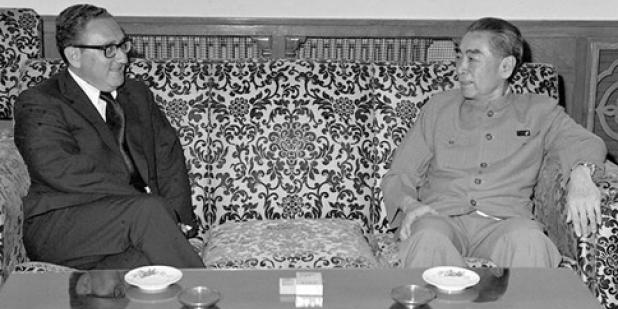
20261002 CDTL NRM D94 26 November 1974 94. Bản ghi nhớ
cuộc Hội đàm.
https://history.state.gov/historicaldocuments/frus1969-76v18/d94
Google Translated
Tài liệu số 94
Quan hệ Đối ngoại của Hoa Kỳ, 1969–1976, Tập
XVIII, Trung Quốc, 1973–1976
94. Bản ghi nhớ cuộc Hội đàm.
Bắc Kinh, ngày 26 tháng 11 năm 1974, 15:45–17:00
THÀNH PHẦN THAM DỰ
Đặng Tiểu Bình, Phó Thủ tướng Quốc vụ viện, Cộng
hòa Nhân dân Tầu cộng
Kiều Quán Hoa, Bộ trưởng Ngoại giao
Vương Hải Dung, Thứ trưởng Bộ Ngoại giao CHND Tầu
cộng
Đại sứ Hoàng Trấn, Trưởng Văn phòng Liên lạc CHND
Tầu cộng tại Washington
Lâm Bình, Vụ trưởng Vụ Châu Mỹ và Châu Đại Dương, Bộ
Ngoại giao
Đường Văn Sinh, Phó Vụ trưởng Vụ Châu Mỹ và Châu Đại
Dương, Bộ Ngoại giao
Tiền Đại Dung, Tham tán, Văn phòng Liên lạc CHND
Tầu cộng tại Washington
Đinh Nguyên Hồng, Trưởng phòng Hoa Kỳ, Vụ Châu Mỹ và
Châu Đại Dương, Bộ Ngoại giao
Triệu Kỳ Hoa, Phó trưởng phòng Hoa Kỳ, Vụ Châu Mỹ và
Châu Đại Dương, Bộ Ngoại giao
Chương Hàm Chi, Phiên dịch
Người ghi chép
Henry A. Kissinger, Ngoại trưởng kiêm Trợ lý Tổng thống
phụ trách An ninh Quốc gia
Donald Rumsfeld, Trợ lý Tổng thống
Đại sứ George Bush, Trưởng Văn phòng Liên lạc Hoa Kỳ tại
Bắc Kinh
Winston Lord, Giám đốc Ban Hoạch định Chính sách, Bộ
Ngoại giao
Philip C. Habib, Trợ lý Ngoại trưởng phụ trách các vấn
đề Đông Á và Thái Bình Dương
Peter Rodman, Chuyên viên, Hội đồng An ninh Quốc gia
Richard H. Solomon, Chuyên viên cấp cao, Hội đồng An
ninh Quốc gia
Karlene Knieps, Người ghi chép
CHỦ ĐỀ
Bình thường hóa quan hệ
Bộ trưởng Kissinger:
Hôm nay phía các ông đông người hơn phía chúng tôi.
Phó Thủ tướng Đặng:
Sẽ có thêm người của chúng tôi đến nữa. Tôi không nghĩ là các ông sẽ đông hơn
chúng tôi được đâu, vì chúng tôi có tới 800 triệu dân.
Bộ trưởng Kissinger:
Vợ và các con tôi rất thích chuyến tham quan Tử Cấm Thành sáng
nay. Chuyến đi thật tuyệt vời.
Phó Thủ tướng Đặng:
Họ có thực sự thích không?
Bộ trưởng Kissinger:
Rất thích.
Phó Thủ tướng Đặng:
Sức khỏe của phu nhân thế nào rồi? Tôi hy vọng bà ấy đã khỏe hơn. [Trang 578]
Bộ trưởng Kissinger:
Bà ấy đã khỏe hơn nhiều rồi.
Phó Thủ tướng Đặng:
Nếu cần hỗ trợ y tế, ông cứ cho chúng tôi biết.
Bộ trưởng Kissinger:
Ông thật chu đáo. Bà ấy định sẽ xem trình diễn châm cứu.
Phó Thủ tướng Đặng:
À, kỹ thuật y học đó của Tầu cộng có lịch sử lâu đời gần bằng Vạn
Lý Trường Thành đấy. Nó ra đời sau Vạn Lý Trường Thành
vài trăm năm, vào thời nhà Hán
Bộ trưởng Kissinger:
Trong một chuyến đi trước, tôi có mang theo một bác sĩ vốn rất hoài nghi về
phương pháp này, nhưng sau khi tận mắt chứng kiến, ông ấy đã vô cùng ấn tượng.
Phó Thủ tướng Đặng:
Nó có từ khoảng hai trăm năm sau Công nguyên, vào thời Tam Quốc.
Chính trong thời kỳ đó, người ta đã có thể thực hiện phẫu thuật kết hợp với
châm cứu.
Bộ trưởng Kissinger:
Thật thú vị khi suy ngẫm về việc làm thế nào mà nó được phát minh ra. Bởi vì
theo tôi hiểu, cho đến nay vẫn chưa ai hiểu rõ lý thuyết hay cơ chế hoạt động của
nó; người ta chỉ biết là nó có hiệu quả.
Phó Thủ tướng Đặng:
Tôi nghĩ chủ yếu là nhờ vào thực tiễn.
Bộ trưởng Kissinger:
Ai là người đầu tiên nảy ra ý tưởng châm kim vào người khác nhỉ?
Phó Thủ tướng Đặng:
Nó được kết hợp với việc sử dụng thuốc thảo dược.
Bộ trưởng Kissinger:
Ai mà ngờ được rằng việc châm kim vào người lại có thể giúp ích cho họ chứ?
Chưa có nền văn minh nào khác nghĩ đến điều đó cả.
Phó Thủ tướng Đặng:
Chúng ta quay lại chủ đề chính nhé? Chúng ta sẽ lắng nghe ý kiến của Tiến sĩ.
Được chứ?
Bộ trưởng Kissinger:
Để tôi thảo luận về vấn đề bình thường hóa quan hệ. Tôi được biết là ông Habib
đã có cuộc trao đổi về quan hệ song phương rồi.
Tôi tin chắc rằng phía chúng tôi có thể tiếp tục tạo
ra thêm nhiều vấn đề phức tạp, miễn là phía các ông cũng làm như vậy. Đó là điều
mà chúng tôi rất giỏi. Hãy để tôi nói về vấn đề bình thường hóa quan hệ.
Khi gặp nhau lần đầu, trong hai cuộc gặp gỡ đầu tiên
[vào năm 1971], chúng ta đã thảo luận về việc hoàn tất tiến trình này trong nhiệm
kỳ thứ hai của Tổng thống Nixon.
Chúng tôi đã tuyên bố sẽ cắt giảm lực lượng quân sự tại
Đài Loan, và chúng tôi đã tái khẳng định điều đó trong Thông cáo Thượng Hải.
Chúng tôi khẳng định sẽ không ủng hộ bất kỳ giải pháp nào theo hướng "hai
nước Tầu cộng ", hay "một Tầu cộng - một Đài
Loan", hoặc bất kỳ biến thể nào khác của các giải pháp đó. [Trang
579] Và chúng tôi cũng sẽ không khuyến khích các quốc gia khác theo đuổi chính
sách như vậy.
Chúng tôi về cơ bản đã duy trì các cam kết này.
Chúng tôi đã cắt giảm lực lượng tại Đài Loan
từ hơn 10.000 quân xuống còn khoảng 3.200 quân như hiện nay. Chúng tôi đã khuyến
khích Nhật Bản tiến tới thiết lập quan hệ với Cộng hòa Nhân dân Trung Hoa. Thực
tế, đây chính là lý do tại sao có thể nói đến một "giải pháp Nhật Bản".
Chúng tôi hoàn toàn không khuyến khích giải pháp "hai nước Tầu cộng
" hay "một Tầu cộng - một Đài Loan"; trái lại là đằng
khác.
Vấn đề hiện nay là làm thế nào để chúng ta hoàn tất tiến
trình này. Tôi muốn chia vấn đề thành một số khía cạnh:
—Vấn đề về quy chế ngoại giao của Đài Loan,
và tất nhiên là vấn đề quan hệ ngoại giao giữa hai nước chúng ta.
—Vấn đề về lực lượng quân sự của chúng tôi tại Đài
Loan.
—Và vấn đề về cam kết quốc phòng của chúng tôi đối với
Đài Loan.
Tình thế của chúng tôi khác biệt so với Nhật Bản—hay bất
kỳ quốc gia nào khác mà các bạn đã bình thường hóa quan hệ—ở hai điểm:
Thứ nhất, tồn tại một mối quan hệ quốc phòng chính thức.
Thứ hai, tại Hoa Kỳ có một nhóm khá đông đảo những người vốn có truyền thống ủng
hộ Đài Loan.
Nhờ sự hợp tác của các bạn, chúng tôi đã có thể vô hiệu
hóa ảnh hưởng của phe ủng hộ Đài Loan tại Hoa Kỳ bằng cách tiến
hành từng bước một cách rất thận trọng. Tuy nhiên, vì lợi ích chung, chúng ta cần
lưu ý ngăn chặn việc quan hệ Trung-Mỹ trở thành một vấn đề gây tranh cãi gay gắt
tại Hoa Kỳ.
Việc xuất hiện một Thượng nghị sĩ hay một nhóm Thượng
nghị sĩ có hành động đối với quan hệ Trung-Mỹ giống như cách Thượng nghị sĩ
Jackson đã cố gắng làm với quan hệ Mỹ-Xô là điều không có lợi cho các bạn, cũng
như không có lợi cho Hoa Kỳ.
Tôi nói chuyện với các bạn rất thẳng thắn để chúng ta
có thể hiểu nhau một cách chính xác. Sau khi tôi trình bày những suy nghĩ của
mình với quý vị, tất nhiên quý vị cũng sẽ chia sẻ quan điểm của mình. Khi đó,
chúng ta sẽ xem liệu có thể giải quyết được vấn đề hay không. Tôi ở đây để tháo
gỡ các trở ngại, chứ không phải để trốn tránh sau chúng.
Như tôi đã nói, chúng tôi tin rằng dù đã có những phát
súng đại bác nổ ra—chủ yếu là từ một phía—thì chúng ta vẫn có những mặt trận
chung.
Như Thủ tướng đã phát biểu ngày hôm qua, phần lớn những
điều đó đều do "gấu Bắc Cực" gây ra.
Chúng tôi không muốn làm tổn hại đến khả năng đó [xây
dựng mặt trận chung với CHND Tầu cộng] khi xét đến những nguy cơ
có thể xảy ra trong tương lai, đồng thời ghi nhớ điều Chủ tịch Mao đã nói với
tôi vào năm ngoái về hai khía cạnh: bình thường hóa quan hệ và môi trường quốc
tế.
Sau khi nói như vậy, tôi xin quay lại các vấn đề cụ thể
giữa hai bên. [Trang 580]
Trước hết, về vấn đề quy chế ngoại giao: Chúng tôi sẵn
sàng giải quyết vấn đề này về cơ bản theo mô hình Nhật Bản; với một điểm khác
biệt là sẽ thuận tiện nhất cho chúng tôi nếu có thể duy trì một văn phòng liên
lạc tại Đài Loan và một đại sứ quán tại Bắc Kinh. Ngoài điểm đó ra, chúng tôi sẽ
tuân theo mô hình Nhật Bản.
Liên quan đến sự hiện diện của quân đội [Hoa Kỳ] tại Đài
Loan, chúng tôi sẵn sàng rút toàn bộ lực lượng khỏi hòn đảo này. Chúng
tôi muốn thống nhất với phía các bạn về một lịch trình, một khung thời gian để
hoàn tất việc này—theo đó chúng tôi sẽ cắt giảm một nửa lực lượng vào mùa hè
năm 1976 và rút số còn lại vào cuối năm 1977.
Nhân tiện, điều tôi đang thảo luận không phải là vấn đề
mà chúng tôi muốn công bố ngay—chúng ta có thể đạt được thỏa thuận tại đây,
nhưng thỏa thuận đó không nên được công bố cho đến cuối năm 1975. Tuy nhiên,
chúng tôi muốn đạt được sự hiểu biết chung ngay từ bây giờ về việc mọi chuyện sẽ
diễn ra như vậy.
Bây giờ, vấn đề cuối cùng còn lại là mối quan hệ quốc
phòng của chúng tôi với Đài Loan. Và đây là vấn đề mà, nói một
cách thẳng thắn, chúng tôi vẫn chưa tìm ra giải pháp thỏa đáng.
Vấn đề của chúng tôi là thế này: xét về mặt hình thức,
tất nhiên thật vô lý khi nói rằng mình có một thỏa thuận quốc phòng với một phần
lãnh thổ của một quốc gia mà mình đã công nhận chủ quyền—tức là phần lãnh thổ
thuộc về quốc gia đó.
Thứ hai, rõ ràng là chúng tôi không có lợi ích gì
trong việc duy trì một căn cứ chiến lược tại Đài Loan sau khi đã
thiết lập quan hệ ngoại giao với Bắc Kinh và công nhận Bắc Kinh là chính phủ hợp
pháp của toàn bộ Tầu cộng.
Nhưng như tôi đã nói với Bộ trưởng Ngoại giao tại New
York, chúng tôi cần một phương thức cho phép chúng tôi tuyên bố rằng, ít nhất
là trong một khoảng thời gian nhất định, sẽ có những đảm bảo về việc tái thống
nhất trong hòa bình; phương thức này có thể được xem xét lại sau một thời gian
để tránh những khó khăn mà tôi đã mô tả. Nếu thực hiện được điều này, đồng
nghĩa với việc chúng ta chấp nhận Bắc Kinh là chính phủ [hợp pháp] [của Tầu
cộng]. Chúng ta sẽ rút lại sự công nhận đối với Đài Loan và cắt đứt
quan hệ ngoại giao với Đài Loan. Chúng ta cũng sẽ rút quân khỏi Đài Loan.
Tất cả những gì còn lại chỉ là việc chúng ta có một mối liên hệ nào đó với tiến
trình tái thống nhất trong hòa bình.
Nói một cách thẳng thắn và thực tế tại đây, xét về tác
động chính trị và tâm lý của việc cắt đứt quan hệ, thì mối quan hệ quốc phòng của
chúng ta sẽ bị suy giảm do hành động công nhận này. Tuy nhiên, chúng ta cần một
giai đoạn chuyển tiếp để dư luận trong nước có thể chấp nhận quá trình này mà
không gây ra những căng thẳng nội bộ quá mức.
Đó là những cân nhắc cơ bản của chúng tôi. Nếu chúng
ta thống nhất được các nguyên tắc, thì sau đó có thể xem xét xây dựng một
phương thức cụ thể.
Phó Thủ tướng Đặng:
Chỉ có vậy thôi sao?
Bộ trưởng Kissinger:
Vâng, đó là những điểm cốt lõi. [Trang 581] Tôi muốn nhấn mạnh một điểm. Đối với
chúng tôi, vấn đề cam kết quốc phòng chủ yếu nằm ở cách thức thể hiện cam kết
đó về mặt chính trị. Vấn đề không phải là duy trì cam kết đó trong một khoảng
thời gian vô hạn.
Phó Thủ tướng Đặng:
Thực ra thì chính các ông đã soạn thảo đạo luật này, phải không?
Bộ trưởng Kissinger:
Đạo luật nào vậy?
Phó Thủ tướng Đặng:
Chính các ông là người đặt ra luật lệ. Ý tôi là luật lệ về cam kết quốc phòng
mà các ông có với Đài Loan. Chính các ông đã quy định điều đó.
Bộ trưởng Kissinger:
Tất nhiên rồi. Điều đó hoàn toàn đúng.
Phó Thủ tướng Đặng:
Vậy thì, vì các ông có thể đặt ra luật, thì đương nhiên các ông cũng có thể bãi
bỏ nó.
Bộ trưởng Kissinger:
Điều đó cũng đúng. Quan điểm của chúng tôi không phải là không thể làm được việc
đó. Vấn đề là, vì những lý do tôi đã giải thích với ông, việc thực hiện điều đó
không phải là nước đi thích hợp—bởi lẽ, bản thân hành động công nhận ngoại giao
sẽ làm thay đổi bản chất của thỏa thuận hiện tại, vì không thể có một hiệp ước
quốc phòng với một phần của một quốc gia.
Phó Thủ tướng Đặng:
Tôi đã ghi nhận những cân nhắc mà Tiến sĩ vừa đề cập. Và tôi hiểu rằng Tiến sĩ
đã thảo luận tất cả những ý tưởng này với Bộ trưởng Ngoại giao khi ông ấy ở New
York vào tháng Mười.
Bộ trưởng Kissinger:
Đúng vậy.
Phó Thủ tướng Đặng:
Và tôi tin rằng về mặt nguyên tắc, Bộ trưởng Ngoại giao đã đưa ra câu trả lời từ
phía chúng tôi đối với các vấn đề chính. Về bản chất, những ý tưởng hay những
cân nhắc của các ông không thể được coi là phù hợp với "mô hình Nhật Bản".
Và chúng tôi cảm thấy rằng, về bản chất, đó vẫn là một
biến thể của công thức "một Tầu cộng, một Đài Loan".
Bộ trưởng Kissinger:
Tại sao lại như vậy?
Phó Thủ tướng Đặng:
Vấn đề chủ yếu là các ông chỉ đảo ngược vị trí, thay đổi vị trí của văn phòng
liên lạc. Tình hình hiện nay là chúng tôi đã thiết lập văn phòng liên lạc tại
Washington và các ông đã thiết lập văn phòng tại Bắc Kinh. Trong
khi đó, các ông vẫn duy trì đại sứ quán tại Đài Loan. Bản thân điều
này cho thấy chưa có đủ các điều kiện cần thiết để bình thường hóa quan hệ.
Nói cách khác, nếu các ông thay đổi trật tự này—tức là
đặt đại sứ quán tại Bắc Kinh và văn phòng liên lạc tại Đài
Loan—thì đó không phải là cách giải quyết vấn đề.
Người ta sẽ đi đến kết luận rằng đó thực chất là một
biến thể của công thức "một Tầu cộng, một Đài Loan".
Do đó, chúng tôi thấy khó có thể chấp nhận công thức này. [Trang 582]
Và vừa rồi ông có đề cập đến vấn đề hiệp ước quốc
phòng. Ý tôi là hiệp ước quốc phòng mà các ông ký kết với Tưởng Giới Thạch
ở Đài Loan. Tất nhiên, nếu chúng ta muốn bình thường hóa quan hệ
giữa hai nước và tuân thủ lộ trình đã được vạch ra trong Thông cáo Thượng
Hải, thì hiệp ước mà các ông ký kết với Đài Loan phải bị
hủy bỏ.
Thực ra, chính Tiến sĩ vừa nêu ra những lý do đó.
Bộ trưởng Kissinger:
Hiệp ước phòng thủ sẽ không còn giá trị pháp lý quốc tế sau khi quan hệ được
bình thường hóa.
Phó Thủ tướng Đặng:
Nhưng nó vẫn mang ý nghĩa thực chất.
Như vậy, có vẻ như thời điểm giải quyết vấn đề này vẫn
chưa chín muồi, bởi vì theo công thức của các ông, chúng tôi không thể chấp nhận
phương thức bình thường hóa này. Dường như các ông vẫn cần đến Đài Loan.
Bộ trưởng Kissinger:
Không, chúng tôi không cần Đài Loan. Đó không phải là vấn đề. Tôi
nghĩ điều này cần được hiểu rõ. Nếu nghĩ khác đi thì đó là sự hiểu lầm về vấn đề
này.
Điều chúng tôi muốn đạt được là tách dần khỏi Đài
Loan theo từng bước, đúng như cách chúng tôi đã thực hiện cho đến nay.
Không còn nghi ngờ gì nữa, vị thế của Đài Loan đã bị suy giảm bởi
tiến trình mà chúng tôi đang theo đuổi. Và tiến trình này sẽ được đẩy nhanh hơn
nữa nhờ những ý tưởng mà chúng tôi đã đề xuất.
Phó Thủ tướng Đặng:
Và một vấn đề khác là phương thức giải quyết vấn đề Đài Loan. Về
việc giải quyết vấn đề Đài Loan, giả sử quý vị đã cắt đứt quan hệ
ngoại giao với Đài Loan, thì vấn đề Đài Loan nên được để cho người
Trung Quốc chúng tôi tự giải quyết với nhau.
Về việc chúng tôi sẽ sử dụng biện pháp nào để giải quyết
vấn đề Đài Loan, tôi tin rằng Chủ tịch Mao Trạch Đông đã nói rất
rõ trong cuộc trao đổi của ông.
Bộ trưởng Kissinger: Chủ
tịch Mao, nếu tôi hiểu đúng ý ông, đã đưa ra hai nhận định: Một là ông
tin rằng vấn đề này rốt cuộc sẽ phải được giải quyết bằng vũ lực. Nhưng ông
cũng tuyên bố rằng Tầu cộng có thể chờ đợi một trăm năm để thực
hiện điều này, nếu tôi hiểu đúng ý ông.
Bộ trưởng Kissinger:
Đúng vậy. Ông ấy đã nói như thế.
Tất nhiên, con số "một trăm năm" chỉ mang
tính biểu tượng.
Bộ trưởng Kissinger:
Tất nhiên, tôi hiểu điều này. Tôi định nói rằng trong một trăm năm nữa, tôi sẽ
không còn là Bộ trưởng Ngoại giao nữa. Thỉnh thoảng tôi phải nói vậy để
mang lại chút hy vọng cho các cộng sự của mình. Tôi hiểu đó là con số mang tính
biểu tượng. Tôi cũng hiểu rằng sau khi bình thường hóa quan hệ, mọi yếu tố mang
tính chủ quyền trong mối quan hệ giữa Đài Loan và Hoa Kỳ đều
phải bị loại bỏ. [Trang 583]
Phó Thủ tướng Đặng:
Chủ tịch Mao Trạch Đông đã nói rất rõ rằng việc giải quyết vấn đề
Đài Loan là công việc nội bộ của Tầu cộng và nên để
người Tầu cộng tự giải quyết.
Vừa rồi Tiến sĩ Kissinger có nói rằng đối với vấn
đề Đài Loan, quý vị mong muốn có một sự tái thống nhất trong hòa
bình.
Bộ trưởng Kissinger:
Đúng là như vậy.
Phó Thủ tướng Đặng:
Và tôi tin rằng ông đã đề cập đến mong muốn của Hoa Kỳ về việc tham gia vào một
cơ chế bảo đảm nào đó liên quan đến vấn đề này.
Bộ trưởng Kissinger:
Để tôi giải thích về mối quan tâm của chúng tôi. Chúng tôi chưa xây dựng được một
công thức pháp lý cụ thể. Chúng tôi tin rằng... điều tôi sắp nói có thể dễ bị
hiểu sai. Hãy để tôi giải thích chính xác lập trường của chúng tôi.
Khi tôi đến đây vào năm 1971, rõ ràng là chúng tôi
đang bắt đầu một tiến trình sẽ dẫn đến sự suy giảm dần vị thế của Đài Loan.
Chắc chắn quý vị sẽ không thể được kết nạp vào Liên Hợp
Quốc vào năm 1971—rốt cuộc thì chuyện đó cũng sẽ xảy ra, nhưng không phải vào
năm 1971. Sẽ cần nhiều thời gian hơn. Và việc bình thường hóa quan hệ với Nhật
Bản sẽ không thể hoàn tất sớm đến vậy. Chúng tôi đã hợp tác toàn diện trong vấn
đề này và thiết lập những nguyên tắc mà sớm muộn gì cũng sẽ được thực thi.
Chúng tôi đã thực hiện điều đó với thái độ hoàn toàn nghiêm túc.
Ông biết đấy, chúng tôi chưa từng nỗ lực ngăn cản bất
kỳ quốc gia nào thiết lập quan hệ với các ông hay cắt đứt quan hệ với Đài
Loan.
Vấn đề nằm ở tác động quốc tế nếu Mỹ đột ngột đảo ngược
hoàn toàn lập trường của mình; điều này sẽ ảnh hưởng đến các quốc gia thân thiện
khác, và thậm chí có thể cả những nước không thân thiện với cả hai bên chúng
ta.
Ngoại trưởng Kissinger:
Nhưng mặt khác, nếu chấp nhận công thức của các ông, chúng tôi cũng sẽ tạo ra
tác động quốc tế cho thấy rằng chúng tôi đã đồng ý với công thức "một Tầu
cộng - một Đài Loan".
Ngoại trưởng Kissinger:
Không, chúng tôi sẽ nỗ lực làm rõ rằng tình hình không phải như vậy. Chúng tôi
sẽ không chấp nhận một giải pháp mà cả hai bên đều đã từng bác bỏ.
Theo tôi, chúng ta có hai lựa chọn cơ bản. Hiện có hai
con đường mà chúng ta có thể đi: Chúng ta có thể tiếp tục tiến trình hiện tại—một
tiến trình có thể chấp nhận được—và dần dần rút lực lượng khỏi Đài Loan
(việc này dù sao cũng sẽ diễn ra, bất kể các ông quyết định thế nào tại đây).
Chúng tôi sẽ tăng cường quan hệ với các ông như đã làm trong ba năm qua, và chờ
đợi thời điểm thích hợp để hoàn tất tiến trình này bằng một quyết định duy nhất.
Hoặc, chúng ta có thể thực hiện một quy trình trong đó
chúng ta nhanh chóng hoàn tất khía cạnh chính trị của mối quan hệ và làm rõ rằng
chúng ta đang giải quyết đồng thời các vấn đề về chủ quyền—về "một Tầu
cộng và một Đài Loan"—đồng thời tìm ra một công thức
thể hiện được ý nghĩa mang tính biểu tượng trong tư tưởng của Chủ tịch
Mao. Đó là nỗ lực tái thống nhất hòa bình trong một khoảng thời gian hợp
lý. Chúng tôi không muốn có tiếng nói trong cuộc thảo luận về việc tái thống nhất
hòa bình. Việc đó nên để dành cho phía Tầu cộng. Chúng tôi không
muốn tham gia vào quy trình đó.
Trương Hàm Chi:
Tôi chưa rõ lắm về phần đầu trong phát biểu của ông.
Bộ trưởng Kissinger:
Phó Thủ tướng đã nói rằng tất nhiên con số một trăm năm chỉ mang tính biểu tượng.
Tôi hiểu ý nghĩa biểu tượng trong tuyên bố của Chủ tịch Mao về thời
hạn một trăm năm. Tôi hiểu rằng phía các ông sẵn sàng dành thời gian để tiến
trình hòa bình phát huy tác dụng—rằng mặc dù về mặt triết lý, giải pháp cuối
cùng có thể sẽ phải dùng đến vũ lực, nhưng các ông vẫn sẵn sàng tạo cơ hội lâu
dài cho con đường hòa bình.
Chúng tôi không muốn tham gia vào quy trình tái thống
nhất. Và chúng tôi hoàn toàn không gặp trở ngại gì trong việc khẳng định nguyên
tắc "một Tầu cộng ". Vì vậy, vấn đề của chúng tôi không
phải là chuyện "một Tầu cộng, một Đài Loan".
Ngoại trưởng Kiều:
Nếu tôi hiểu đúng, thì ý ông là ông ủng hộ nguyên tắc "một Tầu cộng
", nhưng đó phải là một Tầu cộng đạt được thông qua các biện
pháp hòa bình.
Bộ trưởng Kissinger:
Chính xác. Ít nhất là trong một khoảng thời gian hợp lý. Chúng tôi muốn tránh
tình huống Hoa Kỳ ký kết một văn bản dẫn đến giải pháp quân sự ngay sau khi
bình thường hóa quan hệ. Tuy nhiên, chúng tôi cũng không muốn một cam kết duy
trì sự chia cắt. Điều chúng tôi hình dung—có thể chúng tôi chưa có công thức cụ
thể—nhưng những gì chúng tôi nghĩ dường như phù hợp với quan điểm của Chủ
tịch Mao về mặt quy trình.
Phó Thủ tướng Đặng:
Chúng tôi vừa kiểm tra lại chính xác những gì Chủ tịch Mao đã nói
khi trao đổi với Tiến sĩ, và chúng tôi hiểu ý ông ấy là: "Tôi không nghĩ rằng
việc bình thường hóa quan hệ giữa Trung Quốc và Hoa Kỳ sẽ mất tới một trăm
năm." Qua đó, chúng tôi hiểu rằng tuyên bố của Chủ tịch Mao
không có nghĩa là chúng tôi không mong muốn hoàn tất quy trình bình thường hóa
càng sớm càng tốt. Tôi cho rằng vấn đề Đài Loan đồng thời cũng là vấn đề bình
thường hóa quan hệ giữa Tầu cộng và Hoa Kỳ.
Có ba nguyên tắc mà chúng tôi không thể xem xét lại
hay đem ra mặc cả. Nguyên tắc đầu tiên là chúng tôi kiên quyết tuân thủ Thông
cáo Thượng Hải. Nghĩa là, chúng tôi bác bỏ mọi phương án dẫn đến giải pháp
"hai Tầu cộng ", "một Tầu cộng - một
Đài Loan", hay bất kỳ biến thể nào của các mô hình này.
Ý tưởng thiết lập đại sứ quán tại Bắc Kinh
và văn phòng liên lạc tại Đài Loan là một biến tướng của mô hình
"một Tầu cộng - một Đài Loan", điều mà
chúng tôi không thể chấp nhận.
Nguyên tắc thứ hai là việc giải quyết vấn đề Đài
Loan thuộc về công việc nội bộ của người dân Tầu cộng, và
chỉ có chính người dân Tầu cộng mới có thể giải quyết vấn đề này.
Còn về phương thức chúng tôi sẽ sử dụng để giải quyết dứt điểm vấn đề Đài
Loan—dù là biện pháp hòa bình hay phi hòa bình—thì đó là vấn đề, là công việc nội
bộ, cần để cho người dân Tầu cộng tự quyết định.
Điểm thứ ba, cũng là một nguyên tắc đối với chúng tôi,
là chúng tôi không chấp nhận sự tham gia của bất kỳ quốc gia nào khác vào việc
giải quyết vấn đề Đài Loan, bao gồm cả Hoa Kỳ.
Như vậy, có vẻ như vẫn còn một khoảng cách khá lớn giữa
hai bên về vấn đề này. Như tôi vừa nói, dường như phía các ông vẫn cần đến Đài
Loan. Nếu các ông vẫn cần Đài Loan, chúng tôi có thể chờ
đợi. Chúng tôi có thể chờ cho đến khi thời cơ chín muồi hơn để giải quyết vấn đề
này.
Ngoại trưởng Kissinger:
Để tôi bình luận về ba điểm này. Sau đó, tôi xin nói thêm một điều nữa.
Phó Thủ tướng Đặng:
Chúng tôi đã đối chiếu với các ghi chép về những gì Chủ tịch Mao
đã nói vào năm ngoái và nhận thấy cách hiểu của mình là chính xác. Những gì Chủ
tịch Mao nói năm ngoái là chúng ta cần tách biệt hai vấn đề: quan hệ giữa
Hoa Kỳ với chúng tôi và quan hệ giữa Đài Loan với Hoa Kỳ. Hai vấn
đề này cần được tách biệt.
Sau đó, Chủ tịch nói tiếp rằng nếu các ông cắt đứt
quan hệ ngoại giao với Đài Loan, thì việc giải quyết vấn đề quan
hệ ngoại giao [giữa hai nước chúng ta] sẽ trở nên khả thi. Nghĩa là, làm giống
như cách chúng tôi đã thực hiện với Nhật Bản. Chúng tôi hiểu đó là đề cập đến
"mô hình Nhật Bản".
Tiếp đó, Chủ tịch nói rằng, đối với quan
hệ giữa Đài Loan và chúng tôi, chúng tôi không tin vào một quá
trình chuyển đổi hòa bình.
Chủ tịch
cũng nói rằng chúng tôi có thể sống mà không cần Đài Loan—chúng
tôi có thể chờ đợi một trăm năm để giải quyết vấn đề này. Và Chủ tịch cũng nói:
"Còn về quan hệ giữa các ông và chúng tôi, tôi không nghĩ rằng sẽ mất tới
một trăm năm để giải quyết."
Tôi nghĩ ý nghĩa của cuộc trao đổi này đã rất rõ ràng.
Ngoại trưởng Kissinger:
Tôi đồng ý. Đó chính xác là những gì tôi nhớ về cuộc trao đổi đó. Từ điều này,
tôi cũng rút ra một số suy luận bằng bộ não có phần chậm chạp hơn so với người
Trung Quốc. Chưa từng có người Tầu cộng nào phản bác nhận định đó
của tôi (cười).
Tôi nhớ có lần Thủ tướng Chu Ân Lai nhận
xét rằng tôi là người thông minh, và tôi đã đáp lại rằng theo tiêu chuẩn của Tầu
cộng thì ý ông là tôi chỉ có trí thông minh ở mức trung bình. Ông ấy
cũng không hề phản bác lại tôi (cười).
Nhưng xin phép được nói về những gì tôi đúc kết được từ
cuộc đối thoại này; bởi vì cách hiểu của tôi hoàn toàn trùng khớp với những gì
Phó Thủ tướng đã trình bày.
Tôi rút ra kết luận rằng điều kiện tiên quyết để bình
thường hóa quan hệ là phải cắt đứt quan hệ ngoại giao với Đài Loan. Chúng tôi sẵn
sàng thực hiện điều đó. Và tôi tin rằng chúng ta có thể tìm ra một phương thức
giải quyết thỏa đáng cho cả hai bên về vấn đề này. [Trang 586]
Kết luận thứ hai mà tôi rút ra từ phát biểu của Chủ tịch
là ông tin rằng quan hệ ngoại giao có thể được thiết lập, và sau đó có thể sẽ cần
một khoảng thời gian cho đến khi quá trình thực sự hội nhập [của Đài Loan vào CHND
Tầu cộng] hoàn tất—theo quan điểm lịch sử của ông.
Thưa Phó Thủ tướng, trong số ba nguyên tắc mà ông đã
nêu, chúng tôi cho rằng nguyên tắc đầu tiên không phải là vấn đề khó giải quyết.
Chúng tôi sẽ tìm ra giải pháp để khẳng định rõ ràng rằng sẽ không có chuyện tồn
tại mô hình "một Tầu cộng – một Đài Loan".
Đây là vấn đề có thể giải quyết được – và thậm chí còn dễ dàng hơn nhiều so với
những vấn đề khác mà chúng ta từng giải quyết trước đây.
Phó Thủ tướng Đặng:
Nhưng sẽ không ổn nếu các ông thiết lập văn phòng liên lạc tại Đài Loan,
hay thậm chí là lãnh sự quán.
Bộ trưởng Kissinger:
Tôi vẫn tin rằng chúng ta có thể tìm ra giải pháp cho vấn đề này. Tôi nhận thấy
Đại sứ [Hoàng Trấn] rất coi trọng khái niệm văn phòng liên lạc.
Ông ấy là người đứng đầu văn phòng liên lạc duy nhất trên thế giới do một Đại
sứ Tầu cộng lãnh đạo.
Hoàng Trấn:
Hiểu biết của tôi về bản chất của văn phòng liên lạc dựa trên những ý tưởng mà Chủ
tịch Mao đã đưa ra – về bản chất của một văn phòng liên lạc.
Bộ trưởng Kissinger:
Tôi xin nhắc lại, tôi tin rằng chúng ta có thể tìm ra giải pháp cho vấn đề đầu
tiên. Mặc dù hiện tại chúng ta chưa đi vào thảo luận chi tiết, nhưng tôi tin là
sẽ tìm được cách giải quyết.
Vấn đề thứ hai: Chúng tôi không muốn tham gia dưới bất
kỳ hình thức nào vào quá trình tái thống nhất, hay quá trình hiện thực hóa việc
tái thống nhất đó.
Vấn đề thứ ba là điều tôi đã trình bày với ông: Làm thế
nào để tránh tạo ra ấn tượng rằng chúng tôi đơn thuần bỏ rơi những người từng gắn
bó với mình mà không tạo điều kiện – như trong đoạn văn ông đã đọc cho tôi nghe
– để có một khoảng thời gian cho phép quá trình này có cơ hội thành công.
Cụ thể là, việc thiết lập quan hệ ngoại giao có thể diễn
ra trước khi quá trình tái thống nhất hoàn tất – làm sao để thể hiện điều này
trong thỏa thuận của chúng ta. Đây là vấn đề quan trọng.
Theo tôi, chúng ta có hai hướng đi và chúng tôi sẵn
sàng chọn một trong hai.
Hướng thứ nhất là Hoa Kỳ đơn phương giảm bớt sự hiện
diện tại Đài Loan, theo cách chúng tôi vẫn đang thực hiện. Chúng
tôi sẽ làm điều này bằng cách rút quân, và vào thời điểm thích hợp trước năm
1976, sẽ hạ thấp cấp bậc đại diện ngoại giao của mình.
Hướng thứ hai là chúng ta bắt đầu đàm phán về ba điểm
mà chúng ta đã thảo luận ở đây. Tôi không cho rằng những khác biệt giữa hai bên
là không thể vượt qua.
Phó Thủ tướng Đặng:
Tôi tin rằng chúng ta có thể tiếp tục thảo luận về vấn đề này. Tôi không nghĩ
chiều nay chúng ta còn nhiều thời gian cho vấn đề đó. Có vẻ như cả hai bên khó
có thể đạt được thỏa thuận nào trong chuyến thăm lần này của ông.
Chúng tôi còn một cân nhắc khác về quan hệ giữa hai nước.
Đó là, như tôi đã nói trước đây, có những ý kiến cho rằng quan hệ giữa hai nước
đang bị nguội lạnh. Vì vậy, Chính phủ Trung Quốc muốn gửi lời mời tới ông. Cụ
thể là, cầm quyền Tầu cộng mong muốn gửi lời mời
chính thức tới Bộ trưởng Quốc phòng Hoa Kỳ, ông Schlesinger, sang thăm Tầu
cộng. Chúng tôi cho rằng đây sẽ là câu trả lời thỏa đáng cho những dư
luận đang lan truyền trên thế giới.
Bộ trưởng Kissinger:
Điều đó sẽ dẫn đến một cuộc họp Bộ Chính trị tại Điện Kremlin đấy.
Phó Thủ tướng Đặng:
Chúng tôi không ngại chuyện đó. Thực ra, chúng tôi cũng mong muốn họ tổ chức một
cuộc họp Bộ Chính trị ở đó. Nhưng chúng tôi thực sự đưa ra lời mời này với thái
độ hoàn toàn nghiêm túc.
Bộ trưởng Kissinger:
Tôi trân trọng điều này và xin phép được suy nghĩ thêm. Tuy nhiên, tôi muốn nói
một điều về mặt nguyên tắc. Về phía mình, chúng tôi tin rằng việc chứng minh
quan hệ hai nước không hề bị nguội lạnh là điều rất cần thiết; chúng ta cần tiếp
tục cho thấy không những quan hệ không bị nguội lạnh mà còn đang tiếp tục được
cải thiện. Và dù quyết định về lời mời cụ thể này có ra sao, tôi tin chắc rằng
hai bên có thể tìm ra các phương thức để thể hiện sự cải thiện đáng kể trong mối
quan hệ của chúng ta.
Phó Thủ tướng Đặng:
Vậy chúng tôi sẽ chờ câu trả lời từ phía ông—từ chính phủ của ông.
Ngoại trưởng Kiều:
Chúng tôi được biết chiều nay ông Bush sẽ tổ chức tiệc chiêu đãi.
Đại sứ Bush:
Vợ tôi đã dành phần lớn thời gian để chờ đợi rồi, nên xin đừng lo lắng về chuyện
đó.
Phó Thủ tướng Đặng:
Chúng tôi đề nghị 9 giờ sáng mai [cho cuộc họp tiếp theo].
Bộ trưởng Kissinger:
Tôi đề nghị rằng lúc bắt đầu, trong khoảng nửa giờ, chúng ta sẽ họp với một
nhóm rất nhỏ. Về phía các ông thì tùy ý quyết định. Tôi sẽ chỉ mang theo ba người,
bao gồm cả tôi. Các ông có thể cử bao nhiêu người tùy thích.
Phó Thủ tướng Đặng:
Chúng tôi sẽ quyết định số lượng người tham gia dựa trên tỷ lệ dân số của mình
(cười).
Bộ trưởng Kissinger:
So với của chúng tôi! Vậy là các ông sẽ có 12 chiếc. Sẽ không mất nhiều thời
gian đâu.
1. Nguồn:
Thư viện Ford, Cố vấn An ninh Quốc gia, Các báo cáo của Kissinger
về các cuộc thảo luận liên quan đến Liên Xô, Tầu cộng và Trung
Đông, Hộp 2, Các biên bản ghi nhớ và báo cáo về Tầu cộng, ngày
25–29 tháng 11 năm 1974, Chuyến công du của Kissinger. Tuyệt mật; Nhạy cảm.
Cuộc họp diễn ra tại Đại lễ đường Nhân dân. Tất cả các phần nằm
trong ngoặc vuông đều có trong văn bản gốc.↩
2. Biên
bản ghi nhớ về cuộc thảo luận giữa hai bên này – diễn ra vào ngày 26 tháng 11,
từ 14:00 đến 15:15 – cũng nằm trong cùng tài liệu này.↩
Historical Documents - Office of the Historian
1.
Document 94
Foreign Relations of the United States, 1969–1976, Volume
XVIII, China, 1973–1976
94.
Memorandum of Conversation1
Beijing,
November 26, 1974, 3:45–5:00 p.m.
PARTICIPANTS
· Teng
Hsiao-p’ing, Vice Premier of the State Council, People’s Republic of China
· Ch’iao
Kuan-hua, Minister of Foreign Affairs
· Wang
Hai-jung, PRC Vice Foreign Minister
· Ambassador
Huang Chen, Chief of the PRC Liaison Office, Washington
· Lin
P’ing, Director, Department of American and Oceanic Affairs, Ministry of
Foreign Affairs
· T’ang
Wen-sheng, Deputy Director, Department of American and Oceanic Affairs,
Ministry of Foreign Affairs
· Tsien
Ta-yung, Counselor, PRC Liaison Office, Washington
· Ting
Yuan-hung, Director, United States Office, Department of American and Oceanic
Affairs, Ministry of Foreign Affairs
· Chao
Chi-hua, Deputy Director, United States Office, Department of American and
Oceanic Affairs, Ministry of Foreign Affairs
· Chang
Han-chih, Translator
· Notetaker
· Henry
A. Kissinger, Secretary of State and Assistant to the President for National
Security Affairs
· Donald
Rumsfeld, Assistant to the President
· Ambassador
George Bush, Chief of the United States Liaison Office, Peking
· Winston
Lord, Director, Policy Planning Staff, Department of State
· Philip
C. Habib, Assistant Secretary of State for East Asian and Pacific Affairs
· Peter
Rodman, Staff Member, National Security Council
· Richard
H. Solomon, Senior Staff Member, National Security Council
· Karlene
Knieps, Notetaker
SUBJECT
· Normalization
Secretary Kissinger: They outnumber us today.
Vice Premier Teng: Some more on our side are coming. I
don’t think you will ever outnumber us because we have 800 million.
Secretary Kissinger: My children and my wife very much
appreciated the tour of the Forbidden City this morning. It was very nice.
Vice Premier Teng: Did they like it at all?
Secretary Kissinger: Very much.
Vice Premier Teng: How is the health of your wife? I hope
it is better.
[Page 578]
Secretary Kissinger: It is much better.
Vice Premier Teng: If you need any medical help you just
let us know.
Secretary Kissinger: You are very nice. She is going to
watch acupuncture.
Vice Premier Teng: Well that medical technique of China is
almost as old as the Great Wall of China. A few hundred years later than the
Great Wall. It was created at the time of the Han Dynasty.
Secretary Kissinger: On one trip I brought a doctor along
who was very skeptical of it and after he saw it he was very impressed.
Vice Premier Teng: It goes as far back as about two hundred
years after Christ. During the time of the three kingdoms. It was during that
time people were able to have an operation with acupuncture.
Secretary Kissinger: It is interesting to reflect how it
could have been invented. Because as I understand it, to this day nobody
understands the theory, why it works, just that it works.
Vice Premier Teng: I think mainly it was through practice.
Secretary Kissinger: Who got the first idea to stick a
needle into somebody?
Vice Premier Teng: It was combined with the use of herb
medicine.
Secretary Kissinger: Who would have thought if you stick a
needle into somebody it would help him? No other civilization thought about
that.
Vice Premier Teng: Shall we come back to our subject? We
will listen to the Doctor. All right?
Secretary Kissinger: Let me discuss the subject of
normalization. I understand that Mr. Habib has already had a talk on the
bilateral relations.2
I am confident that our side can keep multiplying the
complexities as long as your side can. It is something we are very good at.
Let me speak about the normalization problem.
When we met the first time, in our first two meetings [in
1971] we discussed completing the process during the second term of President
Nixon.
We said that we would reduce our military forces on Taiwan,
and we repeated that in the Shanghai Communiqué;. We said we would not support
any two Chinas solution, or a one China–one Taiwan solution, or any variation.
[Page 579]
And we would not encourage other countries to pursue such a
policy.
We have substantially maintained these commitments.
We have reduced our forces on Taiwan from over 10,000 to
about 3,200 today. We encouraged the Japanese movement towards the People’s
Republic. This is in fact why you can speak of a Japanese solution. We have
given no encouragement to a two Chinas or one China–one Taiwan solution; quite
the contrary.
Now the problem is how we can complete the process. I would
like to divide it into a number of parts:
- —There is the problem of the diplomatic status of Taiwan, and of
course of the diplomatic relations between us.
- —There is the problem of our military forces on Taiwan.
- —And there is the problem of our defense commitment to Taiwan.
Our problem is different from the situation of Japan, or
for that matter from the situation of any other country with which you have
normalized relations, in two respects:
First, there is a formal defense relationship. Secondly,
there is a rather substantial group in the United States that historically has
been pro-Taiwan.
Together with your cooperation we have been able to
neutralize the pro-Taiwan element in the United States by moving step-by-step
in a very careful manner. But what we have to keep in mind for our common
interest is to prevent Sino-American relations from becoming an extremely
contentious issue in the United States.
It is not in your interest, or in that of the United
States, to have emerge a Senator or Senatorial group which does to
Sino-American relations what Senator Jackson has attempted to do to United
States-Soviet relations.
I am speaking very frankly to you so that we understand
each other exactly. After I have put my considerations before you, you will of
course give me yours. Then we will see if we can solve the problem. I am here
to remove obstacles, not to hide behind them.
We believe, as I have said, that while cannons have been
fired— mostly in one direction—we have also had common fronts.
As the Premier said yesterday, they were mostly produced by
the “polar bear.”
We do not want to jeopardize that possibility [of
developing common fronts with the PRC] given the dangers that may be ahead, and
keeping in mind what Chairman Mao said to me last year of the two
strands—normalization, and the international environment.
Now having said this, let me go back to the specific issues
between us.
[Page 580]
First, on the issue of the diplomatic status: We are
prepared to solve this on substantially the Japan model; and with the one
variation that it would be easiest for us if we could maintain a liaison office
in Taiwan and an embassy in Peking. Except for that we would follow the Japan
model.
With respect to the presence of [U.S.] troops on Taiwan, we
are prepared to remove all our troops from Taiwan. We would like to agree with
you on a schedule, a time-frame within which this will be accomplished—by which
we would reduce the forces by half by the summer of 1976, and the remainder to
be removed by the end of 1977.
Incidentally, what I am discussing is not something to
which we want to agree—we can agree to it here, but it should not be announced
until the end of 1975, the agreement we make. But we want to come to an
understanding about it now, that this is what would happen.
Now that leaves the last problem, which is our defense
relationship to Taiwan. And this is a problem to which, in all frankness, we
have not come up with a good answer.
Our problem is this: on the face of it, it is of course
absurd to say one has a defense arrangement with a part of a country one
recognizes, that is, which belongs to that country.
Secondly, we obviously have no interest in maintaining a
strategic base on Taiwan after we have established diplomatic relations with
Peking and recognized Peking as the legal government of all China.
But as I told the Foreign Minister in New York, we need a
formula that enables us to say that at least for some period of time there are
assurances of peaceful reintegration which can be reviewed after some interval
in order to avoid the difficulties which I have described.
If we can, this would mean that we would have accepted
Peking as the [legal] government [of China]. We would have withdrawn our
recognition from Taiwan, we would have broken diplomatic relations with Taiwan.
We would have withdrawn our troops from Taiwan. All that would remain is that
we would have some relation to peaceful reintegration.
Speaking here frankly and realistically, the political and
psychological effect of breaking relations is that our defense relationship
will be eroded by the act of recognition. But we need a transition period for
our public opinion in which this process can be accomplished without an
excessive domestic strain.
These are our basic considerations. If we agree on the
principles, we can then see what formula can then be worked out.
Vice Premier Teng: Is that all?
Secretary Kissinger: This is the essence, yes.
[Page 581]
Let me emphasize one point. To us the question of the
defense commitment is primarily a question of the way it can be presented
politically. It is not a question of maintaining it for an indefinite period of
time.
Vice Premier Teng: Well, actually this law was formulated
by yourselves. Is that so?
Secretary Kissinger: Which law?
Vice Premier Teng: You are the ones who make the law. That
is, the law of that defense commitment you have with Taiwan. That was fixed by
yourselves.
Secretary Kissinger: Of course. That is absolutely true.
Vice Premier Teng: Well, since you can formulate a law,
naturally you can also do away with it.
Secretary Kissinger: That is also true. Our point is not
that it could not be done. Our point is that for reasons I have explained to
you, it is not expedient to do—well, the act of recognition in itself will
change the nature of that arrangement because you cannot have a defense treaty
with part of a country.
Vice Premier Teng: I have noticed the consideration which
the Doctor has just mentioned. And I understand that all of these imaginations
the Doctor has discussed with the Foreign Minister while he was in New York in
October.
Secretary Kissinger: That is correct.
Vice Premier Teng: And I believe in principle the Foreign
Minister gave you the answers on our side concerning the principal matters. In
essence your imaginations—your considerations—cannot be considered as being in
accord with the Japan model.
And we feel that in essence it is still a variation of one
China and one Taiwan.
Secretary Kissinger: Why is that?
Vice Premier Teng: Well, this is primarily that you just
reverse the position, change the position of the liaison office. The present
situation is that we have established a liaison office in Peking—we have
established our liaison office in Washington and you have established one in
Peking. And you keep an embassy in Taiwan. This in itself indicates there has
not been the necessary conditions for the normalization of relations.
In other words, if you change this order, that is, to have
an embassy in Peking and a liaison office in Taiwan, it is not the way to
correct the problem.
People will come to the conclusion that it is actually a
variation of one China and one Taiwan. Therefore, we find it difficult to
accept this formula.
[Page 582]
And just now you touched upon the question of the defense
treaty. That is, the defense treaty which you have with Chiang Kai-shek on
Taiwan. Of course, if we are to achieve the normalization of relations between
our two countries and abide by the course set in the Shanghai Communiqué, then
the treaty you have with Taiwan must be done away with.
The reasons actually have been given by the Doctor yourself
just now.
Secretary Kissinger: The defense treaty can have no
international status after the normalization of relations.
Vice Premier Teng: But still it has a substantial meaning.
So it appears that time is not ripe yet to solve this
question, because according to your formula, it would not be possible for us to
accept this method of normalization. It still looks as if you need Taiwan.
Secretary Kissinger: No, we do not need Taiwan. That is not
the issue. I think that it is important to understand. That would be a mistake
in understanding the problem.
What we would like to achieve is the disassociation from
Taiwan in steps, in the manner we have done until now. There is no doubt that
the status of Taiwan has been undermined by the process which we have followed.
And this process would be rapidly accelerated by the ideas which we have
advanced.
Vice Premier Teng: And the other question is the way
[method] to solve the Taiwan problem. As for solving the Taiwan question,
suppose you have broken diplomatic relations with Taiwan. Then the Taiwan
question should be left with us Chinese to solve among ourselves.
As to what means we will [use to] solve the Taiwan
question, I believe Chairman Mao Tse-tung made it very clear in his talk
Secretary Kissinger: Chairman Mao, if I understood him
correctly, made two statements: One was that he believed that the question
would ultimately have to be solved by force. But he also stated that China
could wait for one hundred years to bring this about, if I understood him
correctly.
Secretary Kissinger: That was true. He did say that.
Of course, the number of “one hundred years” is a symbolic
one.
Secretary Kissinger: Of course, I understand this. I was
going to say that in one hundred years I will not be Secretary of State. I have
to say this occasionally to give some hope to my associates. I understood it
was symbolic. I understand also that after normalization that any attributes of
sovereignty in the relationship between Taiwan and the U.S. have to be
eliminated.
[Page 583]
Vice Premier Teng: Chairman Mao Tse-tung made it very clear
that the solving of the Taiwan problem is an internal affair of China, and
should be left to the Chinese to solve.
Just now Dr. Kissinger said that on the Taiwan issue you
wish to have a peaceful reintegration.
Secretary Kissinger: That is correct.
Vice Premier Teng: And I believe you mentioned something
like a wish of the U.S. in having some part in this guarantee relationship.
Secretary Kissinger: Let me explain what is our concern. We
have not worked out a legal formula. We believe that it is—what I am saying is
capable of misinterpretation. Let me explain our position exactly.
When I came here in 1971, it was clear that we were
starting a process that would lead to the gradual erosion of the position of
Taiwan.
You would certainly not have been admitted to the United
Nations in 1971—eventually it would have happened, but not in 1971. It would
have taken longer. And the normalization with Japan would not have been
accomplished so soon. We fully cooperated in this, and we established
principles that sooner or later have been implemented. And we did this in all
seriousness.
You know we have made no effort with any country to keep
them from establishing relations with you and breaking them with Taiwan.
The problem we have is the impact internationally of a
sudden total reversal of an American position on other friendly countries, and
even perhaps on countries that are not friendly to either of us.
Secretary Kissinger: But on the other hand, if we agree to
your formula we will also be creating an impact internationally that we have
agreed to the formula of one China–one Taiwan.
Secretary Kissinger: No, we will work to make it clear that
it is not this type of situation. We will not now accept a solution which we
have both rejected.
We have, it seems to me, two basic choices. There are two
roads we can now follow: We can continue the present process, which is
tolerable, and gradually withdraw our forces from Taiwan, which will continue
in any event—whatever you decide here. We will increase our relationship with
you as we have done in the past three years, and wait for the opportune time to
complete the process with one decision.
Or, we can do a process in which we complete the political
part of our relationship quickly and make it clear that we are solving the
issues of sovereignty—of one China and one Taiwan—at once, and find a formula
in which the symbolic thought of Chairman Mao is expressed. An effort of
peaceful reintegration over a reasonable period of time. [Page 584]We do not want a voice
in the discussion on peaceful reintegration. That should be left to the
Chinese. We do not want to participate in that process.
Chang Han-chih: I’m not clear about the first part of your
statement.
Secretary Kissinger: The Vice Premier said that of course
the one hundred years is symbolic. I understood the symbolic nature of Chairman
Mao’s statement about a hundred years. I understood it to mean that you are
willing to give the peaceful process time to work—that while philosophically
the resolution will probably come about by force, you are prepared to give the
peaceful road a long opportunity.
We do not want to participate in the process of
reintegration. And we have no difficulty affirming the principle of one China.
So our issue is not one China, one Taiwan.
Foreign Minister Ch’iao: If I understand correctly, I see
what you mean is that you are for one China, but the one China you want is a
one China which is achieved through peaceful means.
Secretary Kissinger: Exactly. For at least a reasonable
period of time. We want to avoid a situation where the United States signs a
document which leads to a military solution shortly after normalization. But we
do not want a commitment which maintains the separation. What we have in
mind—we may not know the formula, but what we have in mind seems compatible
with what Chairman Mao says in terms of the process.
Vice Premier Teng: We have just now checked on what
Chairman Mao exactly said when he talked with Doctor, and we understand what he
said is, “I don’t think the normalization of relations between China and the
United States will take one hundred years.” So from this we understand that it
does not mean that from what Chairman Mao says, that we do not wish to complete
a process of the normalization as quickly as possible.
I think concerning the Taiwan question that at the same
time it is also a question of the normalization of relations between China and
the United States.
There are three principles to which we cannot give other
consideration, which we cannot barter away. The first principle is that we
insist—that we should insist on the Shanghai Communiqué. That is, we refuse any
method which will lead to the solution of “two Chinas,” or “one China, one
Taiwan,” or any variation of these two.
The idea of setting up an embassy here in Peking and a
liaison office in Taiwan is a variation on “one China–one Taiwan,” which we
cannot accept.
The second principle is that the solution of the Taiwan
question is an internal issue of the Chinese people, and it can only be left to
the [Page 585]Chinese people
themselves to solve. As to what means we will use to finally solve the Taiwan
question—whether peaceful methods or non-peaceful methods—it is a matter, an
internal affair, which should be left to the Chinese people to decide.
The third point, which is also a principle to us, is that
we do not admit that there can be another country which will take part in the
solution of the Taiwan question, including the United States.
So it looks as if there is quite a distance between our two
sides concerning this question. As I said just now, it appears that you still
need Taiwan. If you still need Taiwan we can wait. We can wait until the time
is more ripe for the solution of the question.
Secretary Kissinger: Let me comment on the three points.
Then let me say one other thing.
Vice Premier Teng: We were checking with the records we
have about what Chairman Mao said last year and we feel our understanding is
correct. What Chairman Mao said last year is that we should separate the two
things, that is, the relations between the United States and us and the
relations between Taiwan and the United States. These two things should be
separate.
Then the Chairman went on to say that if you break your
diplomatic relations with Taiwan, then it will be possible to solve the issue
of diplomatic relations. That is to say, like what we did with Japan. We
understand that refers to the Japan model.
And then the Chairman went on to say that, as for the
relation between Taiwan and us, we do not believe in peaceful transition.
Then the Chairman said we can do without Taiwan—we can wait
for one hundred years to solve the problem. And the Chairman also said, “As for
the relation between you and us, I do not think that will take one hundred
years to solve.”
I think from this conversation the meaning is clear.
Secretary Kissinger: I agree. This is exactly my
recollection of the conversation. From this I also made certain deductions,
produced by my brain which is somewhat slower than that of the Chinese. I have
never had a Chinese contradict me on my statement (laughter).
I remember once Prime Minister Chou En-lai made the comment
that I was intelligent, and I said by Chinese standards you mean I am of medium
intelligence. He did not contradict me either (laughter).
But let me say what I deduce from this conversation;
because my understanding is exactly the same as what the Vice Premier has said.
I deduce from it that the precondition for normalization of
relations is breaking diplomatic relations with Taiwan. That we are prepared to
do. And I believe we can find a mutually satisfactory formula for this.
[Page 586]
The second conclusion I draw from the statement of the
Chairman was he believes diplomatic relations could be established, and after
that there might be a time interval until the real integration [of Taiwan into
the PRC] is complete—in his perspective of history.
Now of the three principles you have mentioned, Mr. Vice
Premier, the first is, in our judgment, no problem. We will work out a solution
that leaves no doubt there is no “one China–one Taiwan.” This is a soluble
problem—much easier than many other problems we have solved before.
Vice Premier Teng: But it won’t do if you establish a
liaison office in Taiwan, or for that matter a consulate.
Secretary Kissinger: I still believe this is a problem to
which we can find a solution. I see the Ambassador [Huang Chen] has a very
proprietary interest in the concept of a liaison office. He is the head of the
only liaison office in the world which is headed by a Chinese Ambassador.
Huang Chen: My understanding about the nature of a liaison
office is according to the ideas which Chairman Mao gave—the nature of a
liaison office.
Secretary Kissinger: I repeat, I believe we can find a
solution to the first problem. Although we are not now in a detailed
consultation. I believe we can find a solution to it.
The second question: We do not wish to participate in any
way in the process of reintegration, or in the process of realization of
reintegration.
The third problem is the one I have put to you: How we can
avoid the impression that we have simply jettisoned people with whom we have
been associated without giving—as in the passage you read to me, how we can
have a period of time to give this process a chance to work.
Namely, that diplomatic relations can be established before
the process of reintegration is completed—how this can be expressed in our
agreement. This is the serious question.
It seems to me we have two roads we can take, and we are
prepared to take either.
One road is that we, the United States, proceed
unilaterally to reduce its standing on Taiwan, the way we have been doing. We
will do this by withdrawing troops. And at the appropriate time before 1976
[reducing] the seniority of our diplomatic representation.
The other is that we begin a negotiation on the three
points which we have discussed here. I do not believe our differences need be
insurmountable.
Vice Premier Teng: I believe we can continue our discussion
on this issue. I do not think we have too much time this afternoon for the [Page 587]question. It looks as if
probably it is difficult for both sides to reach any agreement on this visit of
yours.
We have another consideration about the relations between
our two countries. That is, as I have said before, some people have been saying
the relations between our two countries have been cooling down. The Chinese
Government is therefore extending an invitation to you. That is to say, the
Chinese Government wishes to extend a formal invitation to the Secretary of
Defense of the United States, Mr. Schlesinger, to visit China. We think this
would be a good answer to all these opinions which are going on in the world.
Secretary Kissinger: It will produce a Politburo meeting in
the Kremlin.
Vice Premier Teng: We don’t mind. Well, actually, it is our
wish that they have a Politburo meeting there. But we really extend this
invitation with all seriousness.
Secretary Kissinger: I appreciate this, and let me think
about it. Let me say, however, one thing in principle. We believe from our side
it is highly desirable to show that our relationship has not chilled and that
we should continue to show not only that it has not chilled but that it is
continuing to improve. And whatever the decision on this particular invitation,
I am certain we can between us find methods of showing a substantial
improvement in our relationship.
Vice Premier Teng: We will be waiting for your answer
then—from your government.
Foreign Minister Ch’iao: We understand Mr. Bush is going to
give a reception this afternoon.
Ambassador Bush: My wife has spent most of her time
waiting, so don’t worry about that.
Vice Premier Teng: We suggest 9:00 tomorrow morning [for
the next meeting].
Secretary Kissinger: I suggest that at the beginning, for
perhaps one-half hour, we have a very small group. On your side it is up to
you. I will bring only three people, including me. You can have as many as you
want.
Vice Premier Teng: We shall decide the number of our
participants according to the percentage of our whole population (laughter).
Secretary Kissinger: In relation to ours! So you will have
12. It will not take very long.
1.
Source: Ford Library, National Security Adviser, Kissinger
Reports on USSR, China, and Middle East Discussions, Box 2, China Memcons and
Reports, November 25–29, 1974, Kissinger’s Trip. Top secret; Sensitive. The
meeting took place in the Great Hall of the People. All brackets are in the
original.↩
2.
A memorandum of conversation of this counterpart
discussion, which took place on November 26, 2–3:15 p.m., is ibid.↩
Thân thế (các) nhân vật
Bush George H W.,
Head of the U.S. Liaison Office in Beijing from October 21, 1974,
until December 7, 1975
https://en.wikipedia.org/wiki/George_H._W._Bush
https://en.wikipedia.org/wiki/President_of_the_United_States
https://en.wikipedia.org/wiki/Vice_President_of_the_United_States
https://en.wikipedia.org/wiki/Director_of_Central_Intelligence
https://en.wikipedia.org/wiki/Chief_of_the_U.S._Liaison_Office_to_the_People%27s_Republic_of_China
https://en.wikipedia.org/wiki/Republican_National_Committee
https://en.wikipedia.org/wiki/United_States_Ambassador_to_the_United_Nations
https://en.wikipedia.org/wiki/United_States_House_of_Representatives
https://www.csmonitor.com/World/Asia-Pacific/2023/1024/Bush-House-How-the-US-ambassador-s-home-in-China-got-its-name
https://history.state.gov/departmenthistory/people/chiefsofmission/china
https://www.state.gov/biographies-list/
https://www.state.gov/resources-bureau-of-global-talent-management/#ambassadors
https://www.cnn.com/2018/12/01/asia/george-h-w-bush-china-intl/index.html
https://en.wikipedia.org/wiki/List_of_ambassadors_of_the_United_States_to_China
https://www.chinadaily.com.cn/china/09usofficials/2009-05/31/content_7956346.htm
https://bush41library.tamu.edu/audiovisual/photos/35
Jiang
Jieshi, Madame (Madame Chiang Kai-shek),
wife of
Jiang Jieshi; born Song Meiling (Soong Mayling)
https://en.wikipedia.org/wiki/Soong_Mei-ling
https://www.bdcconline.net/en/stories/madame-chiang-kai-shek
https://www.britannica.com/biography/Soong-Mei-ling
https://www1.wellesley.edu/ealc/alum-corner/chinese-alumnae-corner/soong-mayling-1917-
https://www.ebsco.com/research-starters/biography/chiang-soong-mei-ling
https://www.phcmontreat.org/history-archive/soong-mei-ling-and-soong-ching-ling/
Chou En-lai, (Zhou Enlai)
Premier
of the People’s Republic of China; member, Standing Committee of the Chinese
Communist Party’s Political Bureau
https://en.wikipedia.org/wiki/Zhou_Enlai
https://en.wikipedia.org/wiki/Premier_of_the_People%27s_Republic_of_China
https://en.wikipedia.org/wiki/Minister_of_Foreign_Affairs_of_the_People%27s_Republic_of_China
https://en.wikipedia.org/wiki/Vice_Chairman_of_the_Chinese_Communist_Party
https://en.wikipedia.org/wiki/Vice_Chairman_of_the_Chinese_Communist_Party
https://en.wikipedia.org/wiki/Chairman_of_the_Chinese_People%27s_Political_Consultative_Conference
https://history.state.gov/historicaldocuments/frus1969-76v17/d139
https://digitalarchive.wilsoncenter.org/document/memorandum-conversation-between-mao-zedong-zhou-enlai-and-henry-kissinger
https://digitalarchive.wilsoncenter.org/document/zhou-enlai-talking-ho-chi-minh
https://digitalarchive.wilsoncenter.org/search?f[0]=topics:86538&fo[0]=86538
https://digitalarchive.wilsoncenter.org/search?search_api_fulltext=&items_per_page=100&sort_bef_combine=created_DESC&f%5B0%5D=topics%3A86538&fo%5B0%5D=86538
https://digitalarchive.wilsoncenter.org/search?search_api_fulltext=&items_per_page=100&sort_bef_combine=created_DESC&f%5B0%5D=topics%3A86538&fo%5B0%5D=86538&page=1
https://digitalarchive.wilsoncenter.org/search?search_api_fulltext=&items_per_page=100&sort_bef_combine=created_DESC&f%5B0%5D=topics%3A86538&fo%5B0%5D=86538&page=2
Tài liệu
Chu Ân Lai yêu
cầu Hoa Kỳ loại bỏ Tổng Thống Nguyễn Văn Thiệu và dùng Dương Văn Minh để lật
đổ hai nền Đệ I và Đệ II VNCH.
https://digitalarchive.wilsoncenter.org/search?search_api_fulltext=&items_per_page=100&sort_bef_combine=created_DESC&f%5B0%5D=people%3A84942&fo%5B0%5D=84942
https://digitalarchive.wilsoncenter.org/document/discussion-between-zhou-enlai-and-le-duc-tho
https://digitalarchive.wilsoncenter.org/document/89367/download
Deng
Xiaoping (Teng Hsiao-p’ing),
Vice
Premier of State Council after 1973
https://en.wikipedia.org/wiki/Deng_Xiaoping
https://www.britannica.com/biography/Deng-Xiaoping
https://www.britannica.com/summary/Deng-Xiaoping
https://www.ebsco.com/research-starters/history/deng-xiaoping
http://www.cppcc.gov.cn/zxww/2012/07/03/ARTI1341300716750109.shtml
https://www.encyclopedia.com/people/history/chinese-and-taiwanese-history-biographies/deng-xiaoping
https://simple.wikipedia.org/wiki/Deng_Xiaoping
Habib, Philip C.,
member, U.S. Delegation to the Paris Peace
Talks from May 1968 until October 1971; Ambassador to Korea from September 30,
1971, until August 19, 1974; Assistant Secretary of State for East Asian and
Pacific Affairs from September 27, 1974
https://en.wikipedia.org/wiki/Philip_C._Habib
https://en.wikipedia.org/wiki/Under_Secretary_of_State_for_Political_Affairs
https://en.wikipedia.org/wiki/Assistant_Secretary_of_State_for_East_Asian_and_Pacific_Affairs
https://en.wikipedia.org/wiki/United_States_Ambassador_to_Korea
https://diplomacy.state.gov/u-s-diplomact-philip-c-habib-presidential-medal-of-freedom-winner/
https://nsuworks.nova.edu/nsudigital_forums/13/
https://www.arabamerica.com/arabamericans/philip-habib-3/
https://www.britannica.com/biography/Philip-Charles-Habib
https://www.encyclopedia.com/humanities/encyclopedias-almanacs-transcripts-and-maps/habib-philip-charles
Huang Zhen (Huang Chen),
PRC Ambassador to France until March 1973; Chief of the PRC Liaison
Office in the United States from March 1973
https://en.wikipedia.org/wiki/Huang_Zhen
https://en.wikisource.org/wiki/Author:Huang_Zhen
https://2001-2009.state.gov/documents/organization/72591.pdf
https://mediaclip.ina.fr/en/i24024268-huang-chen-the-traditional-friendship-of-the-french-and-chinese-peoples.html
https://nsarchive2.gwu.edu/NSAEBB/NSAEBB79/BEBB23.pdf
https://www.facebook.com/NixonPresidentialLibrary/posts/otd-5301973-president-nixon-met-to-discuss-us-china-relations-with-dr-henry-kiss/1102544875230224/
https://www.fordlibrarymuseum.gov/sites/default/files/2024-06/1552743.pdf
https://www.britishpathe.com/asset/236303/
https://cutt.ly/3tezOe3t
https://mediaclip.ina.fr/en/caf97507056-credentials-huang-chen-at-the-elysee.html
https://history.state.gov/historicaldocuments/frus1969-76ve13/d12
Jackson, Henry M., “Scoop”
Democratic Senator from Washington
https://en.wikipedia.org/wiki/Henry_M._Jackson
https://www.senate.gov/artandhistory/history/minute/Henry_Scoop_Jackson.htm
https://henryjacksonsociety.org/who-was-henry-jackson/
https://www.congress.gov/member/henry-jackson/J000013
https://hmjackson.org/about-us/biography/
https://content.lib.washington.edu/jacksonweb/index.html
https://www.k-state.edu/landon/speakers/henry-jackson/
https://guides.lib.uw.edu/research/henry_jackson/campaigns
https://history.house.gov/People/Detail?id=15709
Henry A Kissinger
Assistant to the President for National Security Affairs until
November 3, 1975; also Secretary of State from September 21, 1973
https://www.theguardian.com/world/2023/may/20/bilderberg-meeting-group-lisbon-kissinger
https://www.theguardian.com/world/bilderberg
https://history.state.gov/historicaldocuments/frus1969-76ve13/summary
https://china.usc.edu/getting-beijing-henry-kissingers-secret-1971-trip
https://china.usc.edu/sites/default/files/styles/article_node_featured/public/article/featured-image/kissinger-zhou-sm_0.jpg?itok=qDjPx2_m
https://china.usc.edu/catalog/documents/us-china
http://www.archives.gov/press/press-releases/2001/nr01-47.html
https://china.usc.edu/talking-points-july-22-august-3-2011
https://china.usc.edu/getting-beijing-henry-kissingers-secret-1971-trip#meetings
https://china.usc.edu/getting-beijing-henry-kissingers-secret-1971-trip#nixon-announcement
https://china.usc.edu/getting-beijing-henry-kissingers-secret-1971-trip#chinese-accept
https://china.usc.edu/getting-beijing-henry-kissingers-secret-1971-trip#signals
https://china.usc.edu/getting-beijing-henry-kissingers-secret-1971-trip#the_aim
http://www.foreignaffairs.com/articles/23927/richard-m-nixon/asia-after-viet-nam
https://history.state.gov/historicaldocuments/frus1969-76v17/d4
https://history.state.gov/historicaldocuments/frus1969-76v17/d12
https://history.state.gov/historicaldocuments/frus1969-76v17/d13
https://history.state.gov/historicaldocuments/frus1969-76v17/d141
https://2001-2009.state.gov/documents/organization/100324.pdf
https://en.wikipedia.org/wiki/Henry_Kissinger_and_the_Vietnam_War
Lesson in Vietnam from
Kissinger to Nixon: “when we made it “our war” we would not let
the South Vietnamese fight it; when it again became “their war”, we would not
help them fight it.”
(We
also had trouble with excesses here: when we
made it “our war” we would not let the South Vietnamese fight it; when it again
became “their war,” we would not help them fight it. Ironically, we
prepared the South Vietnamese for main force warfare after 1954 (anticipating another Korean-type attack), and they faced a political war; they had prepared
themselves for political warfare after 1973 only to be faced with a main force
invasion 20 years after it had been expected.)
https://history.state.gov/historicaldocuments/frus1969-76v10/d280
Lesson of Vietnam May 12 1975 by Henry A. Kissinger
https://www.fordlibrarymuseum.gov/library/exhibits/vietnam/032400091-002.pdf
https://thebattleofkontum.com/extras/kissinger.html
“Richard M. Nixon and Kissinger on 3 August 1972,” Conversation 760-006,
Presidential Recordings Digital Edition [Fatal Politics, ed. Ken Huges]
(Charlottesville: University of Virginia Press, 2014-). URL:https://prde.upress.virginia.edu/conversations/4006748
https://player.vimeo.com/video/889937807?h=e44572c8f3&color=e57200&title=0&byline=0&portrait=0
https://millercenter.org/the-presidency/educational-resources/nixon-kissinger-and-the-decent-interval
https://player.vimeo.com/video/889937807?h=e44572c8f3&color=e57200&title=0&byline=0&portrait=0
Discover the Truth at:
http://www.theblackvault.com
https://www.theblackvault.com/documentarchive/the-cias-vietnam-document-cd-rom/
The secret life of Henry
Kissinger minutes of a 1975 meeting with Lawrence Eagleburger
https://etan.org/news/kissinger/secret.htm
Henry Kissinger and the Truth About Negotiations In Vietnam
https://www.youtube.com/watch?v=Z5fxxKVfX5g
Henry Kissinger - Secrets of a superpower | DW Documentary
https://www.youtube.com/watch?v=bWVMTKeAwlA
The Untold Truth of Henry Kissinger
https://www.youtube.com/watch?v=0iheZdvWdbI&t=1s
Was Henry Kissinger a War Criminal?
https://www.youtube.com/watch?v=COqq7862wcU&t=25s
Lord, Winston,
member, National Security Council staff until
1973; Director of the Policy Planning Staff, Department of State from October
1973 until January 1977
https://en.wikipedia.org/wiki/Winston_Lord
https://en.wikipedia.org/wiki/Assistant_Secretary_of_State_for_East_Asian_and_Pacific_Affairs
https://en.wikipedia.org/wiki/List_of_ambassadors_of_the_United_States_to_China
https://en.wikipedia.org/wiki/Council_on_Foreign_Relations
https://en.wikipedia.org/wiki/Director_of_Policy_Planning
https://www.brookings.edu/wp-content/uploads/2016/07/19981208.pdf
https://www.brookings.edu/wp-content/uploads/2016/07/19991104.pdf
https://nsarchive.gwu.edu/document/22669-document-04-winston-lord-director-policy
https://www.ncafp.org/about-us/faps-board-of-advisors/ambassador-winston-lord/
Mao
Tse-tung (Mao Zedong),
Chairman
of the Central Committee of the People’s Republic of China
https://en.wikipedia.org/wiki/Mao_Zedong
https://en.wikipedia.org/wiki/Chairman_of_the_Communist_Party_of_China
https://en.wikipedia.org/wiki/Chairman_of_the_People%27s_Republic_of_China
https://en.wikipedia.org/wiki/Chairman_of_the_Central_Military_Commission_(China)
https://en.wikipedia.org/wiki/Central_People%27s_Government_of_the_People%27s_Republic_of_China_(1949%E2%80%931954)
https://www.biography.com/political-figures/mao-tse-tung
https://www.newworldencyclopedia.org/entry/Mao_Zedong
https://en.wikipedia.org/wiki/Red_Guards
Mao Tse-tung (Mao
Zedong),
Chairman of the Central
Committee of the People’s Republic of China
https://en.wikipedia.org/wiki/Mao_Zedong
https://en.wikipedia.org/wiki/Chairman_of_the_Communist_Party_of_China
https://en.wikipedia.org/wiki/Chairman_of_the_People%27s_Republic_of_China
https://en.wikipedia.org/wiki/Chairman_of_the_Central_Military_Commission_(China)
https://en.wikipedia.org/wiki/Central_People%27s_Government_of_the_People%27s_Republic_of_China_(1949%E2%80%931954)
https://www.biography.com/political-figures/mao-tse-tung
https://www.newworldencyclopedia.org/entry/Mao_Zedong
https://en.wikipedia.org/wiki/Red_Guards
Chiao Kuan-hua, (Qiao
Guanhua)
Vice Foreign Minister, People’s Republic of China
https://en.wikipedia.org/wiki/Qiao_Guanhua
https://history.state.gov/historicaldocuments/frus1969-76ve13/d124
https://archive.sacu.org/archive/photo-cards/box-a/a07/1966374-0561-chiao-kuan-hua-speaks-at-27th-session-of-un-general-assembly-chiafront?
https://www.marxists.org/subject/china/china-reconstructs/1974/CR1974-12-Sup.pdf
SYND 25-11-71 CHINESE DELEGATE CHIAO KUAN HUA SPEAKS ABOUT DISARMAMENT
AT THE UN
https://www.youtube.com/watch?v=bjnyWtitbrg
Rodman, Peter W.,
member,
National Security Council staff
https://georgewbush-whitehouse.archives.gov/government/rodman-bio.html
https://www.fordlibrarymuseum.gov/library/guides/findingaid/nsarodmanfiles.asp
https://www.henryakissinger.com/remembrances/eulogy-for-peter-w-rodman/
https://en.wikipedia.org/wiki/Peter_Rodman
Rumsfeld, Donald,
Counselor to the President from January 1971
until January 1973; Permanent Representative to the North Atlantic Treaty
Organization from 1973 until 1974; Secretary of Defense from November 20, 1975
https://en.wikipedia.org/wiki/Donald_Rumsfeld
https://en.wikipedia.org/wiki/United_States_Secretary_of_Defense
https://en.wikipedia.org/wiki/White_House_Chief_of_Staff
https://en.wikipedia.org/wiki/United_States_Ambassador_to_NATO
https://en.wikipedia.org/wiki/Economic_Stabilization_Act_of_1970#Administrative_history
https://en.wikipedia.org/wiki/Counselor_to_the_President
https://en.wikipedia.org/wiki/Director_of_the_Office_of_Economic_Opportunity
https://history.defense.gov/Multimedia/Biographies/Article-View/Article/571288/donald-h-rumsfeld/
https://www.defense.gov/About/Biographies/Biography/Article/602800/
https://georgewbush-whitehouse.archives.gov/government/text/rumsfeld-bio.html
https://www.nixonlibrary.gov/index.php/finding-aids/donald-rumsfeld-white-house-central-files-staff-member-and-office-files
Schlesinger,
James R.,
Chairman
of the Atomic Energy Commission until February 1973; Director of Central
Intelligence from February 2 until July 2, 1973; Secretary of Defense from July
2, 1973, until November 19, 1975
https://en.wikipedia.org/wiki/James_R._Schlesinger
https://en.wikipedia.org/wiki/James_R._Schlesinger
https://en.wikipedia.org/wiki/United_States_Secretary_of_Energy
https://en.wikipedia.org/wiki/United_States_Secretary_of_Defense
https://en.wikipedia.org/wiki/Director_of_Central_Intelligence
https://en.wikipedia.org/wiki/United_States_Atomic_Energy_Commission
https://history.defense.gov/Multimedia/Biographies/Article-View/Article/571289/james-r-schlesinger/
https://www.washingtonpost.com/national/james-r-schlesinger-cia-chief-and-cabinet-member-dies/2014/03/27/e4a8f01c-b5bb-11e3-8020-b2d790b3c9e1_story.html
https://apnews.com/obituaries-ecc8779791ee4ab7973cf58b7d355305
https://www.encyclopedia.com/people/history/us-history-biographies/james-rodney-schlesinger
https://www.npr.org/sections/thetwo-way/2014/03/27/295270441/james-schlesinger-who-headed-cia-defense-dies-at-85
https://www.csis.org/news/j-stephen-morrison-appointed-james-r-schlesinger-distinguished-professor-miller-center
Solomon, Richard H.,
member, National Security Council
staff
https://en.wikipedia.org/wiki/Richard_H._Solomon
https://www.academyofdiplomacy.org/members-1/solomon/richard-h.
https://carnegiecouncil.org/people/richard-h-solomon
https://www.c-span.org/person/richard-h-solomon/9004/
https://www.chinafile.com/contributors/richard-h-solomon
https://findingaids.lib.umich.edu/catalog/umich-bhl-2008034
https://www.presidency.ucsb.edu/documents/nomination-richard-h-solomon-be-assistant-secretary-state